Indonesia’s Flores region remains trapped in a relentless seismic crisis as powerful aftershocks continue to rattle communities days after a devastating magnitude-7.7 earthquake killed at least 53 people and forced thousands from their homes.
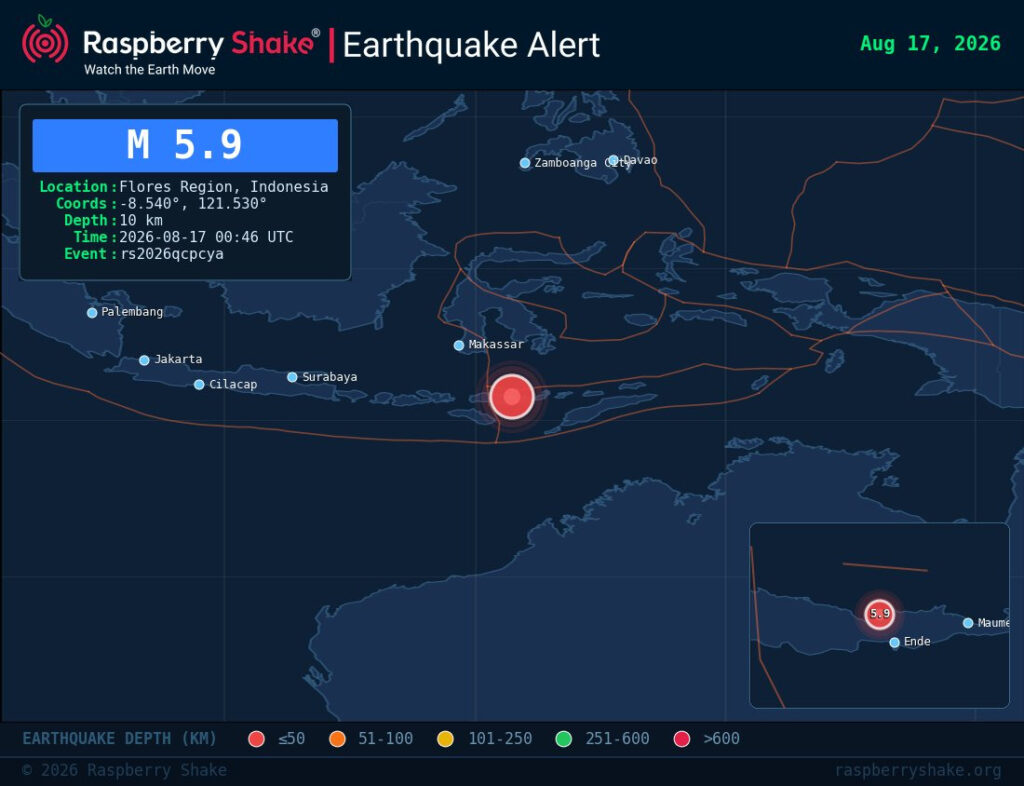
The latest tremors have deepened fears among residents already traumatised by the catastrophic earthquake that struck off the coast of Flores on August 15. A magnitude-5.9 tremor was among the strong shocks recorded in the immediate aftermath of the main earthquake, alongside other significant aftershocks.
The main earthquake triggered landslides, collapsed buildings and generated tsunami waves, while roads and communication networks were disrupted across some of the worst-hit areas. Authorities said around 5,000 people were forced into temporary shelters as rescue and relief operations struggled to reach isolated communities.
The scale of the continuing seismic activity is staggering. Indonesia’s Meteorology, Climatology and Geophysical Agency (BMKG) recorded hundreds of aftershocks following the main quake, with the number approaching 1,000 as rescue teams battled to search damaged and inaccessible areas.
BMKG said the initial earthquake was generated by movement along the Flores Back-Arc Thrust, a tectonically active fault system. Its monitoring showed that the aftershock sequence had not rapidly subsided in the hours following the main shock, underscoring the continuing danger facing already damaged communities.
The disaster has also exposed the brutal secondary consequences of a major earthquake. Landslides blocked sections of the Trans-Flores Highway, while damaged buildings, power disruptions and communication failures complicated rescue operations. More than 1,350 homes were reported damaged, according to Associated Press reporting.
A tsunami warning issued after the main earthquake was later lifted, but tsunami waves were recorded along parts of the affected coastline. The largest reported wave reached about 1.61 metres in Riung village, according to AP.
For survivors, however, the emergency did not end when the main earthquake stopped.
Every fresh tremor carries the threat of another collapse. Thousands remain displaced, rescue crews are still searching damaged areas, and residents are being forced to sleep outside or in temporary shelters rather than risk returning to unstable buildings.
The tragedy is particularly sobering in a region with a long history of destructive earthquakes and tsunamis. Flores was devastated by another magnitude-7.7 earthquake in 1992, an event that generated a major tsunami and killed thousands.
The latest disaster therefore represents more than a single catastrophic earthquake. It is a continuing test of Indonesia’s emergency response capacity — and a stark reminder that after the ground stops shaking, the crisis can continue beneath the surface.
For Flores, the earth has not yet gone quiet.