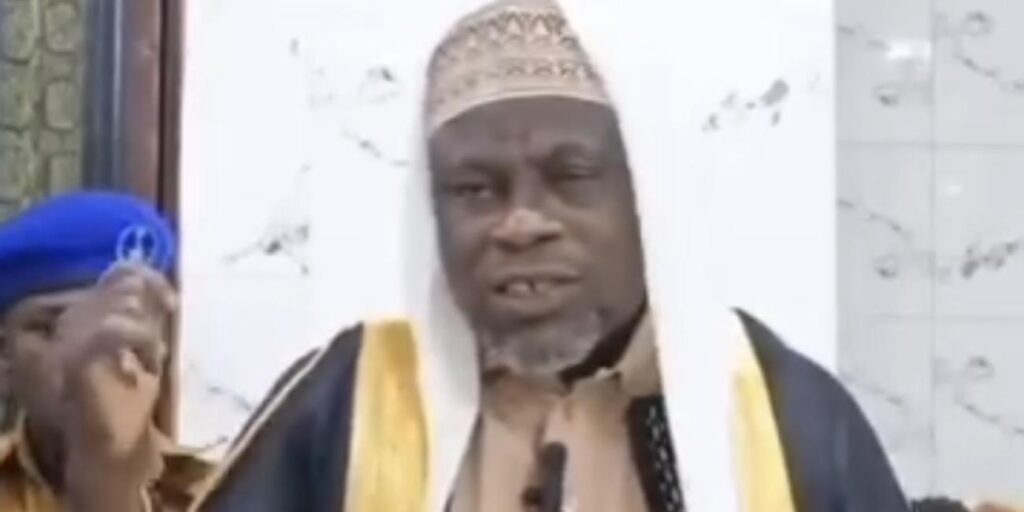
Islamic scholar Sheikh Musa Salihu Alburhan, an ally of prominent Muslim cleric Sheikh Sani Yahaya Jingir, has strongly defended the Muslim-Muslim leadership of President Bola Ahmed Tinubu and Vice President Kashim Shettima, declaring that he would rather endure hardship under a Muslim leader than enjoy material comfort under a non-Muslim ruler.
Alburhan, a member of the leadership of Jama’atu Izalatil Bid’ah Wa Iqamatis Sunnah, headquartered in Jos, Plateau State, made the remarks in a sermon that appeared to respond to comments by fellow Islamic cleric Sheikh Nurul Khalil, who had criticised Jingir’s description of Christians as “infidels.”
“For me, having a Muslim as leader while I eat grass is better than having an infidel as leader while I eat chicken every day,” Alburhan said.
The cleric argued that having Muslims occupy positions of political authority provides what he considers important religious benefits, particularly by preventing or concealing actions that could be harmful to Islam.
“It is written in one of the books, because an infidel will harm my religion. The fact that you are being governed under a Muslim-Muslim arrangement is beneficial. Ninety per cent of things are covered, while only 10 per cent are revealed, all for our good,” he said.
Alburhan further argued that many Muslims had failed to appreciate what he described as the religious advantages of the current political arrangement.
“This is something your minds have not considered. People will say we are working for someone, but who is that person? We are not campaigning for Tinubu; we are campaigning for Islam,” he added.
The cleric also disputed claims that Nigeria’s economic hardship should be blamed entirely on the government, arguing that some Nigerians complaining about suffering were themselves involved in conduct prohibited by Islam.
He cited people who mistreat their parents and those who engage in same-sex relationships as examples.
“If you examine their lives, you will realise that some of them are better off through their work, if Allah judges them accordingly. Some mistreat their mothers and still complain about suffering, while others engage in acts prohibited by Islam,” he said.
Alburhan’s comments have renewed debate over the role of religion in Nigerian politics and the implications of openly mobilising political support around religious identity.
The Muslim-Muslim ticket adopted by Tinubu and Shettima generated considerable controversy ahead of the 2023 presidential election.
Supporters argued that competence, political strategy and the constitutional rights of candidates should take precedence over religious balancing, while critics expressed concerns about religious inclusion, representation and the possible marginalisation of Christians.
The latest comments also come against the backdrop of repeated advocacy by Sheikh Sani Yahaya Jingir for Muslim-Muslim political tickets.
Jingir previously called on Muslims to support Muslim-Muslim candidates and urged his followers to obtain their Permanent Voter Cards ahead of future elections.
He made the remarks at a campaign event for Kano State Governor Abba Kabir Yusuf tagged “Abba Go Again,” where Governor Yusuf was also present.
In a speech delivered in Hausa, Jingir praised President Tinubu for promoting a Muslim-Muslim ticket and reaffirmed his support for the arrangement.
“I am among the staunch advocates of the Muslim-Muslim ticket, and I call on you to come together for Muslim-Muslim ticket,” he said.
Jingir acknowledged opposition to the idea from Christians and other religious groups but questioned whether his advocacy amounted to wrongdoing.
“I am aware that the infidels are embittered by this word. However, are there no Christians alike? Are there no Jews? Are there no traditionalists? Have I done anything wrong by merely campaigning for a Muslim-Muslim ticket?” he said.
“Have I stopped the Christians from their own slogans? Have I stopped traditionalists from a similar campaign?”
The cleric then reiterated his position, declaring: “But as a Muslim, I repeat it, Muslim-Muslim! No going back on this.”
Jingir also challenged arguments that Nigeria’s status as a democracy with citizens from different religious backgrounds should prevent him and other Muslims from campaigning for Muslim-Muslim candidates.
“Some would say ‘it’s a democracy and there are people who are not Muslims,’ are you their spokesperson?” he asked.
“But we pray and observe fasting, and it’s said that the majority carries the votes,” he added.
Jingir subsequently urged his followers to prepare for future elections by obtaining their Permanent Voter Cards.
“I urge all of us here to go and get our voters’ cards ready. Let’s show the infidels their limit, who claim they are more populous than us in Nigeria. They are lying!” he said.
He also attributed the electoral defeat of opponents of the Muslim-Muslim ticket to his position on the issue.
“If it wasn’t for my stance on a Muslim-Muslim ticket, somebody would have claimed they are more populous than us. But by the grace of Allah, we defeated them so ignominiously that they did not even make it to the second place in the polls, did they? They came third after all,” Jingir said.
He then declared his support for Muslim-Muslim candidates and asked his audience to do the same.
“Therefore, my vote is for a Muslim-Muslim candidate! What about you, the Muslim umma?”
The statements by the two clerics have sparked criticism from Nigerians and groups who argue that describing Christians and other non-Muslims as “infidels” is inflammatory and risks deepening religious divisions in the country.
The remarks have also revived wider questions about religious inclusion and political representation in Nigeria, particularly whether religious identity should play a central role in determining political support in a multi-religious constitutional democracy.
While supporters of Muslim-Muslim tickets maintain that voters and political parties have the right to choose candidates regardless of religious combinations, critics contend that Nigeria’s religious diversity requires political leaders to deliberately promote a sense of inclusion among citizens of different faiths.
The controversy surrounding the Tinubu-Shettima ticket has remained one of the most significant political and religious debates associated with the 2023 presidential election and continues to feature prominently in discussions ahead of future elections.
Neither Sheikh Nurul Khalil nor the Presidency had publicly responded to Alburhan’s remarks at the time of this report.
The renewed controversy comes as religious and political leaders continue to debate the relationship between faith, political power, democratic participation and national unity in Nigeria.