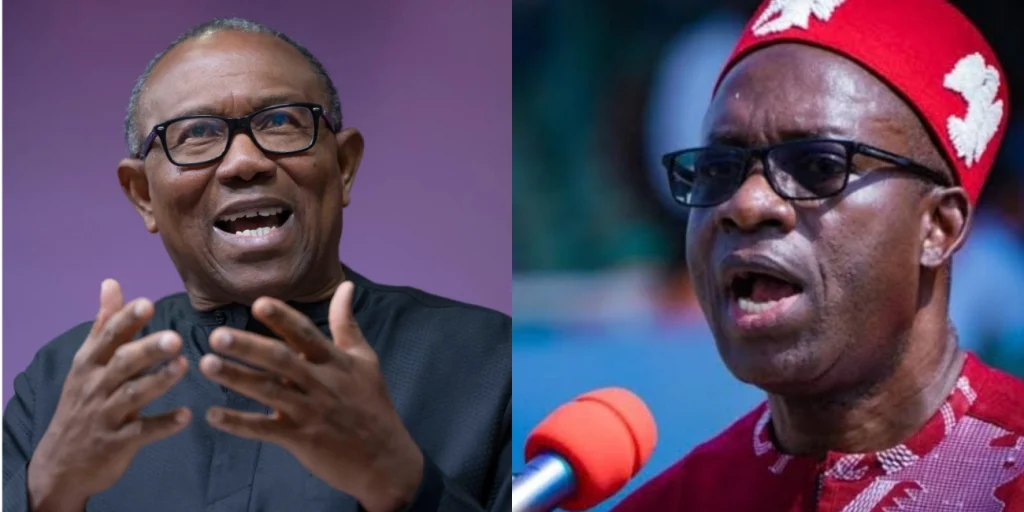
The Anambra State Government has challenged former Governor Peter Obi’s claim that he left the state without unpaid salaries, pensions or contractor debts, citing outstanding World Bank loans and unresolved liabilities involving workers as evidence that his administration left financial obligations behind.
The state government made the claims in a statement issued in Awka on Saturday, following comments by Obi during an interview on Arise TV on September 24, 2026, in which the former governor challenged anyone to establish that his administration owed salaries or contractor debts when he left office.
Obi had also defended his administration’s financial management, including its decision to keep substantial funds in bank accounts to generate interest.
Responding, the Anambra Government said records from the Debt Management Office (DMO) showed that the state continued to carry substantial debt obligations connected to loans obtained during Obi’s eight-year tenure.
According to the government, Obi’s administration signed eight loans from the International Development Association (IDA) of the World Bank, with a combined value of $123,771,179.30.
The government alleged that some of the borrowed funds had been disbursed before Obi left office but were not adequately reflected in his handover documents.
It further stated that the DMO recorded an outstanding balance of $92.35 million as of June 30, 2026.
The state government said successive administrations had continued to service the outstanding obligations through monthly deductions from the state’s Federation Account Allocation Committee (FAAC) revenues.
The government used the figures to dispute Obi’s assertion that he left the state without debt, arguing that the existence of outstanding loan obligations contradicted a blanket claim of zero liabilities.
However, the dispute also raises a distinction between debt incurred during an administration and whether such borrowing was properly authorised, transparently disclosed and responsibly managed. The government’s statement focuses on the existence of the outstanding obligations, while Obi’s public position has emphasised the financial condition in which he says he left the state.
The Anambra Government also disputed Obi’s claim that his administration left no unpaid workers.
It specifically cited more than 700 employees of the Anambra State Water Corporation, alleging that they were owed salaries, pensions and gratuities.
The government said an Arbitration Panel in 2009 and a National Industrial Court judgment in 2019 addressed the workers’ claims.
According to the statement, the state subsequently entered into an out-of-court settlement with the affected workers on February 26, 2024, for N1,563,143,020.13.
The government said N1,199,762,000 had been paid so far, leaving a balance under the settlement.
It also alleged that 11 months of pension arrears owed to primary school teachers, which it said had been inherited from the administration of former Governor Chinwoke Mbadinuju, remained unpaid during Obi’s tenure.
The government argued that the existence of those arrears further complicated the former governor’s claim that he left no unpaid obligations.
Another contentious issue was Obi’s claim that his administration accumulated about $150 million in savings.
The former governor has defended the savings as money kept in banks to earn interest and strengthen the state’s financial position.
The Anambra Government, however, questioned the decision to retain large financial reserves while the state faced infrastructure, public-service and social challenges.
The government described its criticism as an accounting issue, arguing that the assessment of an administration’s financial record should consider both assets and liabilities.
“It is Accountancy 101. In this case, you exaggerated the asset side but concealed and lied about the liabilities side,” the statement alleged.
The state government further listed what it described as challenges during the period, including poverty, insecurity, infrastructure deficits, weaknesses in public health and education, lack of pipe-borne water, urban decay, inadequate power infrastructure and more than 900 active gully erosion sites.
Those assertions represent the current state government’s assessment of conditions in Anambra and were presented in the context of its broader criticism of Obi’s record.
The government also accused Obi of applying different standards when discussing his own administration and those of his predecessors and successors.
It alleged that Obi had criticised former governors Chinwoke Mbadinuju and Chris Ngige while subsequently facing criticism from administrations that came after him.
The statement also entered the political dimension of the dispute, pointing to Obi’s past support for APGA and former President Goodluck Jonathan and contrasting it with his later criticism of APGA over its political alignment with President Bola Tinubu.
The government described the positions as evidence of what it called hypocrisy and political inconsistency.
The latest exchange therefore presents two competing narratives about Obi’s stewardship of Anambra.
Obi’s position is that his administration left the state financially responsible and without unpaid salaries or contractor debts, while the Anambra Government points to outstanding World Bank obligations, workers’ claims and pension arrears as evidence that liabilities remained.
The disagreement ultimately turns on how Obi’s financial record is defined and assessed — whether by the assets and savings accumulated during his tenure, the debts and obligations attached to the state, or both sides of the state’s balance sheet.
The Anambra Government has challenged Obi to account for the outstanding obligations, while Obi’s position remains that his administration’s financial record should not be characterised as leaving the state with unpaid debts and liabilities.