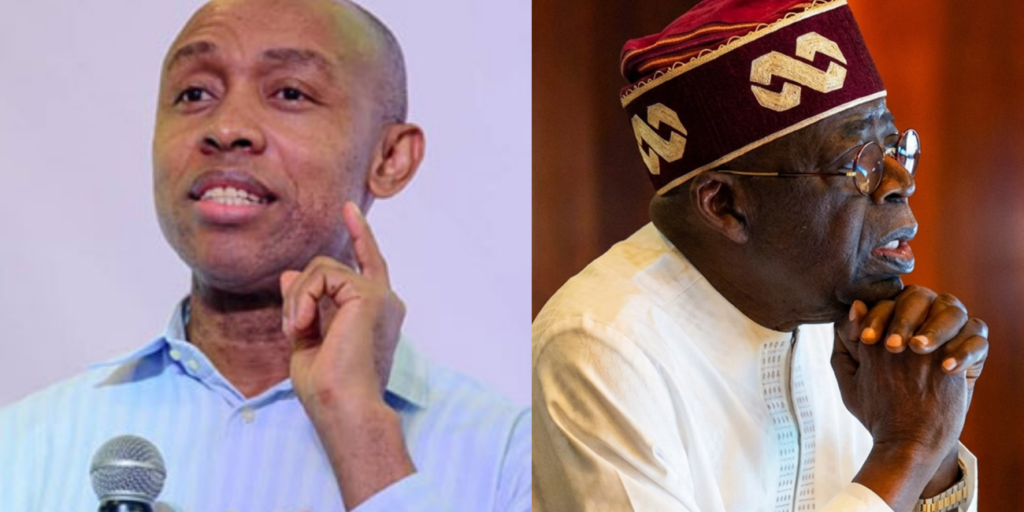
Former Chairman of the National Human Rights Commission, Professor Chidi Odinkalu, has reignited controversy over President Bola Tinubu’s nationality, parentage and educational history, questioning why key aspects of the President’s personal records remain, in his view, unclear.
Odinkalu, a professor of law, raised the concerns during an interview circulated on social media, where he criticised what he described as inconsistencies surrounding information publicly available about Tinubu’s background.
The former NHRC chairman particularly questioned the controversy surrounding an alleged Guinea diplomatic passport linked to the President, arguing that the issue had continued to raise questions about Tinubu’s nationality.
“We have a president whose nationality we do not know because he carries a Guinea diplomatic passport,” Odinkalu said.
He also questioned what he described as a lack of clarity regarding Tinubu’s parentage and genealogy, saying Nigerians still deserved answers about important aspects of the President’s personal history.
“Whose parentage, whose genealogy we do not know and we now understand that President Buhari thought the same thing too; whose primary school we do not know, whose secondary school we do not know, and who now claims to have gone to university,” he said.
Odinkalu further challenged the circumstances surrounding Tinubu’s educational history, questioning how an individual could establish a university education without readily verifiable records of his primary and secondary schooling.
He also revisited claims that Tinubu may have been homeschooled, saying that if such was the case, it should have been clearly disclosed in official documentation.
“If he was home-schooled, as Festus Keyamo posited, famously then they should say so,” Odinkalu stated.
He stressed that homeschooling would not, by itself, prevent an individual from obtaining recognised educational qualifications.
“Home-schooled should be disclosed, and home-schooled does not mean you don’t have a certificate. Home-schooled is a preparatory process. After that, you go forward for certification,” he said.
The senior lawyer also alleged that information previously supplied about Tinubu’s educational background had changed over time.
“But the thing is that he had claimed Government College Ibadan, by the way, in previous forms, and he had claimed other things that proved false,” Odinkalu said.
He further alleged that efforts were being made to reconcile or alter earlier records to fit existing eligibility requirements.
“And now they are trying to make up records or to clean up records in order to align with a current eligibility threshold,” he alleged.
Odinkalu said the absence of clear primary and secondary school records was difficult to understand, arguing that any school attended by a future Nigerian president would ordinarily have reason to take pride in the association.
“How do you not go through primary and secondary certification but you have a university degree?” he asked.
“Is it not an achievement for a school to have produced a president, no matter how remote the school could have been?”
Drawing from his own experience, Odinkalu said he could still identify the primary school he attended despite beginning his education under difficult circumstances following the Nigerian Civil War.
“I started off primary school as an internally displaced person after the Nigerian Civil War. And I know the primary school I started off in. If I mention it to you, it’s not in any place on the map. But I take pride in it. I take pride in the fact that I passed through that primary school. I cannot understand,” he explained.
Questions concerning Tinubu’s educational qualifications and personal records have featured prominently in Nigeria’s political and legal discourse for several years.
During litigation arising from the 2023 presidential election, opposition parties challenged aspects of Tinubu’s academic credentials and documents submitted to the Independent National Electoral Commission.
The Supreme Court ultimately upheld Tinubu’s election, while the President has consistently maintained that he lawfully contested the election and met the constitutional requirements for office.
The Presidency has also repeatedly defended Tinubu’s academic credentials and personal records, dismissing allegations questioning his eligibility as politically motivated.
Odinkalu’s latest comments have nevertheless thrust the controversy back into public debate, raising renewed questions over the completeness and consistency of the records surrounding the President’s nationality, family background and educational history.