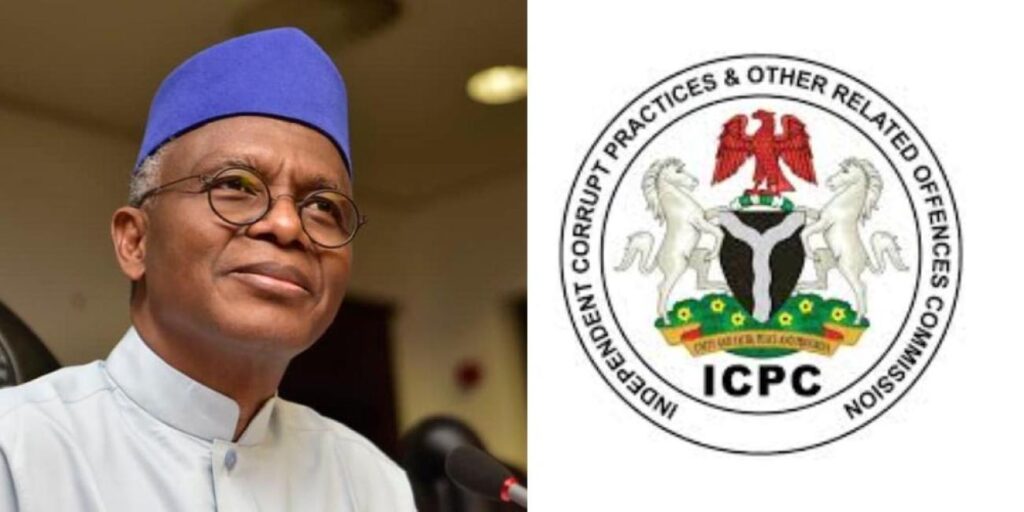
Former Kaduna State Governor Nasir El-Rufai has launched a fresh N10 billion fundamental rights battle against the Independent Corrupt Practices and Other Related Offences Commission (ICPC), accusing the anti-corruption agency of unlawfully cutting him off from his wife and son while he remains in custody.
El-Rufai, through his counsel, Ubong Akpan, filed the suit before the Federal High Court in Abuja, challenging what he described as the continued and unjustified restriction of family access during his detention.
The suit, marked FHC/ABJ/CS/1852/2026 and filed on August 13, 2026, also lists the ICPC Chairman and the Attorney-General of the Federation as the second and third defendants.
The former governor is asking the court to award N10 billion in damages and grant nine reliefs, including declarations that his constitutional rights remain enforceable despite his detention.
At the heart of the case is El-Rufai’s allegation that ICPC officials have prevented his wife, Mrs Aichatou Asabe, and his son, Abba El-Rufai, from having access to him.
According to his legal team, the alleged restriction has had consequences beyond preventing family visits. They claim that his wife and son have been unable to provide him with food, medication and other essential items that they previously supplied during regular visits.
El-Rufai is asking the court to declare that the alleged refusal to allow family access, without lawful justification or a specific court order, violates his fundamental rights under Sections 34 and 37 of the 1999 Constitution, as amended, as well as Articles 5 and 18 of the African Charter on Human and Peoples’ Rights.
He also alleged that ICPC officers physically restrained and intimidated his wife and son on July 7, describing the alleged conduct as an arbitrary interference with his relationship with his immediate family.
The former governor wants the court to declare that the continued denial of family access is unconstitutional, illegal, null and void.
He is further seeking an order compelling the respondents to grant him reasonable and unhindered access to his family members and counsel throughout his detention.
El-Rufai’s lawyers argued that his detention cannot automatically extinguish his constitutional protections, particularly his rights to dignity, privacy and family life.
They relied on an April 1 order of the Federal High Court in Kaduna, presided over by Justice R. M. Aikawa, which they said directed the ICPC to permit access to his lawyers and personal physicians whenever required.
According to the former governor, the order reinforces the principle that a detainee should not be held incommunicado and that law enforcement agencies remain subject to judicial oversight over the conditions of detention.
His legal team also invoked provisions of the Administration of Criminal Justice Act, 2015, arguing that detainees are entitled to humane treatment and reasonable access to family members, particularly where such access enables them to receive essential food, medication and other necessities.
The application states that Mrs Asabe had regularly visited her husband before July 7 and delivered meals and other items to him under the ICPC’s established visiting procedures.
The former governor claims that the alleged change in access has subjected him to humiliation, emotional trauma, anxiety and psychological distress.
His lawyers described the respondents’ alleged conduct as arbitrary, unlawful and inconsistent with constitutional protections.
The fresh suit therefore takes the legal confrontation between El-Rufai and the ICPC beyond the question of detention itself, placing the conditions of his custody and his right to maintain contact with his immediate family squarely before the court.
El-Rufai’s central argument is that incarceration does not place a detainee outside the protection of the Constitution.
He is asking the court to determine whether an anti-corruption agency can lawfully restrict a detainee’s access to his immediate family in circumstances where no lawful justification or specific court order has been established.
The case adds another significant legal dimension to the ongoing proceedings surrounding the former governor, who is being detained over allegations of fraud, abuse of office and money laundering linked to his administration as Kaduna State governor between 2015 and 2023.
His detention remains tied to ongoing court proceedings, with bail applications contested and partly denied amid disputes over medical records and other legal conditions.
The latest N10 billion action now puts the treatment of El-Rufai in custody under fresh judicial scrutiny, with the former governor asking the court not only to protect his constitutional rights but also to compel the ICPC to restore what he describes as reasonable and unhindered access to his wife, son and legal representatives.