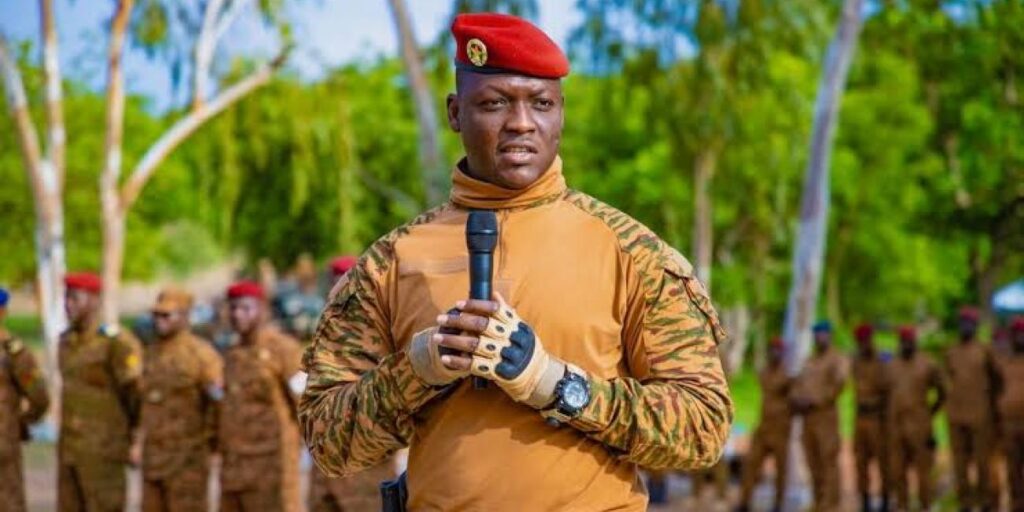
Burkina Faso’s military leader, Captain Ibrahim Traoré, has made explosive allegations against an unnamed Western country’s intelligence service, claiming its operatives once proposed supplying his government with chemical substances to secretly contaminate food, drinks and other consumer products destined for territories controlled by terrorists.
Speaking before members of the armed forces and residents of the Yaadga region, Traoré alleged that the proposed operation was designed to gradually weaken, disable and psychologically impair those who consumed the substances, describing the offer as evidence of what he called decades of covert efforts by foreign powers to undermine African nations.
According to Traoré, intelligence operatives presented his government with four different chemical products that could allegedly be mixed into food, beverages, milk, sugar and cigarettes before being distributed in insurgent-held communities.
“One day, a kind of secret service from a Western country came to see me. They offered us four products to put in the food and send to the areas where there are terrorists,” he said.
The Burkinabè leader claimed the substances were intended to produce different long-term effects, including gradual brain damage, reduced physical strength and chronic insomnia.
“One of the products kills the brain so the person gradually loses the ability to think. Another weakens physical strength over time, while another causes insomnia,” he alleged.
Traoré said his administration immediately rejected the proposal after questioning the visitors about the origin and previous use of the substances.
According to him, the agents allegedly admitted that similar products had been used elsewhere in Africa and parts of Asia, a response he said reinforced his belief that foreign powers have historically employed covert methods to weaken African populations.
However, Traoré did not identify the country involved, disclose when the alleged meeting took place, or provide evidence to support the claims.
Using the alleged incident to advocate greater economic independence, Traoré urged Burkinabè citizens to embrace locally produced goods and reduce dependence on imported products, arguing that Africa remains vulnerable to external manipulation through economic reliance.
He further contended that the continent continues to suffer the consequences of centuries of exploitation, citing both the transatlantic and Arab slave trades as examples of historical oppression.
Traoré also argued that many Africans have developed what he described as a “Stockholm syndrome,” claiming that admiration for former colonial powers has prevented the continent from fully embracing self-reliance and sovereignty.
The military ruler revisited historical accounts, including the existence of so-called “human zoos” in parts of Europe, saying many Africans remain unaware of painful chapters of the continent’s history.
He also accused foreign interests of exploiting ethnic and religious divisions to fuel instability across Africa, describing such tactics as one of the greatest obstacles to the continent’s unity and development.
In another striking claim, Traoré said he received a letter in 2023 from a French national identified only as “Daniel,” whom he alleged was linked to France’s external intelligence agency, the Directorate-General for External Security (DGSE).
According to Traoré, the individual warned that Africans would never fully embrace his political vision, drawing parallels with the late Burkinabè revolutionary leader Thomas Sankara, and allegedly predicted continued efforts to destabilise Burkina Faso through internal conflict.
He also accused unnamed French diplomatic officials and foreign-linked actors of attempting to manipulate media narratives and public opinion in a bid to undermine what he described as Burkina Faso’s revolution.
Traoré, however, presented no documentary or independent evidence to substantiate the allegations against the intelligence services, foreign governments or diplomats.
The remarks come amid increasingly strained relations between Burkina Faso and several Western nations following the country’s military-led realignment of its foreign policy, the expulsion of French troops, and the strengthening of security ties with Russia, Mali and Niger.