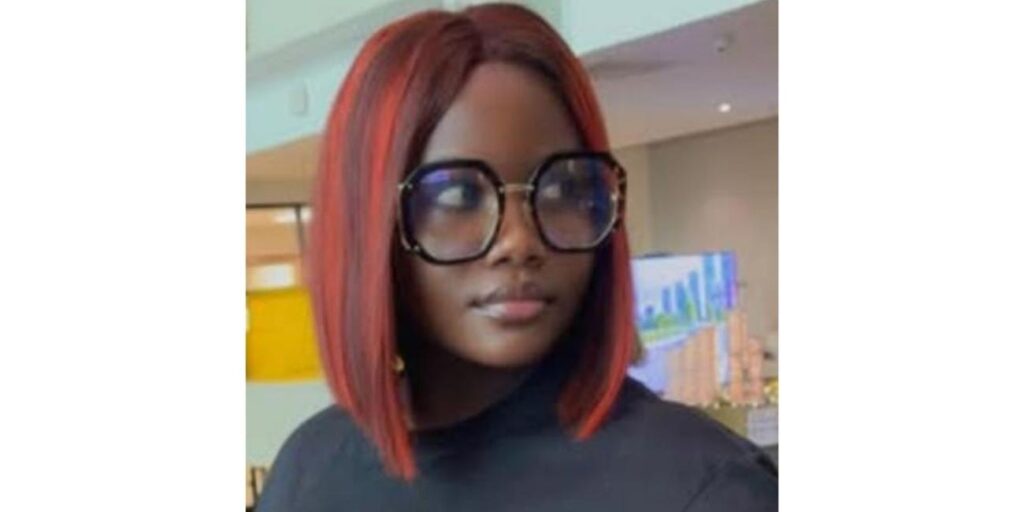
The controversy surrounding the mysterious death of 26-year-old Mary Habila at the Ebonyi residence of Nigeria’s Minister of Works, David Umahi, has deepened following the emergence of an affidavit attributed to Anita Baaki, the second woman linked to the incident, even as police continue investigations into the case.
The affidavit, reportedly sworn before the High Court Registry in Abakaliki on July 15, has sparked fresh public debate after details of Baaki’s account of Habila’s final hours surfaced in media reports. However, the authenticity, context and legal significance of the document have not been independently verified.
Mary Habila was found dead on June 27 at the minister’s residence in Uburu, Ohaozara Local Government Area of Ebonyi State, under circumstances that remain unexplained. The Ebonyi State Police Command has insisted that only a forensic autopsy can establish the exact cause of her death, despite the deceased’s family opposing the procedure.
Baaki, who was identified by Umahi as one of the medical personnel attached to his residence, has since come under heightened public scrutiny. The minister had initially described both Habila and Baaki as physiotherapists before later clarifying that Habila was a nurse attached to his residence through the David Umahi Federal University of Health Sciences and the Ministry of Works.
In the affidavit, Baaki stated that she had worked with Umahi since his days as Governor of Ebonyi State before becoming an employee of the David Umahi Federal University of Health Sciences. She further disclosed that she and Habila had worked together under the minister for about three years and had developed a close friendship.
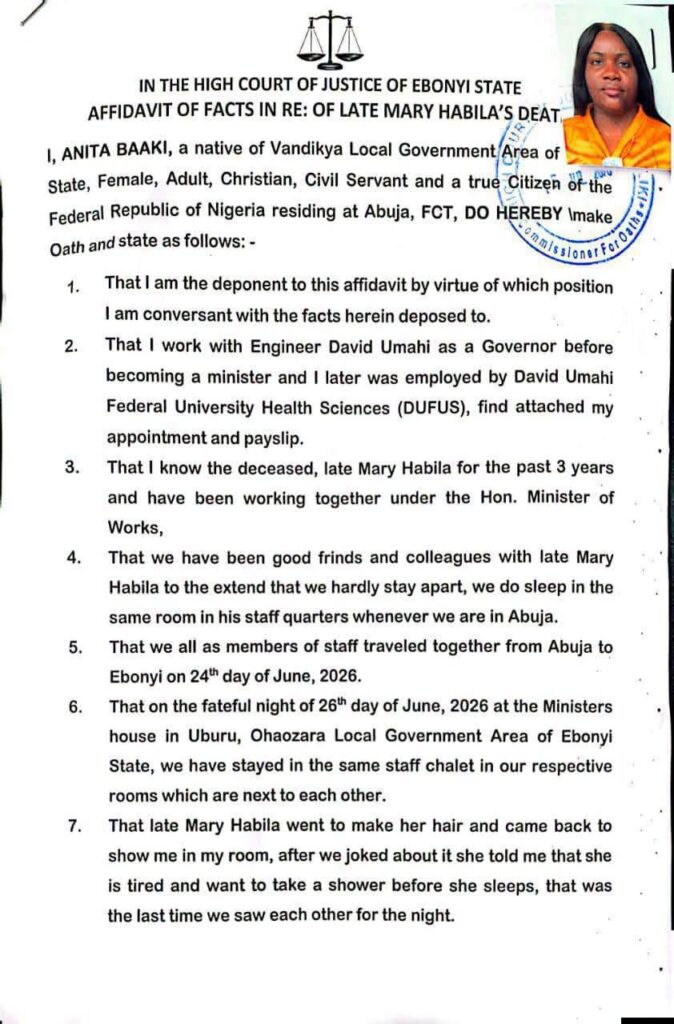
According to her account, both women travelled from Abuja to Ebonyi on June 24 alongside other members of the minister’s staff and stayed in neighbouring rooms inside the staff chalet at Umahi’s residence.
She stated that on the night of June 26, Habila visited her room after returning from making her hair. They joked briefly before Habila said she was tired and intended to take a shower before going to bed.
Baaki said that was the last time she saw her colleague alive.
She further explained that concern arose the following morning when Habila failed to appear as she normally would. After repeated attempts to reach her by phone failed, she knocked on Habila’s door but received no response.
According to the affidavit, she instructed a domestic worker to search for Habila around the premises, but the search proved unsuccessful.
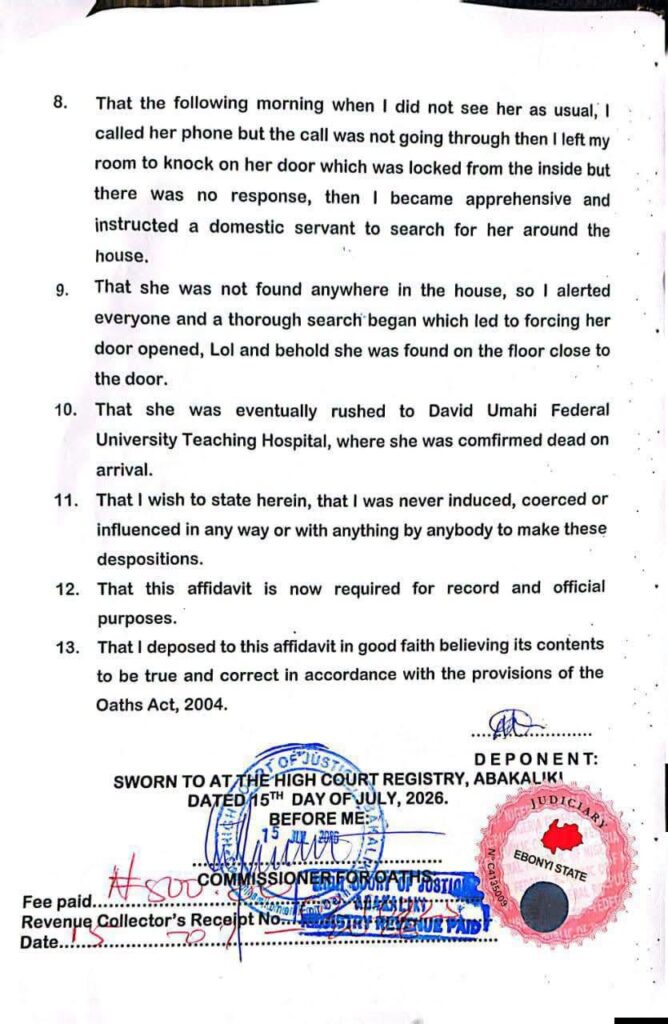
The affidavit stated that a wider search was immediately launched, leading to the forced opening of Habila’s room, where she was allegedly found lying motionless on the floor close to the door.
She was rushed to the David Umahi Federal University Teaching Hospital, where doctors reportedly confirmed that she was dead on arrival.
Despite the detailed account, investigators have not announced any findings implicating Baaki in Habila’s death, while police insist investigations remain ongoing.
Public interest in the case has also shifted to social media, where profiles believed to belong to Baaki have attracted widespread attention.
A review of publicly available Facebook and Instagram accounts bearing her name showed that on July 1 she posted a photograph of herself with Habila alongside a brief tribute.
“Rest on my dearest friend, in a sister’s form, the world will remember your gentle soul,” the post read.
The tribute did not mention the circumstances surrounding Habila’s death.
As the case gained national attention, several social media users questioned Baaki over the timing of the condolence message and her silence on the incident. Some commenters demanded that she speak publicly if she possessed information about Habila’s death, while others made unverified allegations suggesting she had deliberately remained silent.
Baaki did not publicly respond to the allegations but acknowledged condolences from friends and sympathisers on her social media pages.
Meanwhile, Habila’s family has postponed her burial indefinitely after police declined to release her remains, insisting that an autopsy must first be conducted.
Speaking publicly, the deceased’s father, Wisdom Habila, appealed for the immediate release of his daughter’s body, stressing that the family was not accusing anyone of causing her death and did not want an autopsy.
“I don’t have much to talk about in this case. All that I want is the corpse of my daughter,” he said.
The Ebonyi State Police Command said investigators had visited the scene, obtained statements from relevant persons and were awaiting the attendance of the family or an authorised representative before proceeding with the post-mortem examination.
The decision followed legal advice from the Ebonyi State Director of Public Prosecutions, J.U. Chukwu, who maintained that a forensic autopsy was necessary after preliminary evidence indicated that Habila was found lying lifeless on the floor of her apartment with blood stains around her nose and mouth.
Minister David Umahi has denied any wrongdoing and maintained that he personally requested a comprehensive autopsy to establish the true cause of Habila’s death, urging the public to allow investigators to complete their work.
As investigators continue to piece together the events leading to the young nurse’s death, the emergence of Baaki’s affidavit has added a new and closely watched dimension to a case that continues to raise difficult questions and attract nationwide attention.