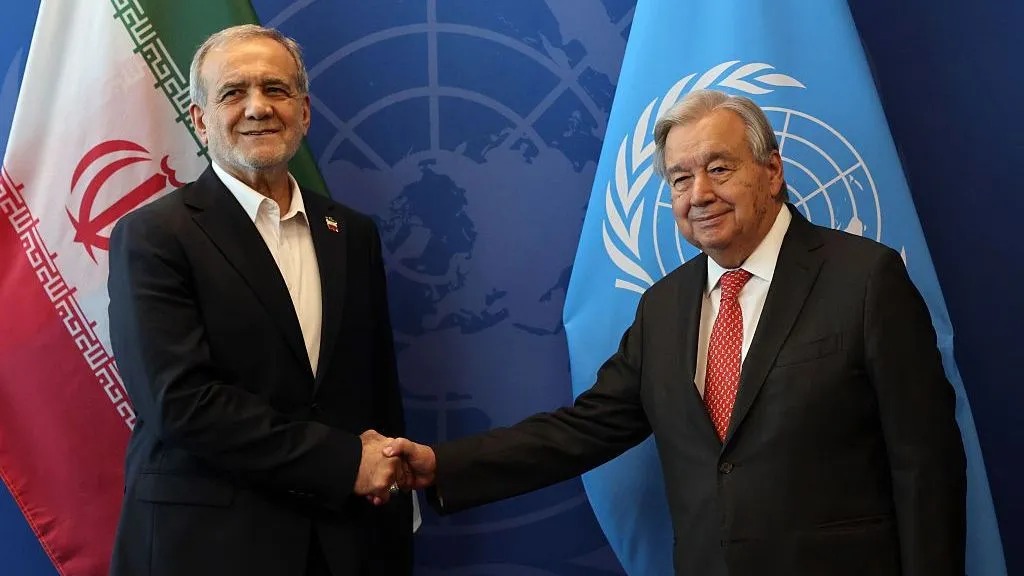
The United States has approved visas for Iranian President Masoud Pezeshkian and Foreign Minister Abbas Araghchi to attend next week’s United Nations General Assembly in New York, despite the two countries remaining locked in an ongoing war, while Palestinian President Mahmoud Abbas has again been denied entry into the United States and is expected to address the gathering by video.
The contrasting visa decisions have placed Washington at the centre of a fresh diplomatic controversy ahead of the annual gathering of world leaders, where issues surrounding the war in Iran, the Israeli-Palestinian conflict and the broader Middle East crisis are expected to dominate discussions.
The U.S. State Department confirmed that members of Iran’s “core delegation,” together with essential staff, would be allowed to participate in the General Assembly’s high-level week. U.S. officials identified Pezeshkian and Araghchi as part of that delegation.
The decision is particularly notable because Washington and Tehran are currently engaged in a prolonged military confrontation. The conflict has continued for more than six months, according to reports, with diplomatic efforts to end the hostilities facing significant obstacles.
Despite the ongoing hostilities, the Iranian delegation will be permitted to enter New York under the United States’ obligations as host country of the United Nations.
The State Department, however, said the Iranian delegation would be subject to restrictions, including limits on its movements and restrictions on the purchase of luxury and other goods while in the United States. The delegation will also be smaller than in previous years.
Pezeshkian is expected to address the General Assembly during the high-level session, putting Iran’s president in a position to speak directly to world leaders from New York despite the extraordinary deterioration in relations between Tehran and Washington.
The American decision stands in sharp contrast to its treatment of the Palestinian leadership.
For the second consecutive year, the United States has denied Palestinian President Mahmoud Abbas a visa to attend the General Assembly in person. The decision also affects other senior Palestinian officials associated with the Palestinian Authority and the Palestine Liberation Organization.
As a result, Abbas will not be physically present in New York for the high-level gathering. Instead, the United Nations General Assembly has approved arrangements allowing him to participate remotely.
The General Assembly voted 152 in favour, three against and four abstentions on a resolution permitting Abbas to address the gathering by video and allowing senior Palestinian officials to participate remotely in UN events over the coming year when they are unable to travel to the United States.
The visa dispute is not new.
Washington has defended its restrictions on Palestinian officials by accusing the Palestinian Authority and the Palestine Liberation Organization of failing to meet commitments made to the United States. American officials have also cited Palestinian efforts to pursue the Israeli-Palestinian conflict through international legal institutions, including the International Criminal Court and International Court of Justice.
The Palestinian Authority has rejected the American position and criticised the decision to prevent Abbas from attending the General Assembly in person, arguing that the move undermines diplomatic engagement and efforts toward a political settlement.
The timing of the two decisions has intensified the controversy.
The announcement that Iranian leaders would be allowed into New York came only a day after Washington’s renewed decision to deny visas to Abbas and other Palestinian officials.
That has produced an unusual diplomatic picture ahead of the 81st session of the General Assembly: Iran, despite being involved in an active war with the United States, will have its president and foreign minister physically present at the UN gathering, while the Palestinian president will be required to participate remotely because Washington has refused him entry.
The United States says the two situations are governed by different considerations.
In Iran’s case, Washington has pointed to its responsibilities as host of the United Nations and has allowed the country’s core delegation to attend while imposing additional restrictions. In the Palestinian case, the State Department has maintained that existing visa restrictions are justified by what it considers failures by Palestinian officials to honour previous commitments and actions it says undermine the peace process.
The United States is generally constrained by its responsibilities as host of the UN headquarters in New York, although Washington maintains that those obligations do not prevent it from imposing visa restrictions in certain circumstances involving security and foreign-policy considerations.
The issue is therefore likely to become part of the wider diplomatic debate at the General Assembly, particularly as countries examine the relationship between national immigration powers and the international obligations attached to hosting the United Nations.
For Iran, the New York visit will provide Pezeshkian and Araghchi with an opportunity to present Tehran’s position directly before the international community at a moment of intense confrontation with Washington.
For Abbas, the platform will once again be virtual.
The contrast has already attracted international attention because both decisions concern the same diplomatic event, the same host country and the same United Nations headquarters — but produce dramatically different outcomes for the two delegations.
As world leaders gather in New York beginning next week, the question of who is physically permitted to stand on the General Assembly floor — and who must appear on a screen — is set to become another contentious issue surrounding an already deeply divided international community.