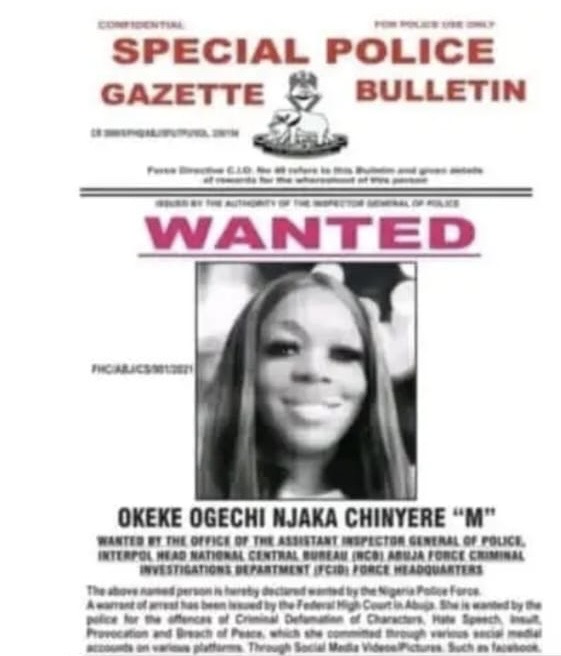
A legal practitioner, Reuben Boma, Esq., has warned that individuals who continue to circulate the Nigeria Police Force’s old gazetted wanted notice against Ogechi Njaka, despite its nullification by the ECOWAS Community Court of Justice, could expose themselves to legal liability under the Nigerian Constitution, the Nigeria Data Protection Act (NDPA) 2023, and the law of defamation.
In a legal opinion made available to the public, Boma stated that the continued sharing of the wanted notice on Facebook and other social media platforms after the ECOWAS Court judgment delivered around June 24, 2026, is legally questionable because the regional court has already declared the notice unlawful and ordered its removal.
According to the legal opinion, the ECOWAS Court, in Case No. ECW/CCJ/APP/18/24, held that the Nigeria Police Force violated Ogechi Njaka’s fundamental rights by publishing a wanted notice that portrayed her as guilty of criminal offences before any judicial determination.
The court reportedly found that the publication breached the principle of presumption of innocence guaranteed under Article 7(1)(b) of the African Charter on Human and Peoples’ Rights and Article 14(2) of the International Covenant on Civil and Political Rights.
The judgment further held that the publication subjected Njaka to stigma, humiliation, social exclusion and reputational damage, thereby violating her right to human dignity.
As part of its orders, the ECOWAS Court directed the Nigeria Police Force to immediately remove the wanted notice from its bulletin and every other medium where it had been published. It also ordered that the judgment be published in Nigeria’s Official Gazette and on the Nigeria Police Force website for six months, while awarding Ogechi Njaka ₦1 million as compensation.
Boma argued that because the court nullified the legality of the wanted notice, any continued circulation of the document by private individuals effectively disregards the judgment and may create fresh legal consequences.
He explained that such actions may amount to a violation of Section 37 of the Constitution of the Federal Republic of Nigeria, 1999 (as amended), which guarantees the privacy of citizens. According to him, Nigerian courts increasingly recognize informational privacy, including an individual’s right to control the collection, use and dissemination of personal information such as photographs, names and official records.
He maintained that republishing a nullified wanted notice containing Ogechi Njaka’s image, identity and allegations continues to expose her to public stigma and reputational harm, potentially giving rise to a fundamental rights enforcement action with claims for damages.
The legal opinion also referenced the Nigeria Data Protection Act (NDPA) 2023, noting that the legislation requires personal data to be processed lawfully, fairly, transparently and accurately, while limiting its use to legitimate purposes.
According to Boma, the continued circulation of a court-nullified wanted notice is likely inconsistent with the NDPA’s principles of lawful processing, accuracy and purpose limitation because the document no longer represents a valid official record.
He further stated that the Act provides data subjects with rights to rectification, erasure, objection to unlawful processing and legal remedies, adding that continued dissemination of the notice after a court-ordered removal could interfere with those statutory rights.
The lawyer noted that unauthorized processing or dissemination of personal data may expose offenders to investigations by the Nigeria Data Protection Commission (NDPC), civil liability and, in applicable circumstances, financial penalties prescribed under the Act. He added that individuals who knowingly continue sharing the notice after becoming aware of the ECOWAS judgment may face increased legal exposure.
Beyond privacy and data protection concerns, Boma argued that the continued publication of the wanted notice could also amount to defamation.
He reasoned that sharing the document may falsely suggest that Ogechi Njaka remains a wanted person or fugitive despite the ECOWAS Court’s decision nullifying the publication. According to him, such conduct could satisfy the elements of libel by constituting a written publication capable of lowering an individual’s reputation.
He further observed that legal defenses ordinarily available in defamation proceedings, including justification or fair comment, may become difficult to sustain where the publication ignores a subsisting court judgment declaring the original notice unlawful.
The legal opinion also noted that while direct contempt proceedings would ordinarily apply to parties specifically bound by the ECOWAS Court’s orders, continued circulation of the notice may nevertheless undermine the effect and purpose of the judgment.
Boma advised members of the public who may still have copies of the wanted notice on their social media pages to remove them immediately, warning that continued publication after becoming aware of the court’s decision could strengthen future claims for aggravated damages.
He also stated that Ogechi Njaka may pursue multiple legal remedies, including a fundamental rights enforcement action, complaints before the Nigeria Data Protection Commission, civil defamation proceedings, applications for injunctive relief, damages and retractions where appropriate.
The legal opinion further suggested that digital platforms may also have obligations under applicable data protection laws and intermediary frameworks to respond appropriately to valid requests for the removal of unlawful content.
While the opinion outlines possible legal consequences arising from continued circulation of the nullified notice, any determination of liability against individual social media users would ultimately depend on the specific facts of each case and the findings of a competent court