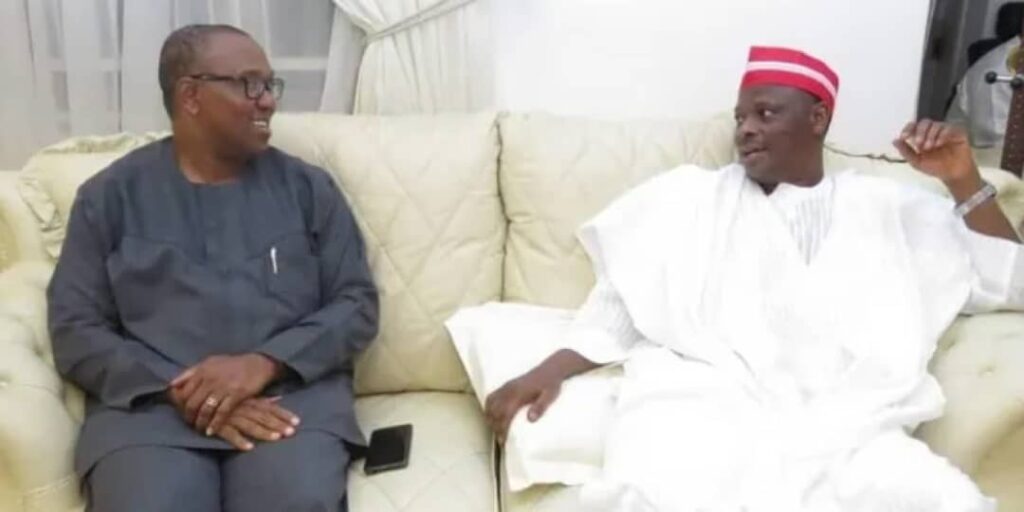
Both Kwankwaso and Obi are understood to be uncomfortable with the outcome of the Ibadan declaration, citing their concerns about how any eventual consensus candidate would emerge.
There are indications that former presidential candidate, Peter Obi and former Kano State governor, Musa Kwankwaso, are set to leave the African Democratic Congress (ADC) following growing disagreements over the opposition Coalition strategy ahead of the 2027 presidential election.
Multiple sources familiar with the discussions revealed that both politicians have been engaged in consultations that could lead to their defection to other political platforms in the coming days.
Obi, who was the presidential candidate of the Labour Party in 2023, and Mr Kwankwaso, who ran under the New Nigeria Peoples Party (NNPP), are considered key figures in ongoing opposition coalition talks.
Their reported absence from recent high-level ADC meetings has further intensified speculation about a possible exit, especially as preparations for party primaries gather momentum.
This setback for the ADC comes amid broader efforts by opposition figures to build a unified front for the 2027 elections.
At a recent meeting in Ibadan, leaders from 14 political parties agreed on the need to present a single presidential candidate to avoid the fragmentation that affected the opposition in 2023.
Both Kwankwaso and Obi are understood to be uncomfortable with the outcome of the Ibadan declaration, citing their concerns about how any eventual consensus candidate would emerge.
The spokesperson for the Kwankwasiyya movement, Habibu Mohammed, confirmed the planned migration of Obi and Kwankwaso on Friday night to TheCable, revealing that the decision was “sealed” after a gathering of stakeholders at Kwankwaso’s Kano residence.
Having previously used the Labour Party and the New Nigeria Peoples Party (NNPP) as platforms, the prominent duo’s brief romance with the ADC appears to have crashed barely months after it began.
Mohammed noted that discussions with the NDC are “about 90 percent” complete, with the formal defection scheduled for Monday or Tuesday.
A recent Supreme Court ruling failed to resolve the internal power struggle in the ADC and, instead returned the case to the Federal High Court.
For the Kwankwaso and Obi camps, the prospect of waiting for a legal resolution was deemed too risky, especially with the Independent National Electoral Commission (INEC) deadlines looming for the submission of membership registers.
Speaking with the outlet, Mohammed described the ADC’s legal landscape as “too murky for comfort,” stating that remaining in the party would amount to “waiting for Godot.”
Mohammed said stakeholders’ representatives from all 44 LGAs in Kano gathered at Kwankwaso’s residence on Friday around 3:30pm to weigh the options — and, in the end, spoke with one voice.
“The stakeholders have unanimously given him the go-ahead to move to the NDC,” he said. Kwankwaso, he added, is currently in Kano and is expected back in Abuja by Sunday ahead of the planned defection.
“If you look at the case referred back to the lower court, it might take time. There could even be another appeal to the supreme court. It does not look feasible to stay there,” Mohammed said.
“The entire caucus voted unanimously that a better platform, not embedded in a leadership tussle, should be used.”
He said while both the NDC and the Peoples Redemption Party (PRP) were considered, stakeholders ultimately threw their weight behind the NDC.
Mohammed said there are three pending cases against the ADC at the federal high court, describing the legal landscape as too murky for comfort.
He also pointed to the ticking clock ahead of the deadline for submission of party membership registers to the Independent National Electoral Commission (INEC) as another factor that forced the movement’s hand.