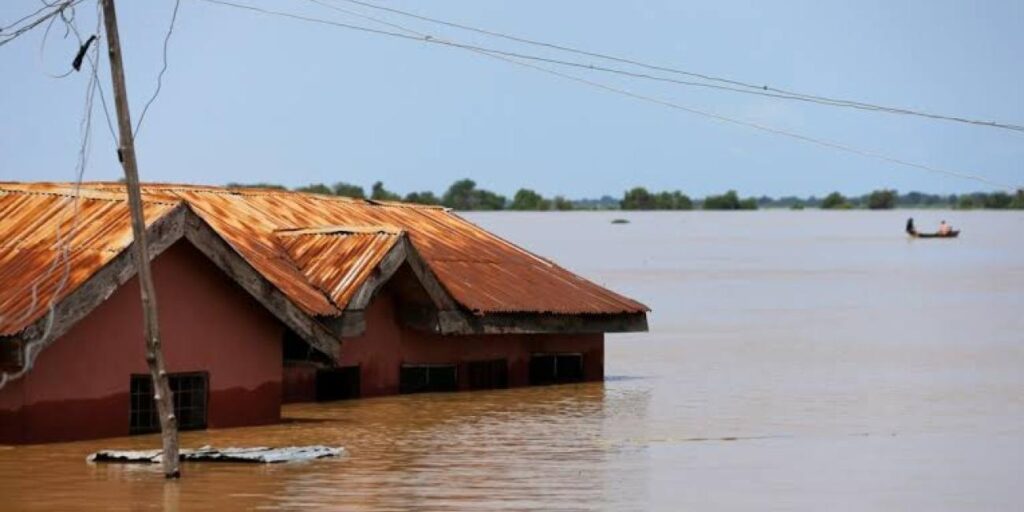
Torrential rainfall on Sunday led to devastating floods across multiple communities in Plateau, Bauchi, and Niger states, destroying over 90 houses, schools, religious centres, and farmlands, and displacing hundreds of residents.
In Plateau State, the Menkaat community in Shimankar District of Shendam Local Government Area bore the brunt of the deluge.
Reports indicate that more than 50 buildings—including two primary schools and a place of worship—were destroyed by the early morning rainstorm, which was accompanied by fierce winds. Residents described scenes of chaos as trees were uprooted, electricity poles were knocked down, and rooftops were torn away, rendering many homes unsafe for habitation.
Mazawaje Daniel Danjuma, the councillor representing Shimankar, said the destruction was overwhelming. “Many homes have collapsed. The rainfall was intense, and it wiped out several farms. People have lost everything,” he said.
Another community member, Lawrence Longwalk, called on authorities to step in without delay. “The level of damage is beyond what we can handle alone. We urgently need assistance,” he appealed.
In Bauchi State, Dass Local Government Area also experienced widespread destruction. Over 40 households were affected, with extensive damage to farmlands. Adamu Nayola, Director of Relief and Rehabilitation at the Bauchi State Emergency Management Agency (SEMA), confirmed the incident. He said, “Although no fatalities were recorded, the victims—especially women and children—are in dire need of aid.”
Nayola attributed the disaster to a poorly built culvert, which failed to accommodate the heavy water flow. He added that SEMA officials had started assessing the damage for possible relief efforts.
In Niger State, the flood crisis extended to Kafin Koro in Paikoro LGA, where several farmlands were submerged. In Lapai LGA, no fewer than 18 communities—including Dere, Apataku, Eshi, Tsakanabi, and Kuchi Kakanda—suffered varying levels of destruction. Many residents now live in fear of further losses if the rains continue.
Responding to the rising threat, the Niger State Government issued a safety advisory on Sunday, urging people in flood-prone zones to relocate to higher ground. Jonathan Vatsa, the governor’s Special Adviser on Communication, Media, and Strategy, stressed the seriousness of the situation.
“We are urging our people to move upland to avoid a repeat of the Mokwa disaster,” he stated. “While we understand their attachment to ancestral homes, the danger is real, and the time to act is now.”
Vatsa recalled that the Nigerian Meteorological Agency (NiMet) had earlier warned that 15 out of the 25 local government areas in Niger were at high risk of flooding in the 2025 rainy season. Additionally, the Federal Ministry of Environment has raised a red alert for 11 states likely to experience severe flooding, based on projections from the National Flood Early Warning Centre.
Sunday’s flooding marks yet another episode in a disturbing trend of climate-induced disasters sweeping across Nigeria.
Between March and July 2025, over 250 people lost their lives while thousands were displaced by floods, windstorms, and rainstorms across states such as Niger, Sokoto, Kaduna, Taraba, Ogun, Ekiti, and Imo.
The most catastrophic of these occurred on June 11, when over 200 people died and dozens went missing in Mokwa, Niger State, due to massive flooding.
Only a week ago, relentless rains pounded Maiduguri in Borno State, displacing several residents and destroying at least eight buildings in Bulunkutu, Damboa Road, and Jiddari Polo. Although there were no reported deaths, residents are still haunted by memories of the destructive flood on September 10, 2024.
In Adamawa State, a similar tragedy occurred in late July. Floodwaters swept through parts of Yola North and Yola South LGAs, killing five and injuring more than 50 people. Sabon Pegi, Yolde Pate, Yola Bypass, and Modire were among the most severely affected, with damage to homes, infrastructure, and agricultural lands.
Experts and emergency management officials are warning that the worst may yet come, as Nigeria approaches the peak of the rainy season.
During the official launch of the 2025 Annual Flood Outlook in April, the Minister of Water Resources and Sanitation, Prof. Joseph Utsev, identified Bauchi, Plateau, Niger, and the Federal Capital Territory (FCT) as high-risk areas for severe flooding this year.
Governments at all levels are calling on citizens to remain alert, heed evacuation directives, and support both relief and recovery efforts to mitigate the growing crisis.
To stay updated with verified reports from The Chronicles Reporters, join our official WhatsApp channel:
🔗 https://whatsapp.com/channel/0029VabITrvEAKW7DSkTfP0J