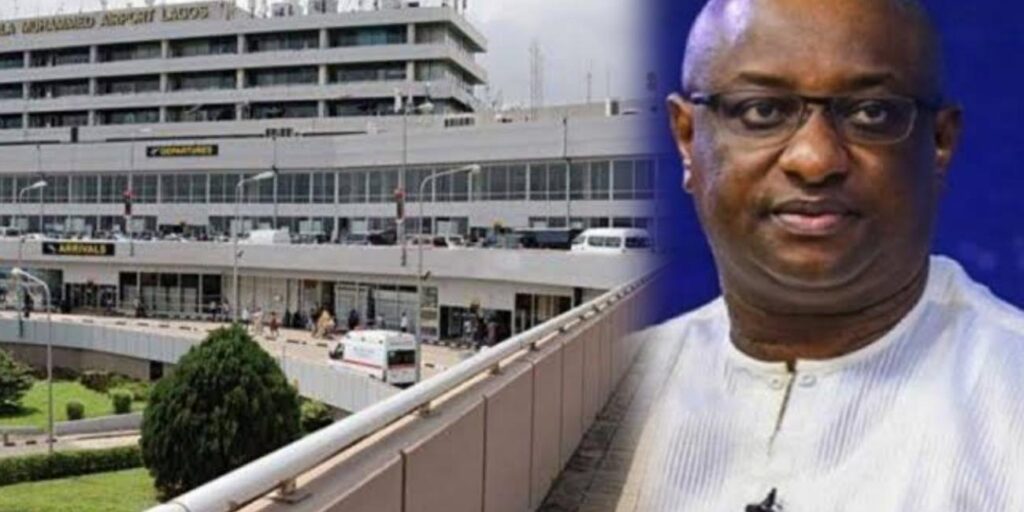
The Minister of Aviation and Aerospace Development, Festus Keyamo, has justified the federal government’s decision to invest ₦712 billion in reconstructing Terminal One of the Murtala Muhammed International Airport in Lagos. According to him, the funding will come from savings generated through President Bola Ahmed Tinubu’s controversial policies—specifically, the removal of fuel subsidy and the unification of exchange rates.
Speaking during an interview on Channels Television, Keyamo explained that the dilapidated condition of the Lagos airport terminal left the government with no choice but to embark on a total overhaul.
He highlighted several issues plaguing the facility, such as leaking roofs, non-functional carousels, failing ceilings, and the presence of unauthorized commercial kiosks within the terminal. “People are selling Indomie and all sorts of things. It has become an eyesore,” he remarked.
The announcement of the massive budget has stirred widespread backlash from Nigerians, many of whom believe the project is ill-timed. Critics argue that, given the severe economic hardship currently facing the population—rising inflation, food insecurity, and increased cost of living—spending such a large sum on an airport terminal is highly insensitive.
However, Keyamo clarified that the funds would not be sourced from the national budget. Rather, the money will come from the “Renewed Hope Infrastructural Funding,” a special initiative introduced by the Tinubu administration to drive critical infrastructure projects using proceeds from economic reforms.
“This administration pledged significant infrastructure renewal across Nigeria using the savings from fuel subsidy removal and the floating of the naira. This is just one of those projects,” Keyamo said, adding that the reconstruction would take about 22 months.
The aviation minister also warned that failure to upgrade the terminal might result in international airlines pulling out of the country. “When your terminals are in bad shape and your runways are deteriorating, foreign airlines consider it a safety and insurance risk. They may stop flying here,” he said.
Keyamo stressed that once completed, the terminal would rival some of the continent’s best, including those in Ethiopia and South Africa. He said the aim is to turn Lagos into a proper aviation hub—something that has been lacking for decades.
“Right now, it’s almost impossible to land at the domestic terminal in Lagos and connect seamlessly to an international flight,” he said. “The airport wasn’t designed that way when it was built in 1977 and commissioned in 1979. That has hindered our aviation growth.”
He revealed that the plan was not for minor renovations but a complete overhaul. “We’re not just refurbishing; we’re pulling down Terminal One entirely. Only the pillars and carcass will be retained. Everything else will be rebuilt from scratch and redesigned to meet modern standards,” Keyamo stated.
Follow our news updates on WhatsApp via our Chronicles Reporters Channel:
https://whatsapp.com/channel/0029VabITrvEAKW7DSkTfP0J