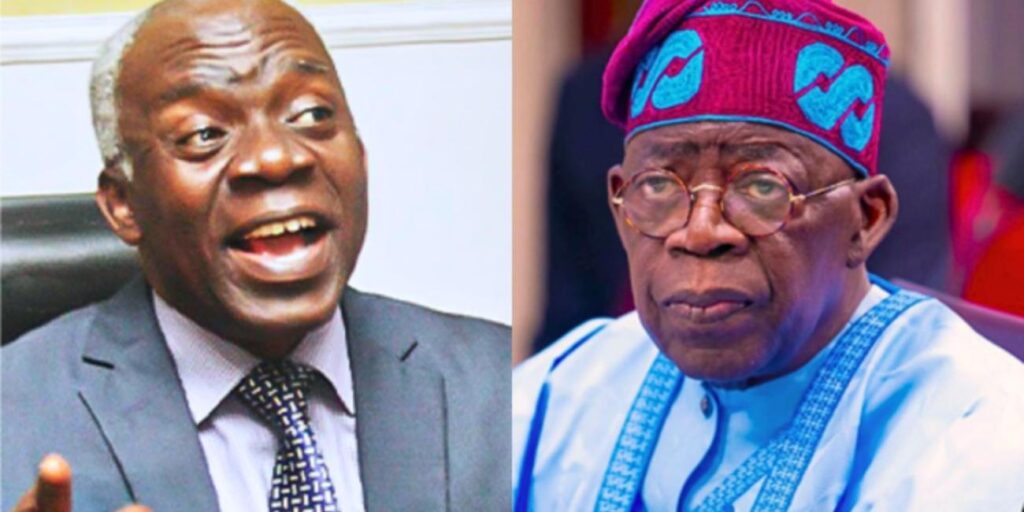
Prominent human rights lawyer and Senior Advocate of Nigeria, Femi Falana, has delivered a scathing assessment of President Bola Tinubu’s economic agenda, condemning the administration’s reforms as “harsh neoliberal policies” that have crushed Nigeria’s middle class and escalated the suffering of ordinary citizens.
Falana voiced his criticism on Monday during an appearance on Politics Today, a political programme aired on Channels Television.
He lamented that even though President Tinubu recently acknowledged the intensifying economic struggles facing the populace, the policies introduced by his administration have only made the situation worse, further widening the gap between the rich and the poor.
The legal luminary also reacted to reports that President Tinubu had urged governors elected under the All Progressives Congress (APC) to “wet the ground” and take steps to alleviate the pressure on Nigerians. Despite this, Falana argued, there has been no tangible improvement in the living conditions of the people.
“In implementing these neoliberal policies without regard to their consequences, the government is driving more Nigerians into poverty,” Falana said, insisting that such an approach demands urgent policy reversal.
He further criticised the administration’s push for privatisation, warning that it contradicts any meaningful attempt to bridge income disparity. Falana stressed the need for a fundamental shift in the government’s policy direction to ensure support reaches those most in need, especially in rural areas.
“You can’t claim to be tackling inequality when you’re transferring the country’s resources to a small elite under the guise of privatisation,” he noted.
He added, “Millions of Nigerians can’t even afford three meals a day anymore. The middle class has been completely wiped out by these economic policies. The government must return to the drawing board and carry out a comprehensive review of the policies being promoted by the IMF and World Bank.”
Since assuming office in May 2023, President Tinubu has introduced sweeping economic reforms, including the removal of fuel subsidies and the liberalisation of the foreign exchange market. While these steps were intended to stabilise the economy, they have triggered a severe cost-of-living crisis marked by rising inflation and deepening poverty.
The removal of fuel subsidies, in particular, led to a sharp increase in petrol prices, which in turn drove up transportation costs, food prices, and other essentials, further straining the finances of average Nigerians.
In response to the ongoing economic hardship, Falana called for the urgent enforcement of social welfare legislation to provide relief to the masses. He specifically mentioned the National Social Investment Programme (NSIP), which was established by law under the Social Investment Programme Agency Act in 2023.
“To eliminate poverty, we must start by implementing the laws that support social welfare,” he stated, referring to government initiatives such as N-Power for youth employment, the Government Enterprise and Empowerment Programme (GEEP), school feeding schemes, and conditional cash transfers designed to assist vulnerable families.
He concluded by urging President Tinubu to ensure that state governors enact and implement social investment programmes as legally binding policies to deliver long-term support to the people.
Follow our news updates on WhatsApp via our Chronicles Reporters channel:
🔗 https://whatsapp.com/channel/0029VabITrvEAKW7DSkTfP0J