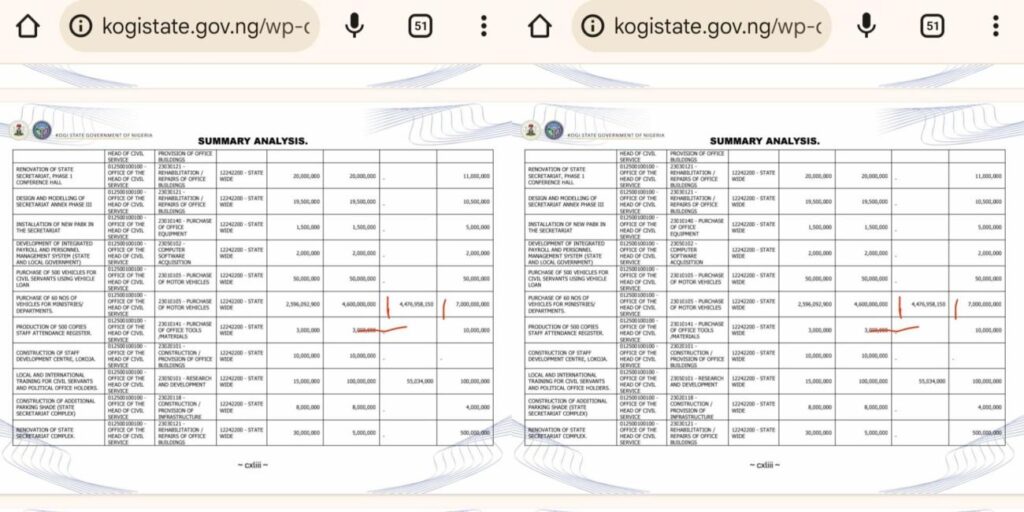
A recent review by Chronicles Reporters of Kogi State’s budget has shown that the state government plans to spend a staggering N11 billion on the purchase of 60 vehicles for ministries and departments between 2024 and 2025—even as the state grapples with dire challenges in public health, water supply, and education.
According to the state’s official budget documents, N4.4 billion was already expended on the procurement of vehicles between January and September 2024. This amount is part of the N4.6 billion initially allocated for the purchase of the 60 vehicles in the 2024 budget. With a balance of N124 million remaining from that allocation, the 2025 budget has now earmarked an additional N7 billion for the same purpose, bringing the total planned expenditure to N11 billion for the two years.
Based on this total figure, each of the 60 vehicles would cost an average of N183 million—a figure that has raised serious concerns among residents and public finance observers, especially at a time when the state is facing persistent underfunding of essential services.
The decision to allocate such a hefty sum to vehicle procurement comes despite ongoing public outcry over poor budgetary priorities. Critics point to the government’s continued neglect of pressing needs in critical sectors. For instance, Kogi’s 2025 budget includes a whopping N3 billion set aside for remodelling the Government House, despite the fact that N2.2 billion had already been spent on the same project in 2024.
Further scrutiny of the budget reveals that another N200 million will go into renovating and furnishing the Deputy Governor’s Lodge, while an identical amount has been allocated to rehabilitate and furnish the Deputy Governor’s Office. In 2024, similar projects had already consumed N100 million each.
Additionally, N15 million has been set aside for the construction of a generator house at the Deputy Governor’s Office—yet, when it comes to vital infrastructure like access to water, only N200 million is budgeted for drilling two boreholes in each of the state’s local government areas.
Even more troubling is the contrast between the government’s lavish spending on administrative buildings and its modest allocations to key social sectors. While N3 billion is dedicated to remodelling the Government House, only N350 million has been budgeted for Kogi’s contributions to Sustainable Development Goals (SDGs) aimed at constructing and rehabilitating schools, clinics, and related infrastructure.
Data from public health and development sources paints a stark picture: in Kogi State, 61% of households do not have access to clean drinking water, and as many as 87% lack access to proper sanitary facilities.
These realities have led many to question the government’s priorities. With poverty, poor healthcare infrastructure, and failing educational systems affecting millions across the state, critics argue that such large-scale spending on vehicles and renovations reflects a troubling disconnect between governance and the needs of the people.
For more in-depth updates from Chronicles Reporters, join our WhatsApp channel:
https://whatsapp.com/channel/0029VabITrvEAKW7DSkTfP0J