Nigeria’s ₦70,000 national minimum wage has suffered a dramatic erosion in value, with the latest data from the National Bureau of Statistics (NBS) showing that a worker earning the statutory minimum wage can now purchase only about 44 litres of petrol.
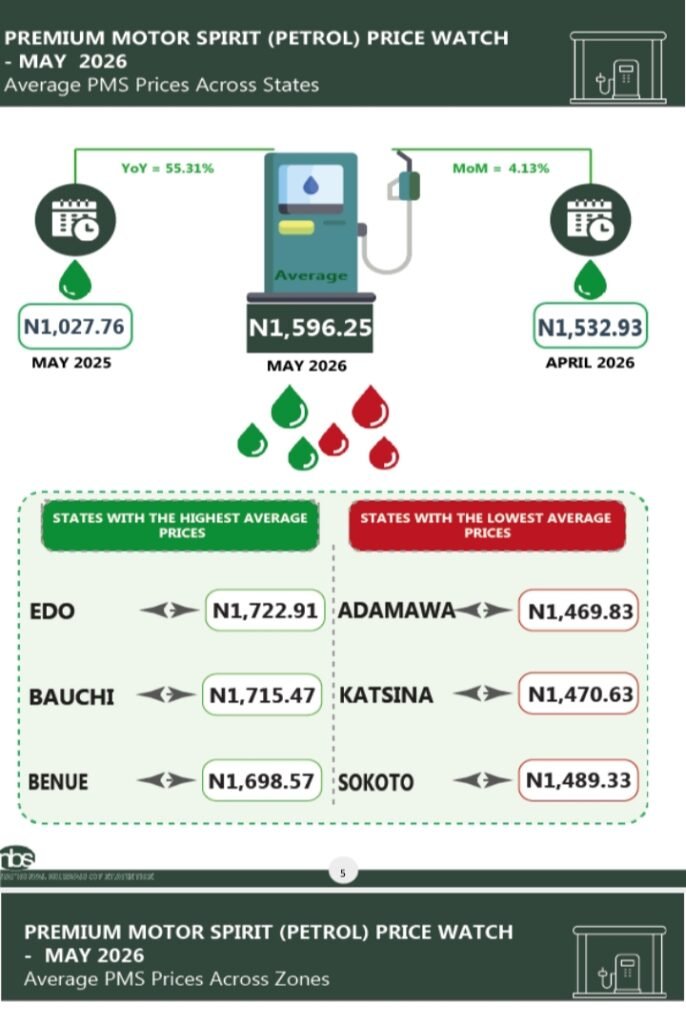
A review of NBS figures by Chronicles Reporters revealed that the average retail price of Premium Motor Spirit (PMS), popularly known as petrol, rose to ₦1,596.25 per litre in May 2026, representing a staggering 55.31 per cent increase from the ₦1,027.76 recorded in May 2025. Compared to April 2026, when the average price stood at ₦1,532.93 per litre, petrol prices increased by a further 4.13 per cent.
At the prevailing national average price of ₦1,596.25 per litre, Nigeria’s ₦70,000 minimum wage can purchase only 43.9 litres of petrol, underscoring the rapid decline in workers’ purchasing power amid soaring inflation, rising energy costs and worsening economic hardship.
The NBS data also exposed significant disparities in petrol prices across the country. Edo State recorded the highest pump price at ₦1,722 per litre, making it the most expensive state for fuel purchases in Nigeria. Bauchi State followed closely at ₦1,715 per litre, while Benue State recorded ₦1,698 per litre.
At the other end of the spectrum, Adamawa State posted the lowest petrol price at ₦1,469 per litre, followed by Katsina at ₦1,470 per litre and Sokoto at ₦1,489 per litre.
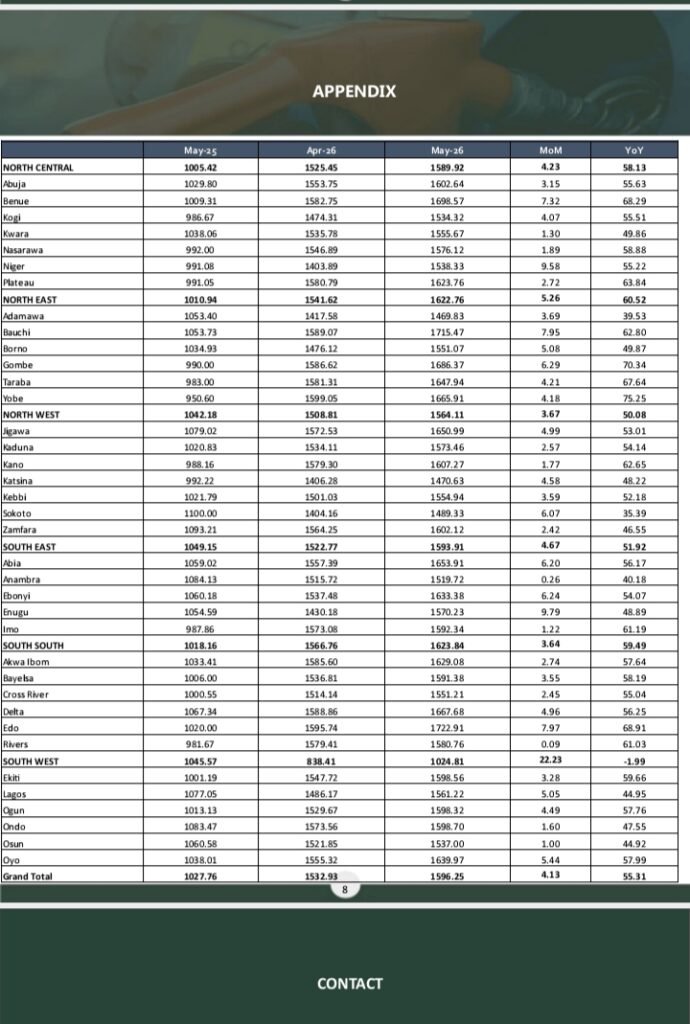
On a regional basis, the South-South geopolitical zone recorded the highest average retail petrol price at ₦1,623.84 per litre, while the North-West had the lowest zonal average at ₦1,564.11 per litre.
The figures have intensified concerns over the worsening cost-of-living crisis confronting millions of Nigerians. With petrol serving as the backbone of transportation, electricity generation and supply chains, every increase in fuel prices has a direct impact on the prices of food, goods and essential services.
Since President Bola Tinubu’s administration removed the petrol subsidy in 2023, fuel prices have continued their upward trajectory. The latest surge has been linked partly to tensions and instability in the Middle East, which have exerted additional pressure on global energy markets.
The soaring cost of petrol has further accelerated inflation, pushed transportation fares beyond the reach of many households and deepened economic hardship across the country. For millions of Nigerians already struggling with stagnant incomes, the increasing cost of fuel has translated into higher living expenses and shrinking disposable income.
Earlier findings reviewed by Chronicles Reporters showed that the economic strain intensified in April 2026 when petrol prices in several states exceeded ₦1,590 per litre, significantly surpassing the national average. At the time, Yobe State in the North-East and Edo State in the South-South ranked among the most expensive locations to purchase petrol, with consumers paying as much as ₦1,599.05 per litre.
The data also showed that marketers and filling stations in several strategic states consistently sold petrol at prices far above the national average, further burdening consumers.
The latest NBS figures paint a troubling picture of an economy where wages are increasingly unable to keep pace with rising costs. While the ₦70,000 minimum wage was introduced as a measure to cushion the effects of economic reforms, its real value continues to diminish as inflation and fuel prices surge.
For many workers, the reality is stark: a month’s minimum wage can no longer guarantee enough fuel to meet basic transportation needs, highlighting the growing gap between earnings and the cost of survival in Africa’s largest economy.