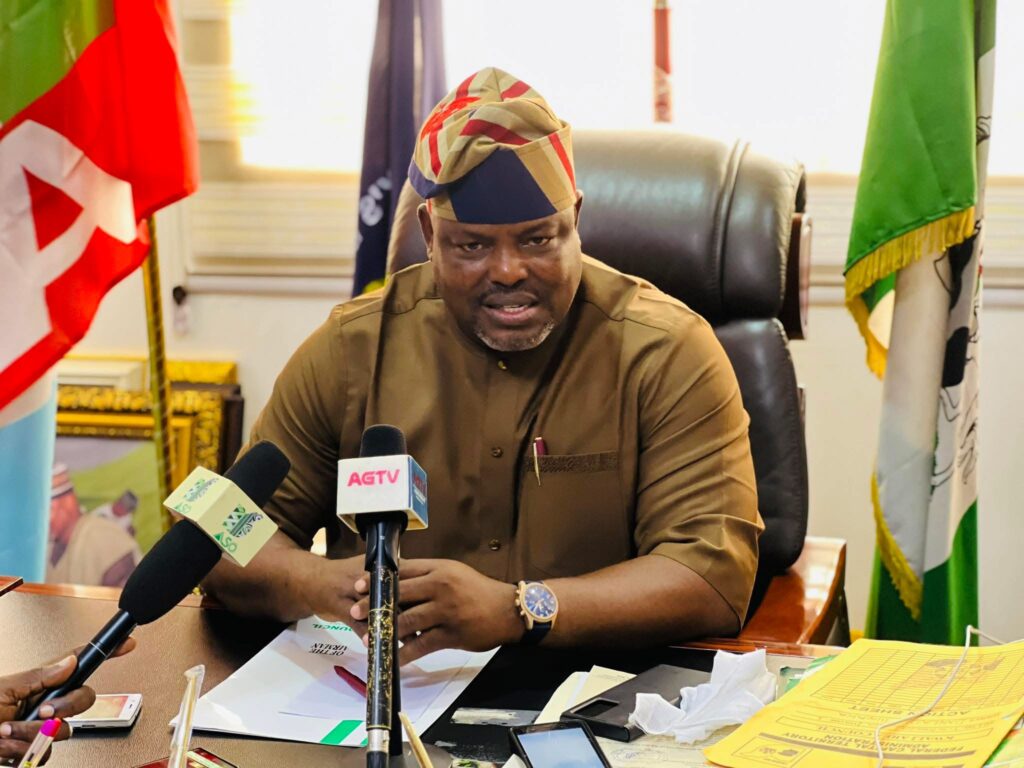
The political conversation around Abuja South is taking another direction as the All Progressives Congress (APC) candidate for the Abaji/Gwagwalada/Kwali/Kuje Federal Constituency, Danladi Chiya, places international education, innovation and sports development at the centre of his proposed youth agenda.
Chiya says his vision is to build a system in which talented young people from Abuja South are not merely mobilised during elections, but deliberately identified, developed and connected to opportunities capable of transforming their individual lives and, ultimately, their communities.
According to him, he intends to collaborate with national and international organisations to create sponsorship opportunities that would enable promising young people from Abuja South to pursue education abroad and return with knowledge, skills and ideas that can contribute to the development of the constituency.
“I will collaborate with national and international organisations to sponsor our youths abroad to school, so that when they return, they can bring progress to Abuja South,” Chiya said.
The proposal represents a shift from the conventional political model in which youth empowerment is frequently associated with short-term distributions, political appointments or temporary interventions.
For Chiya, the more fundamental question is how society can invest in the intellectual capacity of its young population and create conditions under which that investment eventually returns to the community as innovation, enterprise, employment and social development.
He said he had listened to young people across the constituency and encountered what he described as vibrant youths with the intellectual capacity and ambition to study in advanced institutions outside Nigeria.
“I have the idea and I have listened to vibrant youth who can go and school abroad and become innovators to change our society,” he said.
The philosophy behind the proposal is that education should not be viewed simply as an individual pursuit but as an investment in the productive capacity of society.
A young person who acquires advanced knowledge in engineering, medicine, technology, agriculture, artificial intelligence, science, business or other specialised fields can potentially return with expertise capable of creating businesses, solving local problems and transferring knowledge to others.
For Abuja South—with its combination of rural communities, agricultural settlements, expanding urban centres, students, artisans, entrepreneurs and a large youth population—the question of human-capital development is particularly significant.
Chiya’s argument is that government and political representation should help build a pipeline through which talent moves from identification to training, professional development and eventual contribution to society.
The proposed international scholarship model, if implemented, would require transparent criteria for identifying beneficiaries, partnerships with credible institutions, proper monitoring and mechanisms to ensure that beneficiaries have opportunities to contribute their acquired skills after returning home.
Beyond academic education, Chiya says the same philosophy must extend to sports.
He stressed that young people whose talents lie outside conventional academic pathways should not be excluded from opportunities simply because they are not pursuing university degrees.
“Those into sports will not be left out,” he said.
That position broadens the proposed youth-development philosophy beyond the classroom.
Sports, when properly structured, can serve simultaneously as a pathway for talent development, employment, discipline, international exposure and community identity. Young athletes can potentially progress through professional clubs, academies, scholarships and international competitions when the necessary structures exist.
The ideological question therefore becomes bigger than sponsorship.
It becomes a question of what society chooses to do with its human potential.
Chiya’s broader political argument has previously centred on the idea that representation should move beyond patronage and focus on changing the material conditions of communities. He has connected his political thinking to different schools of social and political thought, including Karl Marx and Paulo Freire, while saying that his interest is ultimately in understanding inequality, power, education and the Nigerian reality.
Within that framework, investing in young people can be understood as investing in the future productive capacity of Abuja South.
Instead of asking young people only what political support they can provide, the state and its representatives can ask a different question: what can society provide young people with so that they can become producers, innovators, professionals, entrepreneurs and problem-solvers?
That distinction is central to the philosophy behind Chiya’s proposal.
The APC’s official candidate profile identifies Chiya as its candidate for the Abuja South federal constituency and highlights his previous experience as Kwali Area Council chairman, where his administration focused on areas including agriculture, infrastructure, water supply, electrification and youth-oriented initiatives.
His proposed international education and sports initiative would therefore represent an attempt to extend that grassroots-development argument into human-capital development at the federal legislative level.
For Abuja South, the potential beneficiaries would not necessarily be limited to one category of young people. A student with exceptional academic ability, a technology enthusiast developing an invention, a young farmer interested in modern agricultural systems, a prospective engineer, a medical student, an aspiring entrepreneur or a talented athlete could all potentially form part of a broader talent-development ecosystem.
The deeper proposition is that Abuja South should not merely produce voters; it should produce innovators.
And if young people leave the constituency to acquire knowledge and experience, the ultimate objective, according to Chiya’s proposal, should be to create pathways through which that knowledge returns home and becomes useful to the communities from which they came.
That could mean returning graduates establishing businesses, creating jobs, transferring technical knowledge, mentoring younger people, developing new technologies, improving agricultural practices, contributing to healthcare, entering research or participating in sports development.
In this sense, the proposed scholarship programme is being presented not simply as an overseas education scheme but as a potential human-capital cycle:
identify talent → provide opportunity → acquire knowledge → return home → innovate → create value → develop the next generation.
Whether such a programme can ultimately be implemented, how it would be funded, which organisations would participate and what safeguards would govern beneficiary selection would require detailed policy design.
But the political idea being advanced by Chiya is clear: the future of Abuja South, in his view, should not be built only with roads, buildings and physical infrastructure.
It must also be built inside the minds of its people.
And for a constituency seeking a new generation of innovators, professionals, entrepreneurs and athletes, the greatest infrastructure may ultimately be the human being.