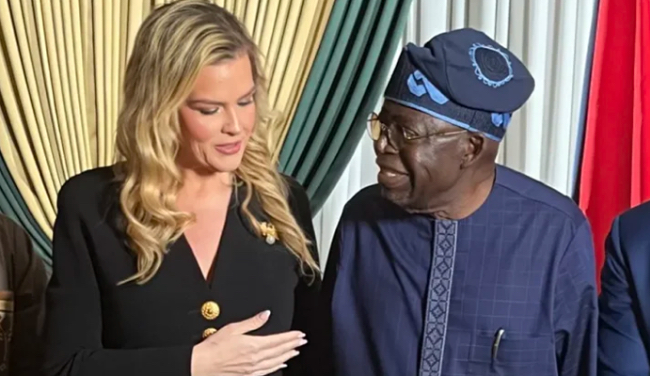
A controversial past involving a criminal charge and a guilty plea has resurfaced in the United States following renewed scrutiny of Diana London, the conservative lobbyist who interviewed President Bola Ahmed Tinubu in an exclusive engagement that has generated heated reactions among Nigerians.
London, who has been associated with DCI Group, a Washington-based lobbying firm working for the Nigerian government’s interests in the United States, pleaded guilty to misdemeanour larceny in 2018 over the theft of nearly $30,000 from Pigman’s Bar-B-Que in Kill Devil Hills, North Carolina, where she had been employed in 2017.
Records relating to the case show that a grand jury in Dare County indicted London on May 21, 2018, following revelations that she had improperly charged personal expenses to the restaurant’s business accounts.
The case attracted further attention after a 27-minute recording reportedly captured London admitting to the theft. The recording became a source of controversy when it emerged that she had denied its existence while working as a legislative assistant to North Carolina State Representative Bob Steinburg.
Steinburg, who had employed London at the time, subsequently terminated her employment after the revelations emerged. The controversy also embarrassed the lawmaker, who had faced political attacks from opponents and was reportedly concerned about the implications of the scandal for his political standing.
According to accounts of the case, London admitted that she had used funds belonging to Pigman’s Bar-B-Que to cover personal expenses. She reportedly told the court that she did not initially realise she was charging personal expenditures to the business but became frightened about admitting what had happened to her employer.
The office of District Attorney Andrew Womble pursued the case, but London eventually entered into a plea agreement that enabled her to avoid imprisonment.
Under the agreement, she pleaded guilty to misdemeanour larceny and agreed to repay $25,000 to the state in two instalments. The first payment of $10,000 was due on December 10, 2018, while the remaining $15,000 was scheduled for payment in May 2019.
The case has returned to public discussion following London’s emergence as a prominent figure in efforts to improve the Nigerian president’s image among American political and policy circles.
After avoiding interviews with sections of the Nigerian local media, Tinubu granted an exclusive interview to London, who subsequently attracted criticism over her professional association with the president and the resurfacing of her past legal troubles.
London travelled to Lagos before proceeding to Abuja, where she conducted the interview with Tinubu. During the engagement, she praised Nigeria under his leadership, describing the country as the “America of Africa.”
Her appearance at the presidential interview also attracted attention because of her expensive fashion choice. Reports described her outfit as a black Schiaparelli skirt suit valued at approximately $10,000. She was also photographed with senior presidential officials, including the President’s Chief of Staff, Femi Gbajabiamila.
The interview has drawn greater scrutiny because of DCI Group’s involvement in lobbying efforts on behalf of Tinubu’s administration in Washington.
The lobbying firm has been linked to a campaign aimed at improving the Nigerian government’s standing in the United States at a time when American lawmakers and religious advocacy groups have raised concerns about targeted killings of Christians and have urged Washington to consider designating Nigeria a Country of Particular Concern.
Documents reported by Peoples Gazette indicated that DCI Group received $4.5 million for work connected to efforts to improve Tinubu’s image in Washington. The reported figure has intensified questions about the scale of public resources committed to international lobbying and the results such expenditure is expected to deliver.
The controversy comes amid a broader debate over how the Nigerian government communicates its position to foreign governments, particularly as concerns about insecurity, religious violence, human rights and governance continue to shape discussions about Nigeria in the United States.
For critics, London’s past conviction raises questions about the judgment involved in selecting individuals to conduct high-profile engagements intended to improve the president’s international image. They argue that a government investing millions of dollars in international reputation management should expect its representatives and contractors to withstand public scrutiny.
London’s supporters may argue that a past misdemeanour conviction does not automatically disqualify an individual from undertaking professional lobbying or media work. However, the circumstances surrounding her appointment and her association with a multimillion-dollar lobbying operation have become part of the public debate over the credibility of the campaign.
The renewed attention to London’s past intensified after her posts on X and Instagram attracted strong reactions from Nigerians, many of whom questioned her association with Tinubu and revisited the details of her 2018 case. She subsequently deleted the posts from both platforms on Wednesday, following the backlash that began after her activities attracted attention on Tuesday.
The episode has raised fresh questions about the Nigerian government’s approach to international public relations, the selection of lobbyists entrusted with representing the country abroad, and whether expensive image-management campaigns can overcome concerns about insecurity, accountability and governance at home.
As the controversy continues, attention is likely to remain on the relationship between Tinubu’s administration and DCI Group, the reported $4.5 million lobbying expenditure, and the background of the individuals engaged in efforts to reshape Nigeria’s image before American political leaders and the international community.