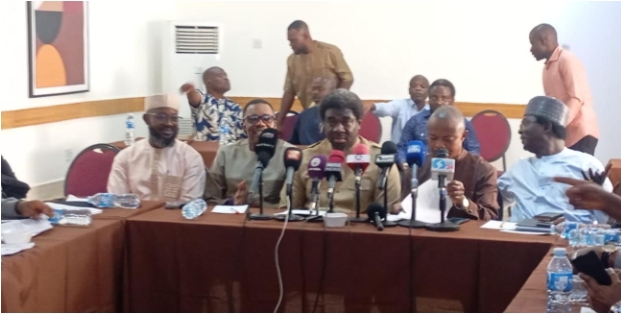
The Nigeria Labour Congress (NLC) and the Trade Union Congress of Nigeria (TUC) have agreed to end their differences and restore unity within the Nigerian labour movement following the intervention of veteran labour leaders who stepped in to prevent their disagreements from escalating into a deeper crisis.
The resolution was announced at a joint press conference in Abuja attended by the current leadership of both labour centres, former union presidents and other senior labour figures.
The reconciliation followed a series of meetings convened by former labour leaders, who summoned the presidents of the two organisations for discussions aimed at resolving their disagreements and protecting the collective interests of Nigerian workers.
Speaking at the press conference on behalf of the former labour leaders, one of the veterans explained that the intervention became necessary because past leaders were uncomfortable with the public exchanges between the two labour organisations.
He noted that disagreements were not unusual within the labour movement but warned that allowing internal disputes to play out publicly could undermine the unity, credibility and collective strength of organised labour.
According to him, former labour leaders had invited the presidents of the NLC and TUC for consultations, with discussions beginning the previous day and continuing until late into the night.
He identified some of the veteran labour leaders who participated in the intervention as Comrades Hassan Sunmonu, Peace Obiajulu, Aliu Bawa, Bukoie Kagama and Kondrick, alongside members of the National Administrative Councils of both organisations.
He said the meetings produced an agreement that the disagreement must be resolved immediately and that state councils of both labour centres should be formally informed about the outcome.
The joint press conference, he explained, was organised to communicate the resolution to Nigerian workers and the general public and demonstrate the commitment of both organisations to putting their differences behind them.
Presenting the position reached during the consultations, the veteran labour leader disclosed that the presidents of the NLC and TUC had endorsed the agreement and resolved to work together in the interest of Nigerian workers.
“To disagree, there is nothing wrong with that. In our movement, we disagree. But having that disagreement play out in the open was something that past presidents were not comfortable with,” he said.
He stressed that the welfare and rights of Nigerian workers must remain the priority of organised labour, regardless of disagreements among its leadership.
“The issue of Nigerian workers is paramount, and that is the struggle that they have decided to embark upon,” he added.
Emphasising the importance of solidarity, the former labour leader maintained that an injury to one worker or labour organisation should be regarded as an injury to all.
“Bygones is bygones,” he declared, reaffirming the commitment of both labour centres to prioritising workers’ interests above their internal disagreements.
The disagreement between the NLC and TUC had intensified following negotiations between the Nigerian government and labour representatives over workers’ welfare, particularly a proposed ₦70,000 monthly transport intervention for public servants for six months.
The controversy followed an October 27, 2026, agreement between the Federal Government and a labour delegation led by NLC President, Joe Ajaero, which addressed several outstanding issues affecting workers.
The agreement reportedly included a proposed ₦70,000 transport allowance for public servants for six months, beginning in November 2026.
Other issues covered in the discussions included the implementation of the 40 per cent peculiar allowance, minimum wage negotiations, welfare demands in the health sector and other outstanding matters affecting Nigerian workers.
However, the TUC leadership expressed dissatisfaction with the negotiations, alleging that it was excluded from the discussions and questioning the authority of the NLC to enter into agreements affecting workers represented by the other labour centre without its participation.
The exclusion reportedly heightened tensions between the two organisations, raising concerns about the possibility of a deeper division within the country’s organised labour movement.
As the disagreement escalated, former labour leaders, including Hassan Sunmonu, Ayuba Wabba, Peter Esele, Bobboi Kaigama and Abdulwaheed Omar, intervened to prevent the dispute from weakening the relationship between the two organisations.
Wabba, a former NLC president and former president of the International Trade Union Confederation, had disclosed that veteran labour leaders were engaging both organisations and urging their leadership to discontinue further public exchanges.
He described the disagreement as a family misunderstanding, warning that allowing it to degenerate could undermine the unity, strength and solidarity required for organised labour to effectively defend workers’ interests.
He also cautioned against attempts by third parties to exploit the disagreement and weaken the labour movement, stressing that divisions among labour unions could ultimately work against Nigerian workers.
The intervention paved the way for further consultations between the NLC and TUC, eventually resulting in the reconciliation announced at the joint press conference.
The agreement is being regarded as an important step towards restoring cooperation between the two largest labour centres in the country, particularly at a time when workers are confronted with worsening economic conditions and growing demands for improved welfare.
However, questions surrounding workers’ welfare, collective bargaining, representation in negotiations with the Federal Government and the implementation of agreements already reached remain critical issues that will test the durability of the renewed relationship.
The reconciliation comes amid persistent concerns over the rising cost of living, expensive transportation, high food prices and declining purchasing power, which have continued to place enormous pressure on Nigerian workers and their families.
Over the years, the NLC and TUC have played significant roles in challenging government policies, negotiating improved wages, organising industrial actions and demanding better working conditions for employees across different sectors of the Nigerian economy.
Their renewed commitment to unity is therefore expected to strengthen the collective voice of organised labour as it continues to engage the Federal Government and other stakeholders on issues affecting the welfare, rights and economic security of Nigerian workers.