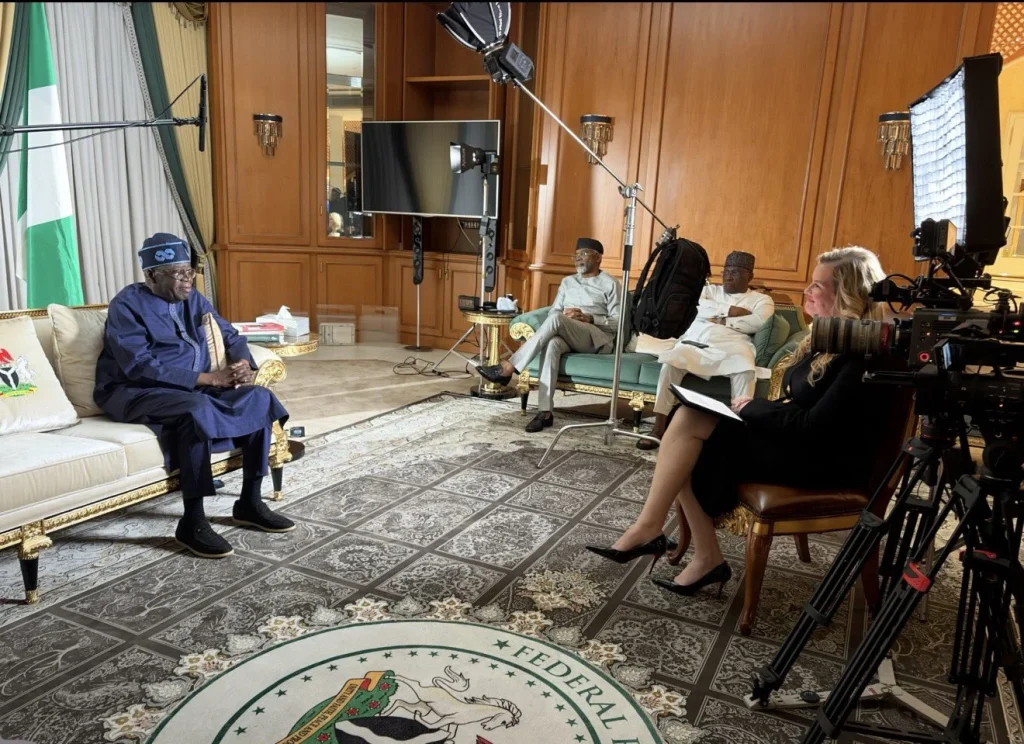
Documents filed with the United States Department of Justice have revealed that American conservative lobbyist, Diana London, received $4.5 million from Nigeria’s National Security Adviser (NSA), Nuhu Ribadu, through a legal representative, raising fresh questions about the Tinubu administration’s multimillion-dollar lobbying activities in the United States.
The disclosure comes days after London conducted an interview with President Bola Tinubu at the Presidential Villa, Aso Rock, Abuja, where she was subsequently presented across social media platforms by several presidential media aides and government supporters as a journalist.
According to a report by Peoples Gazette, London received the $4.5 million payment through Aster Legal, an entity identified in her foreign clients’ disclosure as representing Ribadu.
The payment, described as a “retainer,” was reportedly completed on December 12, 2025, according to documents submitted under the United States Foreign Agents Registration Act (FARA).
The FARA legislation requires individuals and organisations acting on behalf of foreign governments or interests in the United States to disclose their activities, financial arrangements and payments to the US Department of Justice.
London arrived in Abuja on Tuesday and subsequently secured an interview with President Tinubu at the Presidential Villa. Following the engagement, photographs and information about the interview were widely circulated by presidential aides and supporters, with several describing her as an American journalist.
However, documents reviewed by Peoples Gazette reportedly identify London as a conservative American lobbyist affiliated with DCI Group, a right-wing lobbying organisation said to have been engaged with millions of dollars to advance the Nigerian government’s interests in Washington.
London, 40, is also reportedly associated with Roger Stone, a controversial American political strategist and longtime ally of United States President Donald Trump, who has been involved in several high-profile conservative political campaigns and influence operations.
In her FARA disclosures, London listed several foreign clients, including the Bahamas, Mexico, the United Arab Emirates and Nigeria.
She specifically identified Aster Legal as the channel through which she received the $4.5 million payment connected to Ribadu, according to the documents.
The revelation has drawn attention to the nature and extent of the Nigerian government’s lobbying arrangements in the United States, particularly as the Tinubu administration intensifies diplomatic efforts to strengthen relations with Washington following tensions over allegations of widespread killings of Christians in Nigeria.
In 2025, the Trump administration designated Nigeria a “Country of Particular Concern” over religious freedom concerns, following repeated allegations by Trump and some American conservative politicians that Christians were facing systematic persecution and mass killings in the country.
Trump subsequently threatened military intervention and ordered military action that resulted in at least two airstrikes on locations described as suspected terrorist hideouts in northern Nigeria.
The diplomatic tensions generated considerable international attention and placed additional pressure on the Nigerian government to address Washington’s concerns about insecurity and religious freedom.
However, the American president’s position towards Nigeria later appeared to soften following a series of diplomatic engagements and multimillion-dollar lobbying arrangements involving individuals and organisations working to improve the country’s image and strengthen the Tinubu administration’s relationship with influential political figures in Washington.
London’s activities and the disclosed $4.5 million payment have therefore raised questions about the financial arrangements surrounding the government’s efforts to influence American political opinion and policy towards Nigeria.
Following her meeting with Tinubu on Tuesday, London shared photographs of herself with the Nigerian president on social media, describing the country as the “America of Africa” and praising the administration’s economic policies.
In one of her posts, she wrote: “Special day with President Tinubu of Nigeria, the man revolutionising the economy of Nigeria.”
She further declared: “Nigeria is the America of Africa and an important ally to the United States.”
London also credited the relationship between Trump and Tinubu with efforts to improve security across West Africa.
“Thanks to the partnership between President Trump and President Tinubu, they are securing West Africa and protecting lives. The future between the relationship of the two countries is endless and filled with opportunities for all,” she stated.
Her comments have attracted further attention because of the financial relationship disclosed in the American government filings, particularly the $4.5 million retainer linked to Nigeria’s National Security Adviser.
London also generated public interest over her appearance at the Presidential Villa, where she wore a black Schiaparelli skirt suit reportedly valued at approximately $10,000.
The description of Nigeria as the “America of Africa” and her glowing assessment of Tinubu’s economic policies have also sparked questions about the distinction between her political lobbying activities and her engagement with the Nigerian president.
The diplomatic engagement between Nigeria and the United States has also extended to the office of the First Lady, Oluremi Tinubu.
Trump recently invited Mrs Tinubu to the White House for end-of-year prayers, during which he reportedly praised her as a revered pastor who cares deeply about Nigerian Christians.
The First Lady has maintained strong ties with the Redeemed Christian Church of God (RCCG), one of Nigeria’s largest Pentecostal Christian movements.
However, her political history has also been marked by allegations of religious intolerance and political violence.
In 2019, Mrs Tinubu reportedly came under criticism following allegations that she threatened people of Igbo extraction in Lagos, many of whom are Christians, over their political choices during an election campaign.
She was accused of threatening to chase them out of Lagos with violent consequences if they failed to support her husband’s All Progressives Congress (APC).
She has also faced allegations of deploying political thugs to disrupt religious activities and voting exercises in areas with significant Igbo Christian populations in Lagos.
Mrs Tinubu, who served three terms in the Nigerian Senate, has denied allegations of political violence and religious bigotry.
The latest disclosure involving London has renewed scrutiny of the Tinubu administration’s use of foreign lobbyists and public relations consultants to influence political and diplomatic conversations in the United States.
Beyond the reported $4.5 million payment, the circumstances surrounding London’s interview with the Nigerian president have raised questions about transparency, disclosure and the presentation of foreign political operatives to the Nigerian public.
In particular, the revelations have triggered questions about why an individual identified in US government filings as a conservative political lobbyist, with disclosed financial ties to Nigerian government interests, was widely presented as a journalist following her interview with the president.
The development also places renewed focus on the extent to which public funds are being committed to foreign lobbying efforts, the identities of those facilitating the arrangements and the specific outcomes the Nigerian government hopes to achieve through such engagements.