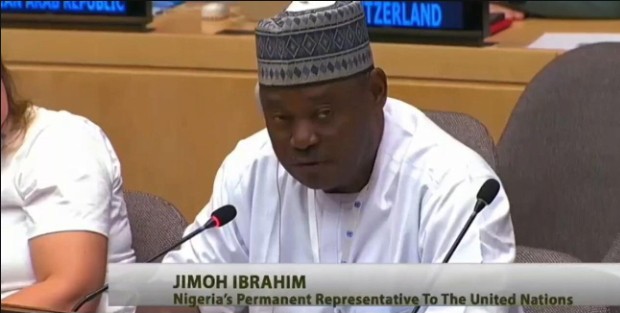
Nigeria does not possess nuclear weapons or other weapons of mass destruction (WMDs) and has never pursued a nuclear weapons programme, the country’s Permanent Representative to the United Nations, Jimoh Ibrahim, has declared.
Ibrahim made the declaration while addressing the United Nations General Assembly at the 108th Plenary Meeting of the 80th Session in New York, where he reaffirmed Nigeria’s commitment to international efforts to end nuclear weapons testing and eliminate the threat posed by weapons of mass destruction.
The Nigerian envoy, who is also Chairman of the UN Committee on Budget and Administration, said Nigeria remained committed to international cooperation aimed at preventing the proliferation of nuclear weapons and creating a safer world free from the threat of weapons of mass destruction.
“Nigeria neither possesses nuclear weapons nor has ever pursued a nuclear weapons programme,” Ibrahim said, conveying the position of President Bola Tinubu.
He said Nigeria had established institutions and regulatory mechanisms to monitor nuclear-related activities and address issues concerning weapons of mass destruction.
Ibrahim identified the Nigeria Atomic Energy Commission as one of the key institutions responsible for overseeing the country’s nuclear activities and regulatory framework.
He also disclosed that Nigeria maintains cooperation with several countries, including Russia, China, France, South Korea and the United States, as part of its commitment to international collaboration on nuclear matters.
According to him, the partnerships demonstrate Nigeria’s willingness to engage with the international community on nuclear issues while supporting efforts aimed at ensuring that nuclear technology is used peacefully and responsibly.
The Nigerian representative, however, raised concerns over the limitations that could arise from Article 2(7) of the United Nations Charter, which establishes the principle of non-intervention in matters essentially within the domestic jurisdiction of states.
Ibrahim called for a review of the provision, arguing that the principle of non-intervention should not be used as a shield to prevent the international community from responding to countries that conduct nuclear weapons tests or possess weapons of mass destruction.
He maintained that issues involving nuclear weapons and WMDs have consequences that extend beyond national borders and therefore require effective international action.
The envoy said President Tinubu had directed him to reaffirm Nigeria’s readiness to strengthen international partnerships aimed at eliminating nuclear weapons testing.
Ibrahim also aligned Nigeria with the statement delivered by the African Group and congratulated member states on the 30th anniversary of the Comprehensive Nuclear-Test-Ban Treaty (CTBT).
He noted that Africa remains a nuclear-weapon-free zone and has rejected nuclear explosive testing on the continent.
According to him, the continent’s position reflects Africa’s long-standing commitment to nuclear disarmament, non-proliferation and the preservation of international peace and security.
Ibrahim urged UN member states to sustain efforts towards the complete elimination of nuclear weapons testing, stressing that the continued existence and development of nuclear weapons pose a serious threat to global security.
He argued that stronger international mechanisms were required to ensure that countries could not undermine global efforts against nuclear weapons while relying on principles of national sovereignty to avoid international scrutiny or action.
The Nigerian envoy further congratulated member states on what he described as progress recorded over the past three decades in the global campaign against nuclear weapons testing.
He said Nigeria would continue to support multilateral initiatives aimed at strengthening the international nuclear non-proliferation regime and eliminating the threat posed by nuclear weapons.
Ibrahim’s declaration at the UN therefore reaffirmed Nigeria’s position as a non-nuclear-weapon state while simultaneously calling for stronger international measures against nuclear weapons testing and the possession of weapons of mass destruction.
The Nigerian government’s position, as conveyed by its UN representative, places emphasis on international cooperation, nuclear disarmament and the need for the global community to have effective mechanisms to respond to activities capable of threatening international peace and security.