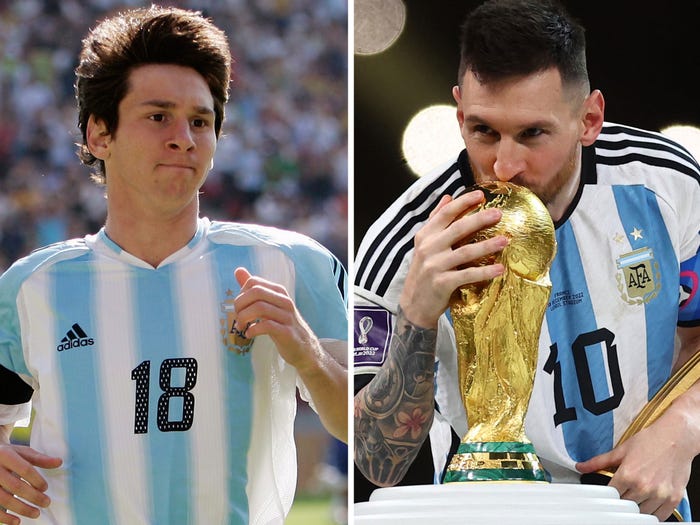
Lionel Messi has announced his retirement from professional international football, bringing an extraordinary 20-year career with the Argentina national team to an emotional end.
The 39-year-old football icon announced his decision in an emotional statement, saying the decision was painful but necessary, while expressing gratitude to Argentina’s fans, his family, teammates, coaches and officials who accompanied him throughout his remarkable journey with the national team.
Messi revealed that he had already made the decision shortly after Argentina’s 2026 World Cup final, but said the death of his father, Jorge Messi, later strengthened his resolve to step away from international football.
“After all this time since the final, and after thinking about it a lot, I want to tell everyone that I’m retiring from the national team,” Messi said.
“It was a decision that hurt and still hurts deep inside, but I understand that this is the right moment.”
Messi said his commitment to Argentina had never been in doubt, insisting that he had always given everything for the national team, including during the difficult years before his major international successes.
“I swear I always gave everything, not only in these last few years when we won everything, but before that too. I always fought and gave everything for this shirt, to bring you happiness and make you feel proud to be Argentine through football,” he said.
Messi’s retirement brings an end to one of the most remarkable international careers in football history.
He leaves Argentina after 207 appearances and 125 goals, according to reports published following his retirement announcement, making him the country’s record appearance holder and all-time leading goalscorer.
His international career included some of the most significant achievements in Argentine football.
Messi led Argentina to the 2022 FIFA World Cup title, ending the country’s long wait for the trophy. He also helped the national team win the Copa América in 2021 and 2024, as well as the 2022 Finalissima.
He won Olympic gold with Argentina at the 2008 Beijing Games and went on to become the central figure of a golden era for the national team.
However, his journey with Argentina was not always filled with triumph. Before eventually lifting major international trophies, Messi endured years of disappointment, including defeats in important finals and intense scrutiny over his performances for the national team.
His eventual success changed his relationship with Argentine supporters and cemented his place among the country’s greatest footballers.
In his retirement message, Messi acknowledged that a new generation of Argentine players was emerging and deserved an opportunity to take over.
“There isn’t much time left, and different chapters are coming to an end. This is one that hurts me a lot. I love, I loved, and I will always love being part of the national team. I gave everything I had, and I don’t have anything more to give,” he said.
“Also, there are great young players coming through who deserve to be here.”
Messi said he would continue to support Argentina from outside the team, promising to remain behind the national side during both its successful and difficult moments.
“Thank you for all the love during these 20 years. I’m going to miss hearing you from the inside. Now I’ll be one of you, always supporting from the outside, in the good times and even more in the bad ones,” he said.
The announcement carries an especially personal dimension following the death of Messi’s father, Jorge Messi, earlier this month.
Jorge Messi, 68, died on August 8 at a medical clinic in Rosario, Argentina, after a period of illness.
He was not only Lionel Messi’s father but also his longtime representative and a central figure in the footballer’s development and career.
Jorge played a major role in his son’s development during his early years in Argentina and remained closely involved when Messi moved to Barcelona, where his professional career blossomed.
He subsequently continued to play an important role in managing his son’s career and business affairs.
Jorge’s health had reportedly been a source of concern during the 2026 World Cup, with reports indicating that Messi was emotionally affected by his father’s condition during the tournament.
The family had also asked for privacy regarding Jorge’s illness.
Following his father’s death, Messi paid tribute to him and reflected on the difficulty of continuing without the man who had supported him throughout his football journey.
His father’s death subsequently added another emotional layer to Messi’s decision to end his international career.
Messi revealed that he had written his retirement statement on July 21, two days after the World Cup final.
“I wrote these words on July 21, two days after the final. Today, after what happened with my dad, I’m even more convinced of this decision than before,” he said.
The Argentine star also thanked his family for standing by him throughout what he described as a beautiful but difficult journey.
“Thank you to my family for always being there and for being with me throughout this beautiful but difficult journey,” Messi said.
He also thanked every coach, teammate and director with whom he had shared his international career, saying he would leave with unforgettable memories.
“I take with me unforgettable memories and moments,” he said.
“I leave with peace and pride, knowing that together with my teammates we gave you moments we once dreamed of. It was crazy to experience all of this with you. I love you!”
Messi ended his emotional statement with a message of gratitude to God and Argentina.
“Thank you God for making me Argentine.
“Vamos Argentina!”
His retirement marks the end of an era for Argentina, with the iconic No. 10 having become inseparable from the country’s football identity over the past two decades.
From his early international appearances to his eventual World Cup triumph and Copa América successes, Messi’s career with Argentina has been defined by extraordinary records, historic victories and intense emotional moments.
Although he has retired from international football, the decision does not necessarily signal the end of his professional playing career.
Messi continues to play club football for Inter Miami, with his current contract reportedly running until 2028.
For Argentina, however, one of the greatest chapters in its football history has closed.
Messi leaves the national team as its most-capped player and leading goalscorer, with a legacy built on 20 years of service, major international trophies and an enduring connection with millions of Argentines.
He will now support the national team from outside the pitch as Argentina begins the process of moving into a new era without its legendary captain and No. 10.