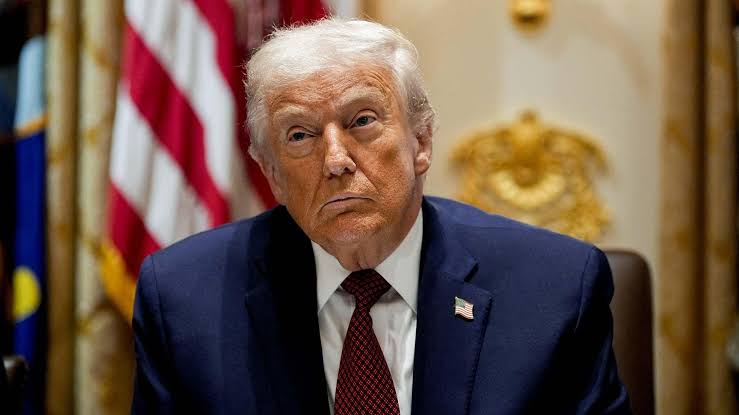
President Donald Trump has vowed that the United States will retaliate against Iran after Tehran launched a wave of missile and drone attacks targeting American military positions in Jordan and the United Arab Emirates on Monday, escalating tensions between Washington and Tehran and raising fears of another round of direct military confrontation.
“We’re going to hit them hard. There will be a response,” Trump told Fox News correspondent Trey Yingst in an interview on Monday.
The US president said American air defence systems successfully intercepted most of the missiles fired towards US forces in Jordan during the attack.
According to Trump, one missile was deliberately allowed to pass after US forces determined that it was unlikely to strike anything significant.
The attacks were claimed by Iran’s Islamic Revolutionary Guard Corps, which said they were carried out in retaliation for a US military strike on Iranian rocket launchers on Larak Island in the Strait of Hormuz on Sunday.
The IRGC said its missile and drone operation targeted the King Hussein and Al Azraq airbases in Jordan, where US military personnel are stationed.
Jordan’s armed forces said its air defence systems intercepted eight missiles that entered the country’s airspace.
Iranian officials, however, claimed that the attacks inflicted heavy damage on the targeted military bases, although details of the alleged damage could not be independently verified.
Iran also claimed that it launched drones towards Al Minhad Air Base in the United Arab Emirates, another facility where US forces are stationed.
The UAE rejected reports that the airbase itself had been attacked, saying instead that its forces intercepted a drone approaching from Iran over UAE territorial waters.
The latest attacks followed a US military operation on Sunday in which American forces struck two Iranian rocket launchers positioned on Larak Island.
The US Central Command said the launchers had posed an imminent threat because they were preparing to fire rockets carrying sea mines into the Strait of Hormuz.
The waterway is one of the world’s most strategically important shipping routes and a major passage for global oil and gas supplies, making any disruption there a potential threat to international energy markets and maritime trade.
The exchange has further complicated efforts to revive diplomatic talks between Washington and Tehran.
Trump, while acknowledging that Iran appeared interested in meeting with US officials, expressed doubts about whether Tehran could be trusted to negotiate and maintain any agreement reached with Washington.
He also maintained that US sanctions against Iran were continuing to take effect and exert pressure on the Iranian government.
The latest confrontation represents the first major direct military exchange between the United States and Iran in more than a month, following weeks of heightened military and diplomatic tensions.
Washington has intensified economic pressure on Tehran through additional sanctions, while mediators from Oman, Pakistan and Qatar have attempted to bring the two sides back to the negotiating table.
However, tensions over the Strait of Hormuz remain a major obstacle.
Trump has repeatedly maintained that the strategic waterway remains open, while Iranian authorities have disputed Washington’s position and continued imposing restrictions on vessels attempting to pass through the strait.
With Trump now openly threatening a forceful military response to Iran’s latest attacks, the possibility of another cycle of US-Iran strikes has increased.
The development comes as diplomatic efforts remain stalled and both sides continue to accuse each other of threatening regional security.
Any further military escalation around the Strait of Hormuz could have consequences beyond the immediate US-Iran confrontation, particularly because of the waterway’s importance to global energy supplies and international shipping.
Trump’s warning has therefore placed Washington at a critical decision point, with the US administration now weighing its military response while regional mediators continue efforts to prevent the conflict from expanding.