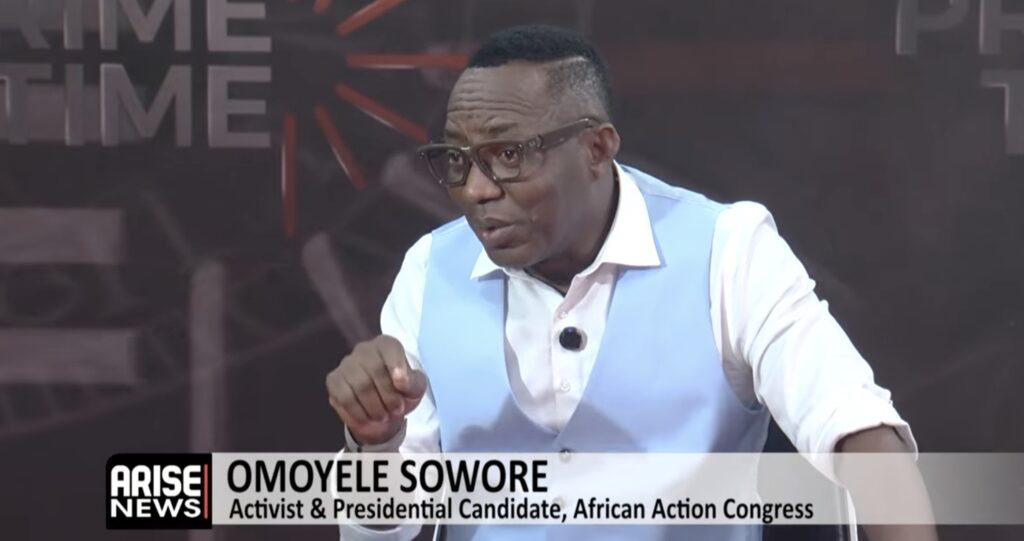
Presidential candidate of the African Action Congress (AAC), Omoyele Sowore, has vowed to restore petrol subsidy if elected president in 2027, arguing that the policy can shield Nigerians from rising fuel and transportation costs if corruption and fraudulent fuel-importation schemes are eliminated.
Sowore made the declaration during an interview on Arise TV’s programme hosted by Charles Aniagolu, where he defended his position on petrol subsidy and outlined plans to reduce fuel prices through domestic refining and tighter controls on government spending.
The AAC presidential candidate insisted that subsidy itself was not the problem, but the corruption and alleged diversion of public funds surrounding its administration.
“Our plan for subsidy is that it will not be removed. I’m restoring subsidy. I made that clear,” Sowore said.
He argued that the removal of subsidy by President Bola Tinubu’s administration contributed significantly to the sharp rise in petrol prices and increased economic pressure on households, businesses and commuters.
According to Sowore, petrol sold for about N400 per litre when subsidy was still provided for in the federal budget but rose to more than N1,400 in some locations after the policy was removed.
“The day you remove it, it went from 400 Naira to 1,400 and something. In some places, 1,600. Everybody took a hit. The economy took a hit,” he said.
Sowore, however, stressed that his proposed restoration of subsidy would not replicate what he described as the fraudulent practices associated with previous subsidy regimes.
He said his government would ensure that public funds allocated for subsidy were tied to actual fuel delivered to Nigerians, while preventing fraudulent importation claims.
“What will be missing in the restoration is that nobody will have a chance to import fuel that did not arrive here,” he said.
The AAC candidate, who is also a journalist and activist, said he had previously investigated alleged fuel subsidy fraud and claimed that fraudulent documentation had been used in the past to secure government payments for petroleum products that were never delivered.
He promised that such practices would be eliminated under his administration.
“We will make sure that every dime that is spent on subsidy is not stolen. It gets to the people,” Sowore said.
He also identified Nigeria’s dependence on imported refined petroleum products as one of the major factors contributing to the high cost of petrol.
Sowore questioned why Nigeria continues to import refined fuel despite having four government-owned refineries, arguing that the country should prioritise domestic refining.
“You have four refineries in Nigeria, none of which are working. I’m not the one who didn’t make them work,” he said.
According to him, his administration would focus on rehabilitating the existing government-owned refineries while encouraging the establishment and licensing of modular refineries across the country.
“It is possible for Nigeria to fix its four refineries. It will build smaller ones or licence several other people who want to have smaller modular refineries,” he said.
Sowore argued that increasing domestic refining capacity would reduce the country’s dependence on imported refined products, lower costs associated with fuel importation and create employment opportunities.
“Why can’t we make our own refineries work?” he asked.
He said Nigeria should stop operating an economy permanently dependent on imported fuel and instead refine its crude oil domestically and make petroleum products available to Nigerians at more affordable prices.
The AAC candidate acknowledged that corruption had historically undermined the subsidy system but argued that corruption should be tackled directly rather than used as a justification for removing the subsidy altogether.
“So you remove the cabal. Subsidy is in order. You keep them in place. Subsidy is out of order,” Sowore said.
He further alleged that the government had effectively replaced the former subsidy arrangement with another system that he claimed continues to benefit powerful interests.
“They have just changed the name of subsidy. They are still subsidising their cabal now,” Sowore alleged.
He said a properly designed subsidy regime should be transparent, closely monitored and structured in a way that ensures government support reaches consumers rather than intermediaries.
Sowore also pointed to Nigeria’s large daily petrol consumption, arguing that even relatively small savings achieved through domestic refining could translate into substantial economic benefits for the country.
‘WE TOLD THEM SUBSIDY REMOVAL WOULD HURT NIGERIANS’
Sowore maintained that he and members of his political movement had warned against the removal of petrol subsidy before the policy was implemented.
He said subsequent increases in fuel prices, transportation fares and the cost of living had demonstrated the consequences of the decision.
“Most of the ideas you are saying that they are picking now, we started fighting for it. We have clearly articulated them,” he said.
“We told them, removing subsidy, will ruin the economy.”
The AAC presidential candidate rejected the argument that subsidy should be permanently abandoned because of corruption, insisting that the government could protect Nigerians while simultaneously prosecuting individuals involved in fraudulent practices.
He said his proposed approach would combine subsidy with strict financial controls, domestic refining and aggressive anti-corruption measures.
The discussion also touched on Sowore’s wider political agenda ahead of the 2027 presidential election.
He described his proposed administration as a break from what he called an entrenched political establishment and rejected the argument that his lack of experience holding executive government office should prevent him from seeking the presidency.
Sowore argued that his years of activism, journalism and challenging successive administrations had given him a different form of leadership experience.
He also rejected the idea of joining a political coalition with established political figures simply to gain access to government.
“I have a lot of experience with these people,” he said, arguing that joining the existing political establishment could compromise those seeking to fundamentally change the system.
Sowore said he would instead pursue what he described as “revolutionary leadership”, aimed at replacing what he considers a political culture that has dominated Nigeria for decades.
He further maintained that Nigerians could adapt to a more orderly and accountable society if the country was led by a government willing to enforce its policies fairly and transparently.
With the 2027 presidential election approaching, Sowore’s promise to restore petrol subsidy is expected to become part of the wider debate over Nigeria’s economic direction, particularly as fuel prices, transportation costs, inflation, unemployment, insecurity and the cost of living remain major concerns for millions of Nigerians.
His position places him directly against the argument that petrol subsidy should be permanently removed, while his proposed combination of subsidy restoration, domestic refining and anti-corruption measures is likely to remain a contentious issue in the 2027 presidential campaign.
For Chronicles Reporters, the central question raised by Sowore’s proposal is whether Nigeria can operate a transparent and affordable subsidy system without returning to the massive leakages and alleged fraud that have historically surrounded the programme.