Tensions between the United States and Iran escalated dramatically on Sunday after President Donald Trump warned that Washington could “militarily complete the job” if Tehran continued to violate a fragile ceasefire, while Iran’s Islamic Revolutionary Guard Corps (IRGC) claimed responsibility for missile and drone strikes on American military installations in Kuwait and Bahrain.
The renewed confrontation has intensified fears of a wider regional war and raised fresh concerns over the security of the Strait of Hormuz, one of the world’s most critical energy corridors.
The latest exchange followed a U.S. military operation targeting Iranian missile and drone storage facilities as well as coastal radar positions, which Washington said was retaliation for an Iranian drone attack on a commercial cargo vessel transiting the Strait of Hormuz.
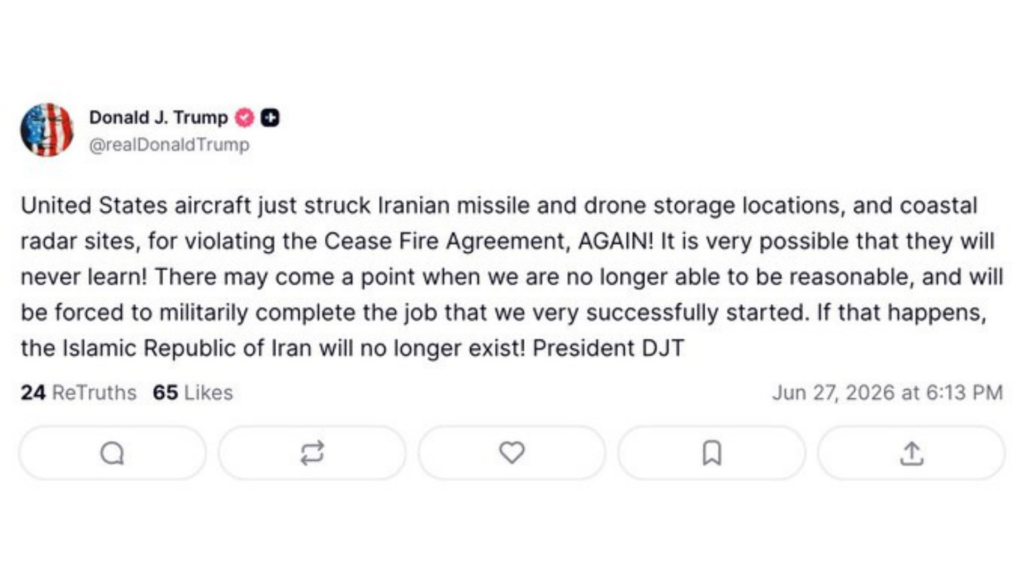
In a statement posted on Truth Social, President Trump said American forces had struck multiple Iranian military sites in response to what he described as Tehran’s repeated violations of the ceasefire arrangement.
The U.S. President warned that Iran appeared unwilling to change its conduct and suggested that Washington could go much further militarily if hostilities persist.
“Maybe Iran will never learn,” Trump wrote, adding that the United States could be compelled to “militarily complete the job” should Tehran continue its defiance.
Trump had earlier accused Iran of breaching the interim truce through attacks on commercial shipping, insisting that Washington would respond decisively to any threat against American interests and international maritime security.
In a swift response, the Islamic Revolutionary Guard Corps announced that its naval and aerospace units had carried out a coordinated missile-and-drone offensive between 2:00 a.m. and 3:00 a.m. on Sunday, targeting eight U.S. military facilities across the Gulf region.
According to the Guards, the operation struck strategic American positions, including Ali Al Salem Air Base in Kuwait and the headquarters of the U.S. Fifth Fleet in Bahrain, although no independent confirmation of the extent of the alleged damage was immediately available.
The IRGC described the attacks as retaliation for what it called an American assault on five Iranian coastal military posts earlier in the day and warned that any further aggression would provoke what it termed a “crushing response.”
Iran’s elite military force also accused Washington of violating the ceasefire and threatened to suspend all navigation-control processes in the Strait of Hormuz if attacks against Iranian territory continued.
The latest military exchange has placed enormous strain on an already fragile truce that has repeatedly been tested by attacks on commercial vessels and strategic infrastructure throughout the Gulf.
The United States launched strikes against Iranian positions on Friday after blaming Tehran for a drone attack on a cargo ship operating in the Strait of Hormuz. Iran, however, maintains that its subsequent actions against American military facilities constituted legitimate retaliation.
The escalating confrontation has renewed global anxiety over the security of the Strait of Hormuz, through which a significant portion of the world’s oil supplies passes daily, raising the possibility that a prolonged conflict could disrupt international energy markets and destabilise the wider Middle East.
Reports indicate that Gulf states and American officials have continued to press for free, unconditional and unrestricted navigation through the strategic waterway. Iran, on the other hand, insists that it retains the authority to regulate maritime movements under ceasefire arrangements which it claims were negotiated in Islamabad.
With Washington threatening more devastating military action and Tehran promising overwhelming retaliation, diplomatic efforts to preserve the ceasefire now face one of their gravest tests, bringing the region perilously close to another full-scale confrontation.