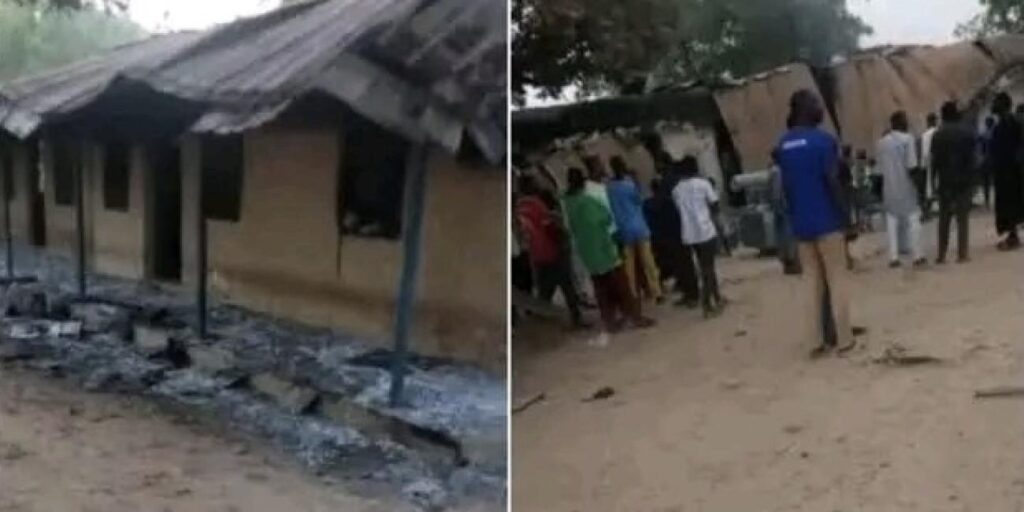
Bandits have reportedly razed a primary school in Dekara community, Borgu Local Government Area of Niger State, despite residents paying a ₦10million levy allegedly imposed by the attackers in exchange for protection from further violence, highlighting the alarming grip criminal gangs now wield over vulnerable rural communities.
The incident, which has reignited concerns over the worsening security crisis in parts of Niger State, was disclosed by security analyst Bakatsine in a post on his verified X handle on Saturday.
According to him, the attackers, believed to have emerged from the Kainji Lake National Park, stormed the community on Wednesday and set Central Primary School, Dekara, ablaze, reducing the educational facility to ashes despite earlier assurances that the settlement would be spared further attacks.
Bakatsine revealed that residents had painstakingly raised and paid the ₦10million demanded by the armed group after receiving threats of an impending invasion. The payment, locals reportedly believed, would guarantee their safety and preserve what remained of peace in the community.
However, in a grim reminder of the lawlessness that now afflicts many rural settlements, the gunmen allegedly reneged on their promises and proceeded to destroy the school’s buildings by fire.
“Bandits have reportedly razed Central Primary School, Dekara community, in Borgu LGA of Niger State, despite community paying a ₦10 million levy imposed on them,” Bakatsine wrote while sharing photographs of the burnt structures.
He added: “The attackers, said to have emerged from the Kainji Lake National Park, stormed the town on Wednesday and set the school ablaze. Residents had raised and paid the money after threats of attack, following assurances they would be spared further violence.”
Describing the development as a troubling reflection of the growing influence wielded by armed groups over isolated communities, Bakatsine lamented that compliance with criminal demands no longer guarantees safety or survival.
“The destruction of the school despite compliance raises troubling questions about the growing influence armed groups wield over vulnerable communities. When criminals impose taxes and still unleash violence, hope becomes the next casualty,” he stated.
The attack underscores an increasingly dangerous pattern across Nigeria’s North-Central and North-West regions, where armed groups have institutionalised extortion, compelling villagers to surrender millions of naira, food supplies, motorcycles, livestock and other valuables under threats of deadly reprisals.
Communities that fail to comply with such demands have frequently suffered brutal consequences, including killings, mass abductions, arson, looting and large-scale displacement, leaving residents trapped between fear and abandonment.
Security experts have repeatedly warned that the extortion of rural communities has evolved into a parallel system of illegal taxation, enabling criminal networks to finance their operations while steadily eroding the authority and legitimacy of the Nigerian state in remote areas.
Niger State remains one of the regions hardest hit by the scourge of banditry, with several local government areas enduring relentless attacks on villages, schools, farmers and commuters. The persistent violence has devastated livelihoods, disrupted agricultural activities and deepened humanitarian concerns across affected communities.
Parts of Borgu Local Government Area, particularly settlements bordering the vast Kainji Lake National Park, have become increasingly exposed to insecurity due to the dense forest terrain, which security agencies have long identified as a strategic sanctuary for armed groups operating across Niger, Kwara and neighbouring states.
The destruction of Central Primary School, Dekara, has further amplified concerns over the safety of educational institutions in conflict-ridden communities, as schools continue to bear the heavy burden of Nigeria’s protracted insecurity crisis, depriving countless children of access to education and dimming hopes for a more secure future.
For many residents, the latest attack is yet another painful reminder that even after paying heavily for peace, violence remains an ever-present spectre, reinforcing the disturbing perception that, in some parts of the country, criminal decrees increasingly rival the authority of the state itself.