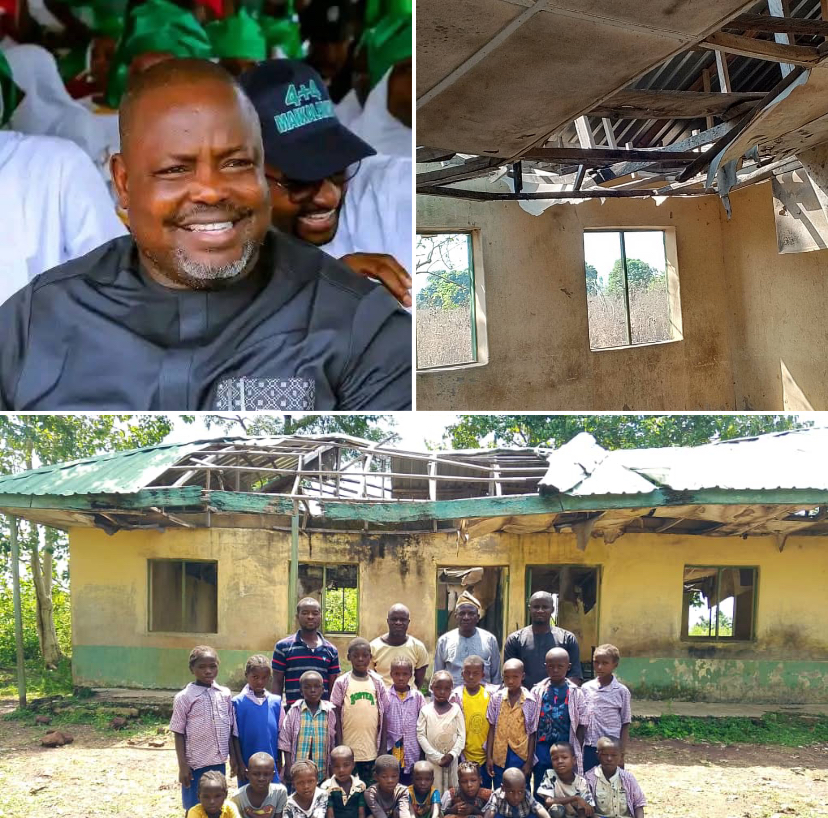
Anger is boiling over in Kwali Area Council of the Federal Capital Territory (FCT) as residents openly accuse the council chairman, Danladi Chiya, of abandoning governance while allegedly splurging public resources on vehicles for political loyalists who attend party events.
Investigations by Chronicles Reporters, based on findings from civic accountability group MonitNG, reveal that basic public infrastructure across the council, particularly primary schools has been left in ruins, even as residents say the chairman prioritises political patronage over the welfare of children.
At LEA Primary School Chida in Wako Ward, the scale of neglect is stark. A recent rainstorm accompanied by strong winds ripped off classroom roofs, shattered walls, and rendered the entire school unsafe. The buildings now stand dangerously exposed, forcing pupils to remain at home for weeks.
Inside the school, teachers are left with broken desks, torn chairs, and rain-soaked teaching materials. Most classrooms are unusable, and learning has completely stopped. Residents told MonitNG that the school no longer qualifies as a learning environment and now poses a serious threat to the safety of both pupils and teachers.
“This is what our chairman calls leadership,” a resident said. “While our children sit at home because there is no classroom, he is busy buying cars for party boys who follow him from one event to another.”
Community members said several complaints and petitions were submitted to the Kwali Area Council, but no meaningful response followed. Instead, they allege that the chairman has been more visible at political gatherings than in affected communities.
The outrage is not limited to Chida.
At LEA Primary School Yebu, which serves three neighbouring communities, conditions are equally dire. Classrooms are plagued by leaking roofs, falling ceiling boards, and flooded floors whenever it rains. Many pupils have reportedly stopped attending school entirely due to fear of injury.
Residents further alleged that abandoned classrooms have become safe havens for hoodlums who use the school premises after hours to smoke Indian hemp and engage in other criminal activities, raising serious security concerns.
“What kind of council is this?” another resident asked. “Our schools are now drug dens, yet the chairman is distributing cars to loyalists. This is a total collapse of responsibility.”
The situation in Kwali has drawn renewed attention to governance priorities within the FCT. While authorities at the federal level announce billions of naira in education spending, satellite communities remain largely excluded from any visible intervention.
UBEC recently announced the release of ₦141 billion to 27 states for basic education infrastructure. In addition, FCT Minister Nyesom Wike said 73 government secondary schools are currently undergoing rehabilitation, with 33 more projects in the pipeline. However, residents of Kwali say these figures mean nothing when primary schools in their communities are falling apart.
Environmental factors have also worsened the crisis. Continuous deforestation in Kwali and surrounding areas has exposed school structures to destructive winds, yet residents say no preventive measures have been taken by the council.
Senator Ireti Kingibe, who represents the FCT at the National Assembly, has also been criticised for what residents describe as silence and inaction on the education crisis in rural Abuja, despite massive UBEC allocations meant to improve basic education.
According to MonitNG, eight out of every ten satellite community schools visited across the FCT are in deplorable condition—an indictment of systemic failure at both the council and territorial levels.
Education advocates warn that prolonged neglect will push many children permanently out of school, worsening learning poverty, trauma, and social vulnerability.
Residents of Kwali are now demanding accountability. They are calling on FCT Minister Nyesom Wike, Senator Ireti Kingibe, the Universal Basic Education Commission, and anti-corruption agencies to investigate how council resources are being spent and why children are being denied safe classrooms.
For many in Kwali, the anger is no longer just about collapsing schools it is about a leadership that, they say, celebrates political loyalty with cars while presiding over a council sinking into decay.