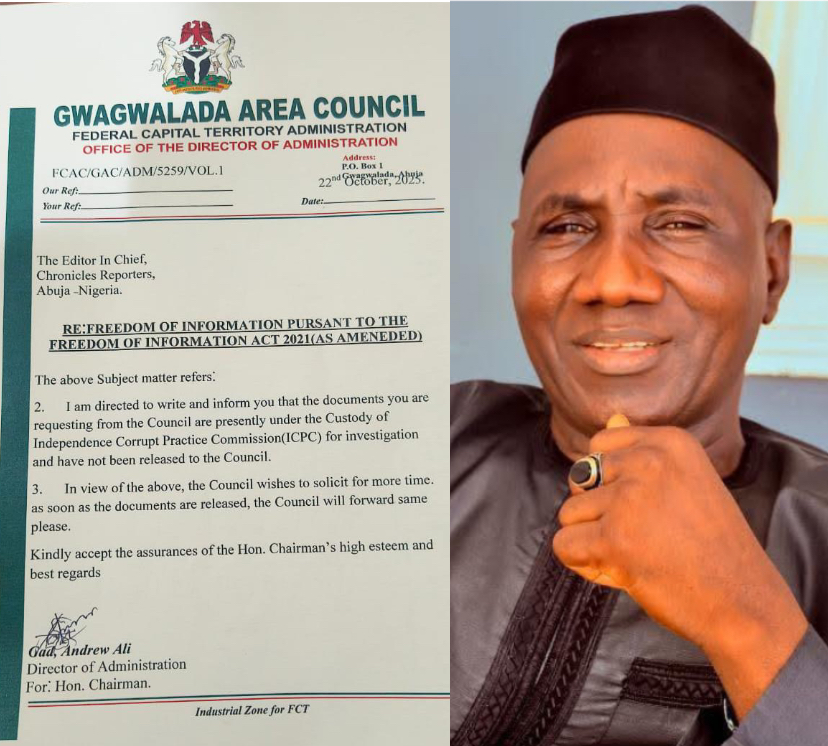
In a development that underscores the ongoing struggle for transparency and accountability in local governance, Chronicles Reporters has received an official response from the Gwagwalada Area Council following its Freedom of Information (FOI) request dated October 6, 2025, pursuant to the provisions of the Freedom of Information Act, 2011 (as amended).
The letter, signed by Mr. Andrew Alt, Director of Administration, on behalf of the Executive Chairman, acknowledged receipt of the request but claimed that the requested financial and administrative records “are presently under the custody of the Independent Corrupt Practices and Other Related Offences Commission (ICPC) for investigation and have not been released to the Council.”
The response, referenced FCAC/GAC/ADM/5259/VOL.1, further appealed for more time, stating that the documents would be transmitted “as soon as the ICPC releases them.”
However, legal and media accountability experts have described the Council’s reply as inadequate, evasive, and non-compliant with the statutory obligations of public institutions under the Freedom of Information Act.
The request, submitted by Chronicles Reporters under the signature of its Investigative Correspondent, Manasseh B. Paul, sought access to key public records covering 2021 to 2024, including:
• Council budgets, allocations, and IGR utilization reports
• Procurement records and awarded contracts
• Nominal roll and staff organogram
• Project completion reports in education, health, sanitation, and rural infrastructure
The request was made as part of Chronicles Reporters’ ongoing investigative series titled “Transparency at the Grassroots: Local Government Accountability in the FCT.”
While the Council’s acknowledgment of the request is procedurally commendable, the explanation provided falls short of the transparency requirements stipulated under the FOI Act.
Legal analysts point to Section 4 of the FOI Act, which mandates that requested information must be made available within seven (7) days, except where valid exemptions apply. Moreover, Section 7(1)requires that where information is withheld, the public institution must explicitly state the grounds for denial, referencing the relevant subsection of the Act that justifies such refusal.
In this case, the Gwagwalada Area Council merely stated that the documents are “with the ICPC,” without providing:
1. Evidence of an ongoing investigation or formal communication from the ICPC indicating that the release of the requested documents would obstruct justice;
2. An explanation of the specific nature of the investigation or the extent to which it affects public access to the records; and
3. A timeframe or legal justification for the delay in providing the requested information.
These omissions, legal experts argue, do not meet the standard of a lawful exemptionunder Sections 11–17 of the FOI Act, which define conditions under which information may be lawfully withheld — such as national security, trade secrets, or matters prejudicial to law enforcement operations.
Counsel Reacts: “This Is a Test Case for Accountability”
In a firm response, Chronicles Reporters’ legal counsel, Barrister Yinka Oyesomi, emphasized that the media organization would not relent in pursuing the case to its logical conclusion.
“The Freedom of Information Act is not a decorative legislation — it is a binding statute that compels transparency and accountability in governance. The response from Gwagwalada Area Council, while polite, fails to satisfy the legal requirements of disclosure or lawful exemption.
We are exploring all necessary legal remedies, including writing directly to the ICPC and EFCC to confirm whether any active investigation justifies withholding these documents,” Barrister Oyesomi stated.
He further noted that even if an investigation is ongoing, Section 12(2) of the FOI Act provides that only specific portions of information that could “prejudice an investigation” may be withheld, not the entire body of requested records.
As a watchdog organization dedicated to promoting ethical governance and informed citizenry, Chronicles Reporters maintains that public accountability cannot be suspended under the guise of investigation — especially when such investigations themselves are part of the public interest.
“The citizens of Gwagwalada have a right to know how public funds were allocated, spent, and accounted for over the past four years,” said Chronicles Reporters’ Editor-in-Chief.
“Our demand is not political — it is constitutional, professional, and rooted in the right of the people to know how their resources are managed.”
Following the Council’s vague response, Chronicles Reporters has confirmed that it will:
1. Formally write to the ICPC and EFCC to verify whether the requested documents are indeed under investigation and whether releasing them would obstruct justice.
2. File a pre-action notice in line with Section 20 of the FOI Act to compel compliance through the Federal High Court if the Council fails to provide a clear, lawful response within the next seven (7) working days.
3. Publish a detailed exposé on FOI compliance levels across all six Area Councils of the FCT as part of a broader accountability index.
This case once again highlights the deep-rooted culture of bureaucratic secrecy that continues to plague grassroots governance in Nigeria. Despite the FOI Act’s enactment over a decade ago, many Local Government Councils still treat public records as private property, undermining citizens’ trust and transparency.
For democracy to thrive at the grassroots, access to information must not be seen as a privilege but as a constitutional right and civic necessity.
The Gwagwalada Area Council’s letter may acknowledge the existence of public records, but its failure to provide specific legal justification or evidence of an ICPC-imposed restriction raises more red flags than clarity.
As Chronicles Reporters and its legal team prepare to escalate the matter, this test of transparency in Gwagwalada may soon set a precedent for how far local councils can go in evading public scrutiny — and how firmly the press will stand to hold them accountable.