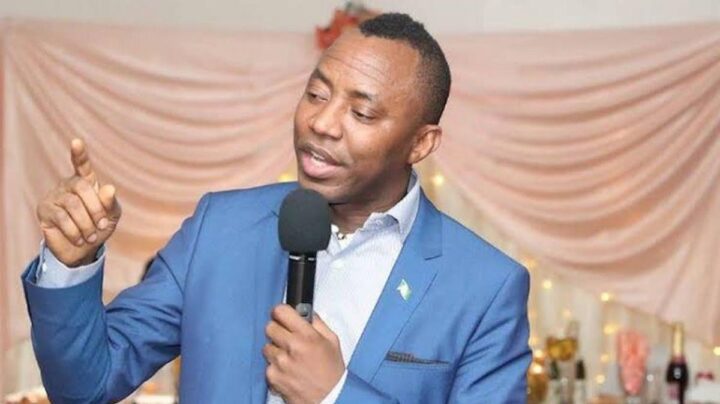
The presidential candidate of the African Action Congress (AAC) and human rights activist, Omoyele Sowore, has accused Nigerians of contributing to the country’s worsening condition by defending corrupt and incompetent politicians along ethnic, religious, tribal and regional lines, warning that the nation’s crisis goes beyond bad leadership.
Sowore made the remarks on Wednesday during an appearance on the Berekete Family programme, where he identified what he described as a serious crisis of followership, widespread inequality, corruption and the failure to embrace modern technology as some of the major obstacles to Nigeria’s development.
The activist argued that although Nigeria has a leadership problem, citizens must also accept responsibility for sustaining a political system that allows incompetent and corrupt individuals to remain in positions of authority.
According to him, many Nigerians deliberately refuse to condemn wrongdoing when those responsible are from their villages, ethnic groups, religious communities or political parties, even when their actions negatively affect the country.
“We all know that Nigeria has a leadership problem. Even when we are sitting in our houses, we know that we have a leadership problem. But it is not only a leadership problem; we also have a followership problem,” he said.
Explaining what he meant by a followership problem, Sowore said some citizens protect politicians because they benefit from their activities or believe they have an obligation to defend people who share their identities.
“When things are bad, we say it is not from my village, it is not from my church, it is not from my ethnicity. We will fight to keep bad leaders because we are benefiting from them. That is a followership problem.
“When you see the truth, you refuse to speak because the truth will affect your bottom line. That is how we have reached where we are today,” he added.
He maintained that Nigeria cannot achieve meaningful progress if citizens continue to prioritise personal benefits, ethnic loyalty and religious sentiments over competence, integrity and accountability in choosing their leaders.
Sowore argued that Nigerians must develop the courage to question those in power and demand accountability rather than defending political officeholders regardless of their performance.
The AAC presidential candidate also criticised the political system for what he described as the manipulation of youth representation, questioning the practice of describing elderly politicians as youth leaders when the country needs a new generation of progressive and visionary leadership.
He called for a fundamental change in the country’s political culture, insisting that leadership positions should be occupied by individuals with the capacity, exposure and ideas to address Nigeria’s challenges.
Addressing the distinction between literacy and education, Sowore argued that possessing academic qualifications or the ability to read and write does not automatically mean an individual has the exposure, understanding and vision required to lead a country.
“Literacy is learning how to read and write. Education is about exposure, having a mission and vision, and understanding how things work around you. That is why you see some people who have PhDs but are not educated in the real sense of understanding the world,” he said.
He also accused some Nigerian academics of abandoning their responsibility to protect democratic values, alleging that individuals who should defend electoral integrity have instead become involved in manipulating elections and announcing disputed results.
Sowore further insisted that Nigeria needs leaders who can be trusted, regardless of their religious beliefs, ethnic backgrounds or places of origin.
He urged Nigerians to abandon the practice of selecting political leaders simply because they belong to the same religious community, ethnic group or geographical area, arguing that such sentiments have repeatedly produced poor governance.
“We need leaders we can trust. They do not necessarily have to come from our religion or our village. We have tried leaders from our villages, and they have turned Nigeria into a hamlet,” he said.
The activist also identified vision as one of the most important qualities required of anyone seeking political leadership, explaining that a visionary leader must possess the ability to identify opportunities, imagine possibilities and develop practical strategies for transforming society.
Using Dubai as an example of what visionary leadership could achieve, Sowore said leaders should be able to look at seemingly undeveloped environments and recognise their potential for transformation.
He explained that Nigeria needs leaders capable of turning deserts into cities, barren lands into forests, communities without schools into university centres and areas lacking basic infrastructure into modern settlements.
“Vision is not prophecy. Vision is when you look at a place and imagine what it can become. When you look at a village and see a city, when you look at a desert and see a river, when you look at barren land and see a forest, when you look at a place without a school and imagine a university, or a place used as a shrine and imagine a hospital.
“Those are the kinds of people we need as leaders,” he said.
Sowore further stressed that Nigerian leaders must be educated, knowledgeable and exposed to developments across the world, particularly in science and technology.
He argued that the country cannot compete with developed nations or achieve meaningful transformation if those entrusted with political authority lack an understanding of modern innovations and the role of technology in national development.
He also criticised the concentration of the country’s resources and opportunities in the hands of powerful individuals, raising concerns about inequality, corruption and the exploitation of Nigeria’s mineral wealth.
The activist’s remarks centred on the need for a fundamental change in both leadership and citizens’ attitudes, insisting that national development would remain difficult as long as Nigerians continue to defend wrongdoing, tolerate corruption and place loyalty to individuals above the collective interest of the country.