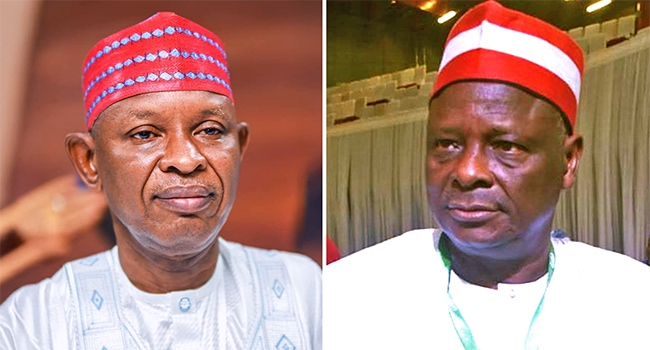
Former Kano State Governor and Vice-Presidential candidate of the Nigeria Democratic Congress (NDC), Rabiu Musa Kwankwaso, has accused his successor, Governor Abba Kabir Yusuf, of allegedly using anti-corruption agencies and other government institutions to weaken his political influence and frustrate his camp ahead of the 2027 general elections.
Kwankwaso also accused the Kano State governor of orchestrating politically motivated campaigns aimed at dragging him and members of his family into public controversy in an attempt to damage the reputation he has built over several decades.
The former governor made the allegations in a statement issued on Friday, November 27, expressing concern over the worsening relationship between him and Yusuf, whom he accused of deploying government institutions and sections of the media against him.
Kwankwaso recalled that Yusuf had served under him in several capacities, including as his Personal Assistant, Principal Private Secretary and Commissioner, adding that he was also the political movement’s preferred candidate in the 2019 and 2023 governorship elections.
According to him, Yusuf eventually emerged victorious in the 2023 election through the collective efforts of the political structure and supporters of the Kwankwasiyya movement.
He described their relationship as one spanning 43 years, alleging that the trust and access he extended to the governor had been abused.
“The longstanding relationship of 43 years with him and trust I reposed in him afforded him access to information and insight into the value I place on personal integrity, trust that has, regrettably, been misused and abused,” Kwankwaso stated.
The NDC vice-presidential candidate alleged that Yusuf personally approached the Economic and Financial Crimes Commission (EFCC) several months ago with a formal request to investigate him but turned to another organisation after allegedly failing to get the anti-graft agency to act as desired.
“It is on this basis that I believe he is determined to drag me and my family into public controversy by leveraging reputable government agencies, particularly the EFCC, in an attempt to tarnish the public image I have spent nearly fifty years building,” he said.
“We believe that some months ago the Governor personally submitted a formal request to the EFCC seeking to come after me.
“After failing to compel the Commission, owing to its institutional integrity and established procedures, he resorted to a little-known body called the Society for Anti-Corruption and Good Governance Initiative (SACGGI).”
Kwankwaso further questioned the credibility and legal status of the organisation, alleging that it was neither registered with the Corporate Affairs Commission (CAC) nor had any verifiable digital presence or formal affiliation with the EFCC or the Independent Corrupt Practices and Other Related Offences Commission (ICPC).
He claimed that the organisation was subsequently used to organise physical protests at the EFCC headquarters in an alleged attempt to pressure the commission into commencing action against him.
“It was used to stage physical protests at the EFCC premises in a deliberate attempt to exert pressure on the agency,” he alleged.
The former governor also accused Yusuf and some members of his cabinet of using the media to advance what he described as a coordinated campaign against his reputation.
He alleged that information was being selectively leaked and amplified through media organisations and public platforms to create a negative impression about him and his political associates.
Kwankwaso linked the alleged actions to the growing political realignments ahead of the 2027 general elections, arguing that the developments were designed to distract his camp, undermine its credibility and weaken its chances of securing electoral victories.
“Coming as it does within the context of the electioneering season, these actions appear calculated to distract attention from substantive issues, undermine our credibility, and weaken our capacity to contest and win elections in 2027,” he stated.
He warned that the alleged activities were also capable of heightening political tension and threatening the peace and security of Kano State.
Kwankwaso further alleged that the purported campaign was not restricted to him but had extended to other candidates seeking elective positions under his political camp, particularly the NDC’s Kano State governorship candidate, Comrade Aminu Abdussalam.
He claimed that Abdussalam was currently defending his candidature before the Independent National Electoral Commission (INEC) and the courts, accusing the Kano State Government of allegedly attempting to influence institutions to frustrate his participation in the 2027 governorship election.
“The campaign is not limited to me and my candidature; it extends to other candidates, particularly the Kano State gubernatorial candidate, Comrade Aminu Abdussalam, who is currently defending his ticket before INEC and the courts,” he said.
“This constitutes a further attempt by the Governor to manipulate elements within reputable institutions, INEC and the judiciary, to prevent the publication of our candidate’s name and ultimately bar him from contesting the 2027 general election, so that the Governor may run unopposed,” Kwankwaso alleged.
The accusations come amid an escalating political disagreement between the two former allies following Yusuf’s defection from the New Nigeria Peoples Party (NNPP) to the ruling All Progressives Congress (APC) in January 2026.
Yusuf, who rose to political prominence through the Kwankwasiyya movement established by Kwankwaso, was widely regarded as the former governor’s political protégé.
Kwankwaso played a significant role in Yusuf’s emergence as the NNPP governorship candidate in the 2019 and 2023 elections, with the latter eventually winning the Kano governorship election in 2023.
However, their relationship reportedly began deteriorating amid disagreements over Yusuf’s political independence and growing pressure on him to abandon the NNPP for the APC.
The defection deepened the political division between the former allies, with both camps now pursuing different political interests ahead of the 2027 elections.
Kwankwaso’s latest allegations have further exposed the depth of the political crisis in Kano, particularly over control of the state’s political structure and the battle for electoral dominance in 2027.
The allegations against Governor Yusuf, the EFCC and other institutions remain claims made by Kwankwaso in his statement.