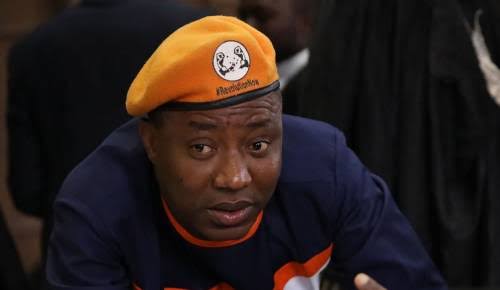
Omoyele Sowore, presidential candidate of the African Action Congress (AAC), has vowed to reverse President Bola Ahmed Tinubu’s fuel subsidy removal policy on his first day in office if elected president in the 2027 general elections, describing the subsidy regime as a scam.
Sowore also promised that public officials who divert funds meant for schools, hospitals, roads and other public infrastructure would be prosecuted and sent to prison, arguing that failure to punish individuals who steal public resources amounts to bad public policy.
The human rights activist and AAC presidential candidate made the declarations during a recent interview with Symfoni TV, where he outlined his proposed policies and approach to governing Nigeria if elected in 2027.
Responding to a question on whether he would make a major policy announcement immediately after his inauguration, similar to Tinubu’s decision to remove the petrol subsidy during his May 29, 2023 inauguration, Sowore said he would reverse the policy immediately.
“On the first day I’ve been sworn in, I’m also going to reverse Tinubu’s policy. That’s to reinstate whatever they call subsidy,” he said.
Sowore argued that the fuel subsidy arrangement was fraudulent, insisting that whatever mechanism had previously kept petrol prices at about N400 or below should be restored.
“I don’t believe there’s subsidy. We found out that it’s all a scam. Whatever it is that is called subsidy, whatever was there that kept petrol at N400 or less, that will be reinstated immediately,” he added.
Tinubu announced the removal of the petrol subsidy during his inauguration on May 29, 2023, a decision that was followed by a sharp increase in petrol prices, transportation costs and the cost of living, amid growing economic pressure on millions of Nigerians.
Sowore further condemned the policies of the Tinubu administration on the economy, energy, education and security, saying he would not retain any of the administration’s policies if elected president.
“There’s no policy of this present administration, the regime, that I would touch with a six-foot-tall pole. Never,” he said.
“His policy on energy is a failure. His policy on education, which is giving loans to people who can’t afford to find jobs and pay back, is a failure. His policy on the economy is a failure. His security policy is the worst.”
On corruption, the AAC candidate said his administration would prosecute public officials accused of stealing public funds, particularly money allocated to essential services and infrastructure.
Sowore, however, stressed that imprisonment would not be deployed as a political weapon against opponents or critics, insisting that only people who commit crimes should face punishment under the law.
“Sending people to prison is not public policy. But not sending thieves to jail is bad public policy,” he said.
He said officials who divert money meant for schools, hospitals and roads to acquire personal properties in Nigeria or abroad must be held accountable.
“If you took the money that is meant for schools, hospitals, you know, and for the development of highways, and you go and build a mansion in Europe or Dubai or even Abuja, if we don’t send you to jail, we are not serious,” he said.
Sowore also rejected criticism that he lacked the political experience required to govern Nigeria, arguing that several of the policies he proposed during the 2019 presidential election had subsequently become part of national political discussions.
According to him, his previous proposals on insecurity, electricity, economic diversification, workers’ wages and other national challenges had increasingly been adopted or discussed by politicians and successive governments.
He said his political agenda was built around the acronym “SPICER HEAT,” which he introduced during his 2019 presidential campaign.
The framework covers security, power, infrastructure, the economy, anti-corruption, restructuring, health, education, agriculture, technology and tourism.
Sowore said the framework remained relevant to Nigeria’s present challenges, although some aspects would require adjustments to reflect changing economic and security conditions.
On insecurity, he expressed support for decentralised policing, advocating policing structures at the federal, state, local government, campus, city and community levels.
He said the various policing units should operate under nationally established training and operational standards, while the Federal Government should retain the authority to intervene where security personnel violate human rights or abuse their powers.
“I support state police, I support campus police, I support city police, I support town-to-town policing. The only thing that must be there is that the training must be done centrally and by national standards,” he said.
However, Sowore warned that state police could worsen human rights abuses if proper safeguards were not put in place, citing alleged abuses associated with vigilante groups and other quasi-security organisations.
He also called for better remuneration for security personnel, arguing that poorly paid officers could become vulnerable to corruption and other forms of abuse.
The AAC candidate proposed redirecting funds currently allocated as security votes to governors towards the direct payment of police salaries, alleging that the existing security-vote system had been abused by some public officials.
“You cannot give guns to people who are hungry. They are just empowered armed robbers,” he said.
On Nigeria’s political structure, Sowore rejected calls for a return to regional government, arguing that the existing state structure could bring government and development closer to citizens if states were given sufficient autonomy.
He said states should be allowed to formulate policies and pursue development programmes based on the needs of their residents.
Sowore argued that a return to regional government could instead concentrate government activities in regional headquarters and make access to public services more difficult for residents in some states.
He cited Ekiti State as an example, arguing that residents could be forced to travel to Ibadan to access certain regional government services.
“I am not in support of regional government. I am in support of the presidential state system,” he said.
The AAC presidential candidate also defended his party’s funding model, saying the party does not depend on wealthy political sponsors or the sale of nomination forms to finance its activities.
According to him, the AAC relies on crowdfunding, donations from members and voluntary contributions.
He said the party operates an online platform through which Nigerians can donate to the party and individual candidates, with the funds used to support its political activities.
Sowore also said party members contribute what he described as “sweat equity,” volunteering their time and resources without financial compensation.
He maintained that the funding model had helped the AAC sustain its political activities over the past eight years without depending on the financial structures associated with conventional political parties.
Speaking on Nigeria’s foreign policy and its role in Africa, Sowore described Nigeria as a critical force in the continent’s political and economic development.
He argued that Nigeria’s inability to resolve its domestic problems had weakened its influence across Africa and maintained that the country’s progress was essential to the advancement of the continent.
“The only way you can pull Africa to the top and to become the best is to make Nigeria the best, because Nigeria, as I often describe, is Africa,” he said.
Sowore likened Nigeria to the trigger of an African pistol, arguing that developments in Nigeria would have consequences for other African countries.
The AAC candidate also dismissed President Tinubu’s Independence Day address, saying he no longer listens to the President’s speeches because he does not believe in his leadership.
Sowore is expected to face other presidential contenders in the 2027 election as he seeks another opportunity to implement the political programme he says he has advocated since his emergence as a presidential candidate.