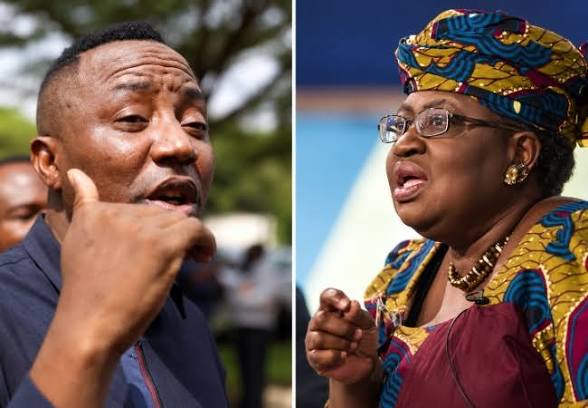
Activist and African Action Congress (AAC) presidential candidate, Omoyele Sowore, has challenged the Director-General of the World Trade Organisation (WTO), Ngozi Okonjo-Iweala, to provide verifiable evidence identifying those responsible for an alleged $2.4 billion fuel subsidy fraud in Nigeria, demanding the release of audit findings, investigation reports and prosecution records relating to the case.
Sowore also questioned the connection between the alleged fraud and the December 2012 abduction of Okonjo-Iweala’s mother, Professor Kamene Okonjo, insisting that the circumstances surrounding the kidnapping and the alleged diversion of public funds should be subjected to independent scrutiny.
The activist’s criticism followed a recent interview in which Okonjo-Iweala recounted how her efforts to expose an alleged $2.4 billion fuel subsidy fraud while serving as Nigeria’s Minister of Finance under former President Goodluck Jonathan purportedly led to threats against her and the kidnapping of her mother.
During the interview with Bloomberg Television journalist Francine Lacqua on the Leaders programme, Okonjo-Iweala said the abductors demanded that she resign from her ministerial position and leave Nigeria in exchange for her mother’s release.
However, Sowore, in a post on X on Sunday, October 18, 2026, questioned whether publicly available evidence established a direct connection between the alleged subsidy fraud and the kidnapping.
He challenged the former finance minister to identify the companies and individuals allegedly implicated in the fraud and explain what became of the investigations into the missing funds.
“During her two terms at the centre of Nigeria’s economic management (where she failed spectacularly), who exactly did she discover was responsible for this multibillion-dollar subsidy fraud?” Sowore wrote.
“Which companies and individuals were implicated? Where are the audit findings, investigation reports and records of prosecution?” he added.
Sowore argued that although Okonjo-Iweala had repeatedly linked her mother’s kidnapping to her anti-corruption efforts, Nigerians deserved access to documentary evidence establishing who allegedly stole the money and what actions were taken to recover it or prosecute those responsible.
He also criticised her book, Fighting Corruption Is Dangerous, in which she recounted her experiences confronting corruption in public office and described the kidnapping of her mother.
According to Sowore, the book presented the abduction as retaliation for her efforts to tackle corruption but failed to establish the identities of those responsible for the alleged $2.4 billion fraud or explain the outcome of the investigations into the matter.
“She also used the book to attack critics, including those of us who publicly challenged her failed economic policies and questioned her record,” Sowore alleged.
The activist maintained that the account of the kidnapping should not automatically be accepted as proof that the alleged subsidy fraud was responsible for the crime without verifiable evidence establishing the connection.
He further questioned what he described as the absence of publicly presented audit findings, investigation reports and prosecution records identifying the alleged beneficiaries of the fraud.
“The central question remains, who stole the alleged $2.4 billion? Where are the audit findings? Who were the implicated companies and individuals? What became of the investigations?” he asked.
“And, most importantly, what verifiable evidence establishes a direct connection between the alleged oil subsidy fraud and her mother’s kidnapping?”
Sowore also referred to police investigations into the abduction, arguing that the accounts surrounding the kidnapping should be assessed against the available investigation records and judicial findings rather than relying exclusively on the narrative that the crime was retaliation for Okonjo-Iweala’s anti-corruption activities.
He alleged that police evidence implicated palace guards, relatives and domestic workers in the circumstances surrounding the abduction. However, the specific roles of the individuals mentioned and the status of any related proceedings would need to be established from the relevant investigation and court records.
Sowore added that, to his knowledge, Okonjo-Iweala had neither publicly challenged the police’s account of the kidnapping nor demanded a fresh, independent investigation to establish an alternative explanation for the crime.
He acknowledged that the police’s account should not be accepted or dismissed without evidence, despite his frequent criticism of the Nigeria Police Force.
The circumstances surrounding Professor Okonjo’s abduction were documented in contemporary media reports, which detailed police investigations, the arrest of suspects and allegations that an insider had provided information that helped the kidnappers plan the operation.
Professor Kamene Okonjo, who was 82 at the time, was abducted from the family residence in Ogwashi-Uku, Delta State, on December 9, 2012.
Her abduction attracted national and international attention because of her daughter’s position as Nigeria’s coordinating minister for the economy and minister of finance.
Reports of the incident indicated that the abductors initially demanded that Okonjo-Iweala resign from her ministerial position and leave the country before subsequently demanding a ransom.
Professor Okonjo was held for several days before escaping from her captors and obtaining assistance to return to safety.
On April 16, 2013, Vanguard reported that the Lagos State Police Command had announced the arrest of eight suspected members of a kidnapping gang linked to the abduction.
The then Lagos State Commissioner of Police, Umar Manko, reportedly said the suspects had confessed to participating in the kidnapping and collecting N13 million in ransom.
Among those identified in the report was Chiejine Onochie, a native of Ogwashi-Uku who had previously worked as a palace guard at the Okonjo family residence before becoming a security guard at Delta State Polytechnic.
According to the newspaper’s account, investigators alleged that Onochie provided members of the gang with information about the family and helped facilitate the operation.
Onochie reportedly told investigators that he targeted Professor Okonjo because her daughter was a federal government minister and he believed the government would assist in paying the ransom.
“I decided to give them Mama Okonjo because I knew her daughter works for the government and if we succeeded in kidnapping her, the Federal Government would assist in paying the ransom,” he was quoted as saying.
The report further stated that Onochie had taken another suspect to the family residence and shown him around before the kidnapping was carried out.
The suspects were reportedly arrested following investigations by the police Special Anti-Robbery Squad, with operations extending to Delta, Edo, Rivers and Enugu states.
The reported police findings provided an account of how investigators linked members of the kidnapping gang to the abduction. However, those accounts, on their own, do not establish whether the alleged fuel subsidy fraud was connected to the crime or whether the kidnapping was ordered by individuals seeking to obstruct an investigation into the missing funds.
Sowore insisted that the questions surrounding the alleged subsidy fraud remained separate from the criminal investigation into the kidnapping unless evidence demonstrated a direct relationship between the two.
He also criticised Bloomberg journalist Francine Lacqua, accusing her of failing to sufficiently scrutinise Okonjo-Iweala’s account during the interview.
According to the activist, journalists interviewing prominent public officials about allegations of corruption and politically sensitive criminal cases should demand documentary evidence and independently examine claims that may shape public understanding of major national events.
His intervention has reopened questions about the transparency of investigations into Nigeria’s controversial fuel subsidy regime, particularly the identification of alleged beneficiaries, the recovery of public funds and the prosecution of individuals suspected of involvement in subsidy-related fraud.
The alleged $2.4 billion fraud remains a central issue in Sowore’s challenge, but his questions do not, by themselves, establish that Okonjo-Iweala’s account of the kidnapping was false or that the alleged fraud did not occur.
The specific audit findings, identities of all individuals and companies implicated in the alleged $2.4 billion fraud, and the final outcomes of the relevant investigations and prosecutions were not established in the material cited in Sowore’s post.
For now, the activist is demanding answers to questions he says remain unresolved: who allegedly benefited from the $2.4 billion, what became of the investigations, and what verifiable evidence connects the alleged fraud to the kidnapping of Professor Kamene Okonjo.