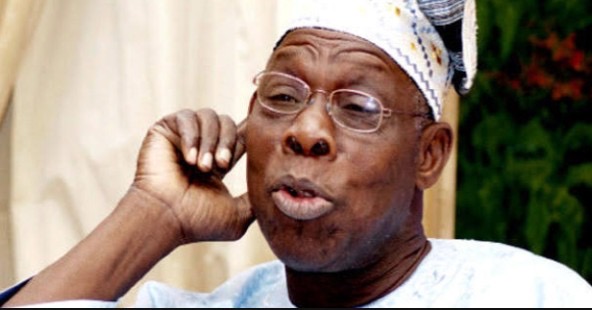
Former President Olusegun Obasanjo has raised concerns over President Bola Tinubu’s proposed $21 billion external borrowing plan, warning that Nigeria’s increasing debt burden could place a heavy financial responsibility on future generations.
Obasanjo made his position known while speaking at the 3rd Ajibosin Annual Symposium in Abeokuta, Ogun State, where discussions focused on Nigeria’s economic challenges and the potential role of artificial intelligence (AI) in addressing national problems.
The former president questioned the country’s economic performance under successive administrations, asking what Nigeria had achieved after decades of governance, particularly in improving its currency value and the living conditions of citizens.
He expressed concern over the depreciation of the naira, widespread poverty and the growing number of out-of-school children, arguing that these challenges raised serious questions about the direction of the country’s economic management.
Obasanjo specifically questioned how the exchange rate had deteriorated to approximately ₦1,500 to the dollar, challenging political leaders to account for the decisions that contributed to the situation.
“What has Nigeria done in 47 years that we now have ₦1,500 to the dollar? What have we done?” he asked.
His comments come amid renewed public attention on the Federal Government’s proposed $21 billion external borrowing plan and concerns about the country’s ability to manage additional debt.
The proposal has also brought attention to the need for the government to demonstrate that funds obtained through borrowing will be invested in projects capable of generating economic benefits and improving the lives of Nigerians.
Nigeria continues to face several economic difficulties, including currency depreciation, rising living costs, food insecurity and inadequate infrastructure, placing additional pressure on the government to justify its borrowing decisions.
Obasanjo warned that the effects of poor economic decisions could extend beyond the present administration, leaving younger and future generations to shoulder the consequences of accumulated national debt.
His remarks also come against the backdrop of President Tinubu’s earlier defence of borrowing, in which the President argued that borrowing was not inherently wrong if properly managed.
Obasanjo’s position underscores the continuing debate over Nigeria’s borrowing strategy, debt sustainability and the responsibility of government to ensure that loans translate into measurable economic development.