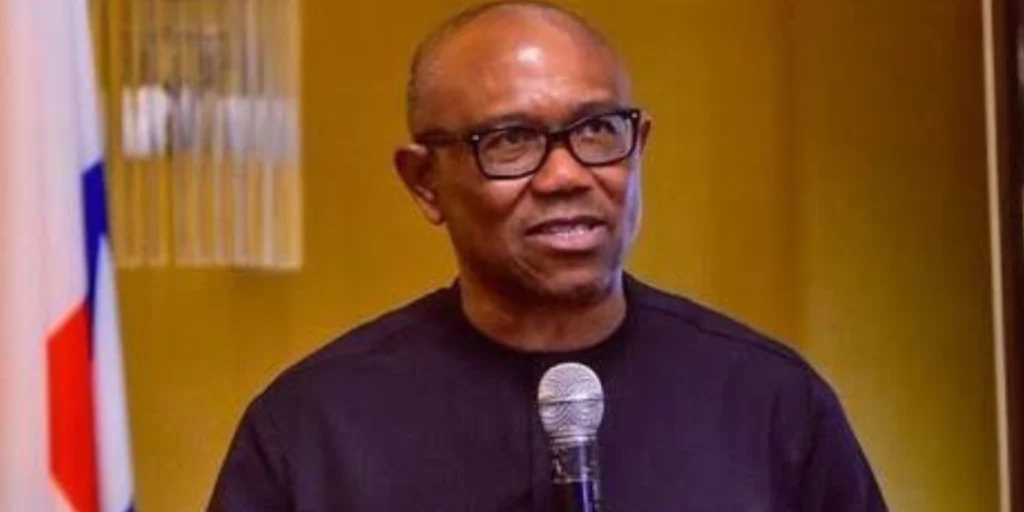
The presidential candidate of the Nigeria Democratic Congress (NDC) for the 2027 general elections, Peter Obi, has urged Nigerians living in the United Kingdom to tell people seeking financial assistance from Nigeria to stop asking for money, arguing that the country must confront corruption and poor governance before meaningful change can occur.
Obi made the call during a town hall meeting with his supporters in the UK on Sunday, where he appealed to Nigerians in the diaspora to support his presidential ambition ahead of the 2027 general elections.
The former governor of Anambra State, who is seeking to unseat President Bola Tinubu, urged Nigerians abroad to encourage their relatives and acquaintances at home to support a political candidate they believe can address the country’s economic and governance challenges.
Speaking during the meeting, Obi argued that Nigerians must stop tolerating a political system in which public resources are allegedly diverted for personal enrichment while citizens struggle to access basic services.
“I need you people and that is why I’m having lunch with you today. This lunch is for you to say, this man came and what he said is the reality of our problem. Let’s work with him,” Obi said.
He added, “You have people at home who are begging you for money. Tell them no. Let’s put somebody who has proven… I said I’m not a saint, but at least I have said something.
“I wasn’t the only person who has been a governor and I challenged people and said, if there is one governor who has saved 10 percent of what I saved, and nobody has.
“So, let’s start with this one who is maybe less corrupt. We are not saying it is all, but let’s not pretend it is not happening.”
Obi, who has consistently campaigned on prudent management of public resources, maintained that Nigeria’s economic difficulties could be addressed if citizens rejected political leaders who, according to him, had failed to prioritise public welfare.
He argued that money allegedly diverted by public officials to acquire properties and other personal assets could have been invested in schools, hospitals and essential public infrastructure.
“That is how the countries change. Countries change by people saying, hey, wait a minute, enough of this. And we know what our problem is. It is that money that they are sharing, that money they are using to buy properties, that is why they don’t build school. It is why they don’t build hospital,” he said.
The former Anambra governor also recalled claims about the state of public institutions in previous generations, contrasting what he described as better access to public services in the past with allegations of corruption and the accumulation of private wealth by some public office holders.
Obi said, “He (not specifying who he was referring to) said when his parents were there, they used to go to hospital. When his parents were there, people were not stealing money to come and buy a house in England.
“People were not stealing money to build a house. You don’t hear people finish being military and they own 50 houses. Now you hear such news. Millions of money are missing.”
He further urged Nigerians to recognise their responsibility in changing the country’s political system, arguing that meaningful national development would require citizens to reject corruption and demand accountability from those in positions of authority.
Obi’s remarks come as political parties and presidential aspirants intensify their mobilisation ahead of the 2027 general elections, with Nigerians living abroad increasingly becoming an important constituency for political engagement, financial support and mobilisation.
However, his appeal has triggered criticism on social media, with some users questioning the implications of asking Nigerians abroad to stop sending money to relatives and other people in the country.
Critics argued that financial assistance from Nigerians in the diaspora remains an important lifeline for millions of people facing economic hardship, particularly families struggling to pay school fees, hospital bills, rent and other essential expenses.
An X user, @Mobola_A_Star, accused Obi of pursuing his presidential ambition at the expense of Nigerians who depend on relatives abroad for financial assistance.
“So, he wants the donation of diaspora people, but the same diaspora people shouldn’t send money home again till he wins,” the user said.
The user further criticised Obi’s remarks, describing them as an attempt to use fear and hopelessness as a campaign strategy and predicting that his supporters would eventually disappear from public discourse after the election.
Another X user, @NduEbitea, condemned the statement, questioning whether Obi’s presidential ambition should influence Nigerians abroad to stop supporting their parents and siblings.
“Senseless talk. So, because of your desperate bid to become president, people should not supporting their parents and siblings again? Can you imagine this man?” the user wrote.
Similarly, @B_Mizack attacked the former governor, making a disparaging comment about his mental health and predicting his defeat in the 2027 presidential election.
“This guy should be checked into a mental health facility after he loses in 2027. And apparently, all the inanities his dumb followers spew on here emanate from him!” the user wrote.
Another critic, @Deshysmalls, suggested that Obi might have been drinking alcohol when he made the statement.
“E sure me say Peter don drink plenty of that Guinness on the table, because only a drunkard will say this,” the user said.
Also reacting, @koobakedah described Obi’s remarks as an act of political desperation, arguing that Nigerians would continue to depend on financial assistance from relatives abroad regardless of who occupies the presidency.
“Obi, how much you go dey pay each Nigerian if you become president? This is desperation,” the user wrote.
The critic added that even a well-managed economy would not eliminate the need for family members in the diaspora to assist their relatives and friends in Nigeria.
“Let me tell you one thing: even if the entire economy of the United States were transferred to Nigeria today, and the leadership of the US or any well-run country in the world started running Nigeria, there would STILL be people in Nigeria who would need financial assistance from family members in the diaspora.
“So, telling people to stop sending money to their friends and family in Nigeria until they vote Tinubu out and vote you in is the highest form of hypocrisy, desperation and ‘I-don’t-know-nothing’ I have ever heard from a politician,” the user added.
Another X user, @abbeykool, accused Obi of promoting division, alleging that the former governor was exploiting divisions along religious, ethnic and family lines in pursuit of political power.
“This lunacy is progressing rapidly. The king of division, always looking for cracks along religious, tribal and now family line. This guy is not well at all,” the user wrote.
Meanwhile, @osazenoo commented, “Obidients learn their toxicity from Obi. Just imagine…,” while @olohunjuedani responded, “It’s obvious.”
The controversy has drawn attention to the relationship between political campaigning, economic hardship and the financial support Nigerians living abroad provide to their families back home.
For many Nigerian households, money sent by relatives in the diaspora helps cover food, education, healthcare, accommodation and other basic needs. Critics of Obi’s remarks argue that asking people abroad to withhold such assistance could worsen the difficulties faced by vulnerable families who have little control over the country’s political leadership.
Others may interpret his comments as an appeal for Nigerians to use their influence to demand accountability and reject political leaders they believe have failed the country.
Nevertheless, the backlash highlights the sensitivity surrounding diaspora remittances and the extent to which political messages can generate controversy when they touch on family obligations and the economic survival of ordinary Nigerians.
Obi has yet to respond to the criticisms contained in the social media reactions presented in the reports.