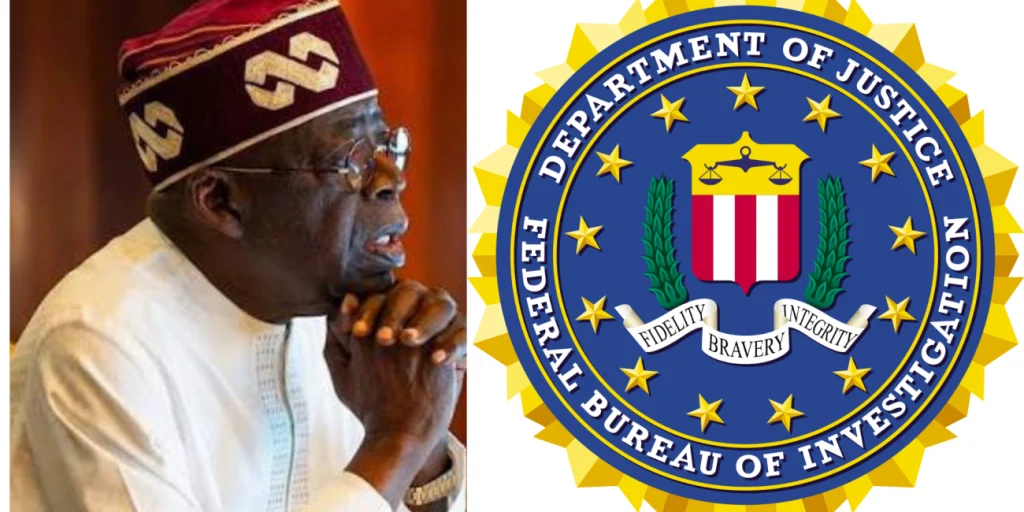
The United States government has asked a federal court in Washington, D.C., to rule in favour of the Federal Bureau of Investigation (FBI) and Drug Enforcement Administration (DEA) in a long-running Freedom of Information Act (FOIA) dispute over records relating to Nigerian President Bola Ahmed Tinubu.
The latest development is contained in a September 23, 2026 filing in Greenspan v. Executive Office for U.S. Attorneys et al., in which the U.S. Attorney’s Office for the District of Columbia urged U.S. District Judge Beryl Howell to grant summary judgment to the FBI and DEA.
The submission was signed by Assistant U.S. Attorney Samantha-Josephine Baker and filed by the office headed by Jeanine Pirro, a longtime ally of U.S. President Donald Trump.
“For these reasons, as well as those in Defendants’ motion (ECF No. 100), the Court should grant Defendants’ motion and enter judgment in favor of the FBI and DEA,” the government said in its filing.
The case centres on records sought by transparency activist Aaron Greenspan through FOIA requests submitted to U.S. government agencies concerning Tinubu, Nigerian businessman Abiodun Agbele and others in connection with a historical investigation into a Chicago-area heroin-trafficking and money-laundering network dating to the late 1980s and early 1990s.
The latest filing does not amount to a judicial finding that Tinubu committed a criminal offence. Rather, it represents the federal agencies’ argument that they have complied with the court’s orders, conducted adequate searches and are legally entitled to withhold or redact portions of the responsive records.
The FBI told the court that it searched for the terms “Bola” and “Tinubu” separately and manually reviewed pages contained in a multi-subject file. The government said the page-by-page review was undertaken in part to address Greenspan’s objections concerning search terms and possible spelling variations.
The agencies further argued that they released information that could reasonably be separated from material protected from disclosure under FOIA.
Among the exemptions relied upon by the government are provisions protecting grand-jury information, pen-register data, internal prosecutorial strategy, confidential sources, investigative techniques and private individuals’ personal information.
The government also invoked FOIA Exemption 7(F), which covers law-enforcement records where disclosure could reasonably be expected to endanger an individual’s life or physical safety.
In defending the FBI’s use of Exemption 5, the government described some of the withheld material as reflecting the “thought process, strategy and legal impressions” of U.S. Attorney’s Office personnel working with federal investigators on criminal cases involving third parties.
The agencies maintain that disclosure of such material could expose protected prosecutorial and investigative deliberations.
The FBI and DEA have produced hundreds of pages in response to the litigation, with portions withheld or redacted under statutory exemptions covering matters including grand-jury secrecy, confidential sources, investigative techniques and personal privacy.
The dispute follows earlier litigation in which the agencies initially relied on what is known as a “Glomar” response, a legal position under which an agency refuses to confirm or deny whether responsive records exist.
On April 8, 2025, Judge Howell rejected the FBI and DEA’s use of that response in relation to the records at issue and directed the agencies to search for and process reasonably segregable, non-exempt material.
The ruling did not order the release of every record and did not determine whether allegations concerning Tinubu were true or whether he had committed a criminal offence.
The litigation has consequently shifted to whether the agencies conducted adequate searches and whether the particular information withheld or redacted falls within exemptions allowed under U.S. law.
Tinubu has also intervened in the proceedings through his lawyers.
In a separate August 28, 2026 filing, his legal team asked the court to uphold the FBI and DEA’s redactions and withholdings, arguing that the records implicate his privacy interests.
The lawyers relied, among other provisions, on FOIA Exemption 7(C), which protects certain personal information contained in law-enforcement records, as well as the Privacy Act.
Tinubu’s lawyers argued that the public interest recognised under FOIA principally concerns understanding the operations and performance of government agencies, rather than obtaining private information about an individual merely because that person is a public figure.
They also disputed claims surrounding an alleged secret investigation or government cover-up and argued that the disclosure request had not demonstrated how releasing identifying information about individuals would expose government misconduct or otherwise advance the public interest recognised under FOIA.
The lawyers further maintained that Tinubu’s later emergence as a public official does not automatically eliminate privacy interests attached to law-enforcement records generated before he became president.
The historical background to the dispute includes a 1993 civil forfeiture proceeding in the United States District Court for the Northern District of Illinois involving approximately US$460,000 held in an account in Tinubu’s name.
Records cited in the litigation describe the funds as being connected to proceeds of narcotics trafficking or transactions prohibited under U.S. law.
The proceeding was a civil forfeiture action, however, and not a criminal conviction of Tinubu. According to the material cited in the litigation, the United States and individual claimants reached an agreement to settle and compromise the action, with the funds ultimately forfeited to the United States.
The Nigerian Presidency has repeatedly stressed this distinction, describing the current Washington proceedings as a civil FOIA records-disclosure dispute rather than a criminal prosecution of Tinubu.
Special Adviser to the President on Information and Strategy, Bayo Onanuga, has also said the court has not found Tinubu guilty of criminal wrongdoing.
The latest controversy follows claims by Greenspan that he has identified three separate U.S. cases connected to the historical investigation.
According to Greenspan, the matters include a 1992 set of criminal indictments involving members of an alleged heroin-trafficking network, a separate case involving Nigerian businessman Abiodun Agbele, and the civil forfeiture proceeding involving funds held in Tinubu’s name.
Greenspan made the claims during an interview with Laolu Akande, founder of Empowered Newswire, on September 23.
“There’s at least three known cases now that are tied to this drug ring,” Greenspan said, while explaining that the matters were connected to his efforts to obtain historical FBI and DEA records.
Greenspan has also raised the possibility of a fourth case involving Tinubu, which he suggested could have been a criminal indictment filed under seal.
He has, however, expressly acknowledged that he has no conclusive evidence that such a sealed indictment exists.
“There could be a fourth. There could be a criminal indictment of Bola Tinubu as well, and that’s what we’re trying to do,” Greenspan said, adding that he had no evidence that such an arrangement had been made and that the possibility remained an open question.
Greenspan has linked his theory to historical investigative material which he says contains detailed references to bank accounts, Tinubu’s wife, possible involvement by his mother, and a Nissan vehicle and its vehicle identification number.
He has argued that the level of detail in the material raises questions about what happened after the investigation, but the available material does not establish that a sealed indictment exists.
The historical investigation also includes records concerning Lee Andrew Edwards and other individuals allegedly linked to a heroin-trafficking network.
Greenspan has cited testimony by Drug Enforcement Administration Special Agent Vincent Balbo in proceedings involving Edwards, claiming that Balbo testified about Abiodun Agbele and the alleged supply of heroin originating from Nigeria.
Those claims form part of Greenspan’s broader effort to obtain government records and should be distinguished from findings made by the court in the present FOIA litigation.
One of the historical documents referenced in the wider litigation is a 2007 order in the separate Indiana criminal case of United States v. Edwards.
That case involved Willie Edwards Jr., who had been convicted in 1994 of heroin-conspiracy and communication-facility offences.
The 2007 order concerned a later challenge to his sentence and dismissed the matter because the court lacked jurisdiction without the required approval from the appeals court.
The FOIA lawsuit itself began after Greenspan filed requests with several U.S. agencies in 2022 and 2023, including the FBI, DEA, CIA, Internal Revenue Service and Executive Office for U.S. Attorneys.
The requests sought historical records relating to Tinubu, Agbele, Edwards, Mueez Akande and others in connection with the alleged drug-trafficking and money-laundering investigation.
After the agencies initially refused to confirm or deny the existence of some responsive records, Greenspan filed the federal lawsuit.
The CIA was subsequently allowed to maintain its Glomar response in the litigation, while Judge Howell rejected similar responses by the FBI and DEA concerning the records at issue and ordered further searches and processing.
The FBI later submitted records to the court under seal for private judicial review.
The present dispute therefore centres not on whether the court has found Tinubu criminally liable, but on whether the FBI and DEA have properly complied with the court’s orders and whether U.S. law permits them to continue withholding or redacting particular portions of the records.
Pirro’s involvement has attracted attention because of her political relationship with Trump.
Trump appointed Pirro interim U.S. Attorney for the District of Columbia in May 2025, while the Senate confirmed her nomination in August 2025.
Before joining the U.S. Attorney’s Office, Pirro spent nearly two decades at Fox News, where she became a prominent supporter of Trump. NPR has described her as a longtime Trump ally and reported that the two had known each other for years.
Trump also pardoned Pirro’s former husband, Albert Pirro, during the final hours of his first presidency.
The case itself, however, predates Pirro’s appointment and has continued through successive stages of litigation.
A source close to the U.S. case described the latest government filing as significant but cautioned against interpreting it as a definitive disclosure concerning Tinubu.
“There is no real smoking gun. US government defending Tinubu strongly; that is even the news in the latest document,” the source said.
The source also characterised Pirro’s involvement in strong political terms, saying, “When you have Jeanine Pirro defending Tinubu. That is the entire Trump administration.”
The comments are the source’s characterisation and do not constitute findings by the court or statements establishing that the Trump administration has personally intervened in the FOIA case.
The U.S. government’s formal position, as contained in the September 23 filing, is that the FBI and DEA conducted reasonable searches, released segregable information and properly withheld the remaining material under federal law.
The court has yet to rule on the government’s request for summary judgment.
The outcome will determine whether the agencies must disclose additional material sought by Greenspan or may continue withholding the disputed portions of the records.
For now, the proceedings remain a civil dispute over access to U.S. government records. Neither the FOIA lawsuit nor the September 23 government filing constitutes a criminal prosecution or conviction of President Bola Ahmed Tinubu.