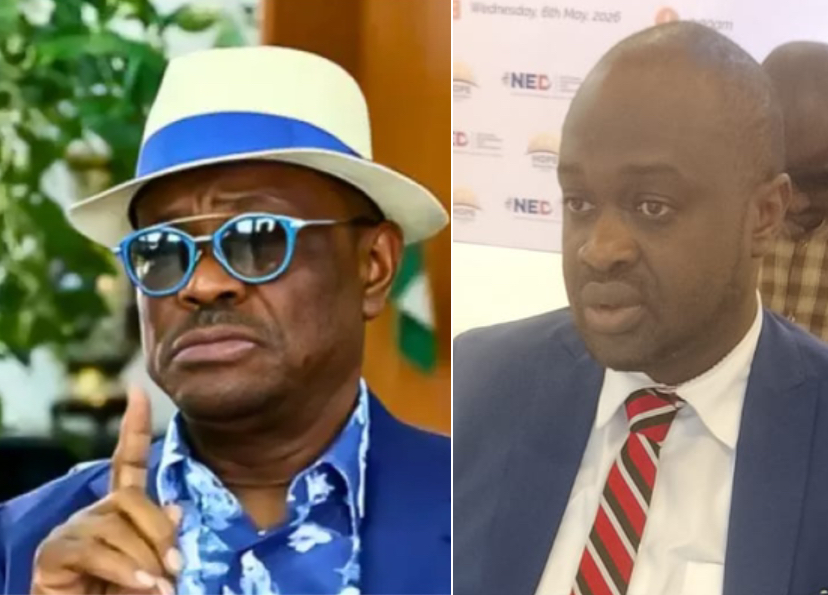
The directive by the Minister of the Federal Capital Territory, Nyesom Wike, for the immediate demolition of houses and other structures obstructing designated waterways in Maitama and other flood-prone parts of Abuja has triggered a fresh legal debate over the limits of executive power, property rights and the requirement for due process.
Wike issued the directive on Tuesday, August 18, 2026, following an inspection of areas affected by flooding in the Federal Capital Territory. He directed the FCT Department of Development Control to commence the demolition of structures obstructing water channels and complete the exercise by Saturday. Reports from the scene indicate that demolition activities have already commenced in parts of Maitama.
While the FCT Administration has justified the exercise as necessary to restore drainage channels, prevent flooding and protect lives and property, legal practitioner and public-interest advocate Samuel Ihensekhien has questioned whether the directive can lawfully be implemented without compliance with constitutional safeguards and the procedures established by planning and land laws.
In a legal position made available on Tuesday and dated Abuja, August 18, Barrister Samuel Ihensekhien argued that the protection of lives, property and the enforcement of the Abuja Master Plan are legitimate governmental objectives, but maintained that such objectives must be pursued within the Constitution and applicable statutes.
According to him, the central legal question is not whether the government has the power to remove structures unlawfully erected on waterways, but whether such power can be exercised through an immediate demolition directive without giving affected property owners the statutory notices and opportunities required by law.
He argued that Section 43 of the 1999 Constitution guarantees citizens the right to acquire and own immovable property anywhere in Nigeria, stressing that the existence of a public-interest objective does not, by itself, extinguish proprietary interests without lawful procedure.
Barrister Samuel Ihensekhien further relied on Section 44 of the Constitution, which regulates compulsory acquisition of property and provides constitutional safeguards including compensation and access to a court, tribunal or other competent body where applicable. The constitutional provision, however, also contains exceptions, including laws dealing with dangerous property and penalties or forfeitures for breaches of law.
He therefore contended that where the government intends to remove privately owned buildings, each case should be examined according to the applicable law rather than treated as automatically subject to destruction solely on the basis of a ministerial announcement.
He also raised concerns under Section 36 of the Constitution, arguing that affected owners should have an opportunity to know the allegation against their properties, present building approvals and other relevant documents, and make representations where their civil rights and obligations are being determined.
He specifically questioned the legality of demolishing properties immediately after inspection without first establishing, on a case-by-case basis, whether the structures are actually located on designated waterways, drainage corridors or right-of-way areas, whether approvals were issued, and whether the owners had previously received notices from the relevant FCT authorities.
Another major part of the legal argument concerns the Nigerian Urban and Regional Planning Act. Barrister Samuel Ihensekhien maintained that planning enforcement is governed by statutory procedures involving notices and opportunities for compliance or challenge, rather than an instantaneous demolition process.
He argued that the relevant enforcement provisions require authorities to follow prescribed steps before demolition and that affected persons should not be deprived of the opportunity to challenge an enforcement decision.
The Nigerian urban planning framework contains provisions dealing with notices, enforcement and the removal of structures, as well as provisions relating to acquisition and compensation. The legislation also provides that compulsory acquisition connected with planned development is to be handled in accordance with the Land Use Act and applicable compensation rules.
Barrister Samuel Ihensekhien consequently argued that an executive directive ordering immediate demolition cannot be allowed to substitute for statutory procedures where those procedures apply.
He further questioned the role of the FCT Urban and Regional Planning Tribunal in disputes arising from planning enforcement, arguing that affected property owners should have access to the statutory dispute-resolution mechanisms available to them rather than being confronted with demolition before their objections can be considered.
He also raised the issue of legitimate expectation, particularly in circumstances where buildings may have been developed with the knowledge, supervision, monitoring or apparent acquiescence of FCT agencies responsible for development control.
According to him, where government agencies monitored construction activities or allowed structures to remain for substantial periods without enforcement action, affected owners may reasonably argue that government conduct created expectations concerning the status of their developments.
He maintained that the government should therefore establish the history of each affected property, including approvals, inspections, notices, correspondence, development-control records and any previous enforcement action, before resorting to demolition.
The argument also extends to the Minister’s powers under the Land Use Act. Barrister Samuel Ihensekhien contended that the Minister’s authority over land in the FCT does not amount to an unrestricted power to destroy buildings and that where government seeks to acquire or revoke interests in land for public purposes, the relevant statutory procedures and compensation requirements must be respected.
Existing Nigerian law provides for compensation in circumstances involving revocation or compulsory acquisition of interests in land, while the Constitution guarantees access to a court or competent tribunal concerning compensation in applicable compulsory-acquisition cases.
Barrister Samuel Ihensekhien further referred to judicial decisions in the FCT which, according to him, have treated compliance with statutory demolition notices as a condition precedent to lawful enforcement action.
He argued that authorities cannot simply mark a building, issue an informal warning or rely on a ministerial directive and proceed to demolish the structure without following the applicable statutory process.
The legal practitioner also invoked the broader principle of the rule of law, stressing that government officials are themselves bound by the laws they are empowered to enforce.
His position comes as the FCT Administration moves against buildings identified as obstructing waterways following flooding in Abuja. Multiple reports on Tuesday confirmed that Wike ordered the immediate removal of structures blocking designated water channels and that the Development Control Department had begun acting on the directive.
The controversy therefore places two competing public interests at the centre of the debate: the government’s responsibility to prevent flooding and protect residents, and the obligation of government agencies to respect property rights and due process.
Barrister Samuel Ihensekhien acknowledged that no property owner should be permitted to obstruct a lawful drainage channel or build in an area prohibited by an approved planning scheme. However, he argued that enforcement must still be conducted in accordance with the law.
He maintained that where a property genuinely obstructs a designated waterway, the government can take appropriate enforcement action, but must first establish the legal status of the property and follow the applicable statutory process.
He also argued that the fact that a property may belong to a senator, businessman, civil servant or any other influential individual should neither protect it from lawful enforcement nor make it subject to arbitrary treatment.
In his view, the same legal standard should apply to every property owner.
The lawyer said affected owners whose properties are demolished without lawful procedure may approach the courts for appropriate remedies, including declarations concerning the legality of the government’s action, injunctions where available, enforcement of fundamental rights and claims for damages or compensation where legally established.
He stressed that the objective of protecting Abuja from flooding does not give government officials a licence to disregard the Constitution, legislation or judicial authority.
“The issue is not whether government should protect Abuja from flooding,” the legal position argues, but whether that objective can be achieved “strictly within the four corners of the Constitution and the enabling statutes.”
The latest development is therefore likely to generate further legal scrutiny if affected property owners challenge the demolitions, particularly over the questions of notice, identification of designated waterways, planning approvals, previous government supervision, compensation, jurisdiction and access to judicial or statutory remedies.
For the FCT Administration, the immediate challenge will be to demonstrate that the structures being removed fall within areas where development is legally prohibited and that the enforcement action is being carried out under the appropriate statutory powers.
For affected property owners, the central question will be whether the government complied with every mandatory legal requirement before their properties were demolished.
As the demolition exercise continues, the dispute has consequently moved beyond the question of flooding and urban planning into a wider test of how far executive authority can go in enforcing the Abuja Master Plan without running afoul of constitutional guarantees and the rule of law.
Barrister Samuel Ihensekhien is a Legal Practitioner and Public Interest Advocate.