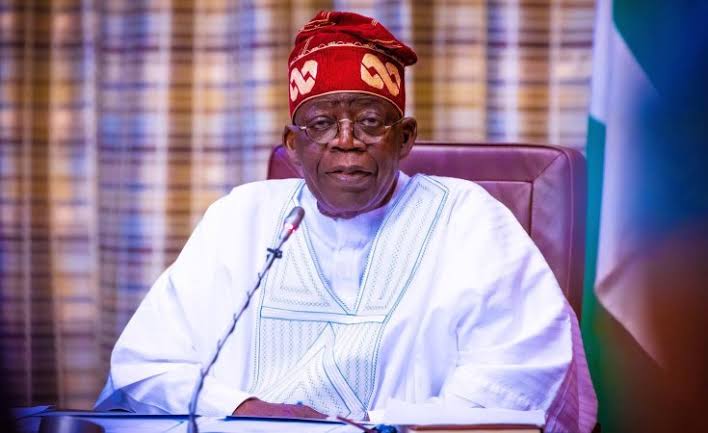
President Bola Ahmed Tinubu has formally joined the United States Department of Justice in seeking a 10-day extension to respond to a motion demanding the release of records connected to allegations and investigations concerning him and alleged drug-trafficking activities in the United States.
Tinubu’s legal team filed a notice of joiner before the United States District Court for the District of Columbia, asking that his response remain on the same schedule as that of the U.S. government defendants in the long-running case.
The development was made public by Von Batten-Montague-York, L.C., a U.S.-based policy advisory and lobbying firm retained by former Vice President Atiku Abubakar.
The case, Aaron Greenspan v. Executive Office for U.S. Attorneys, et al., Civil Action No. 23-1816 (BAH), has been before the U.S. District Court for more than three years and involves efforts to obtain government records connected to allegations and investigations involving Tinubu.
In the notice of joiner, Tinubu’s lawyers stated: “Intervenor joins Defendants’ motion for a 10-day extension of time to file response to the motion for summary judgment (DE 92), in as much as Intervenor requests that the responses remain on the same schedule.”
The document was signed by Christopher W. Carmichael and Victor P. Henderson of Henderson Parks, LLC.
The filing indicated that the plaintiff opposed the extension request, while the defendant did not.
However, according to Von Batten-Montague-York, U.S. District Judge Beryl Howell subsequently denied the request for additional time.
The lobbying firm described the development as significant, alleging that Tinubu was seeking to delay the legal process surrounding the requested records.
In a post on X, formerly Twitter, the firm wrote: “We just received a copy of President Bola Tinubu’s filing from just two business days ago. Not surprisingly, President Tinubu has now formally joined @TheJusticeDept’s request for a 10-day extension, which the judge has now swiftly denied.”
The firm went further, alleging that Tinubu could seek to mobilise political contacts in Washington to oppose the release of the records.
It alleged that the Nigerian president could “call upon his friends in DC to argue that the release of these files would harm U.S.-Nigeria relations and undermine his ability to work with the United States to combat terrorism and the killing of Christians in Northern Nigeria.”
Von Batten-Montague-York also warned against what it described as improper political interference in the judicial and Freedom of Information Act process.
“We believe that any U.S. government personnel who improperly attempt to interfere with the judicial or FOIA process on behalf of Nigerian President Tinubu to prevent the lawful release of these records should be exposed and fired,” the firm stated.
The lobbying group also referenced U.S. President Donald Trump, arguing that the United States should not shield individuals alleged to have been involved in criminal activity.
“President @realDonaldTrump and the United States do not protect individuals alleged by the DOJ to have been part of a criminal organization that smuggled heroin into the United States,” it stated.
The latest development has renewed attention on a controversial chapter of Tinubu’s history in the United States involving a $460,000 asset forfeiture during the 1990s.
Reports based on U.S. court documents and affidavits from the Internal Revenue Service and Federal Bureau of Investigation have previously linked the forfeiture proceedings to a federal investigation into a Chicago-based heroin trafficking network.
The investigation centred on a narcotics organisation operated by Chicago-based figures Adegboyega Mueez Akande and Abiodun Agbele, who were investigated by U.S. authorities over the trafficking of heroin into Illinois between 1988 and 1991.
According to documents cited in previous reports, IRS Special Agent Kevin Moss investigated the movement of funds through several U.S. bank accounts associated with Tinubu.
U.S. authorities subsequently obtained a court order in January 1992 freezing more than $1.4 million in accounts linked to Tinubu.
In 1993, a U.S. District Court ordered the forfeiture of $460,000 held in an account in Tinubu’s name to the U.S. government.
The forfeiture order stated that the funds represented proceeds of narcotics trafficking or were involved in financial transactions violating U.S. money-laundering laws.
The issue has remained politically sensitive in Nigeria, particularly because Tinubu is now the country’s president and has repeatedly faced questions about his activities and financial dealings in the United States during the period.
Tinubu has consistently denied any involvement in drug trafficking and has rejected allegations that he participated in criminal activity.
His legal team has maintained that the U.S. case was an in rem civil forfeiture proceeding, meaning that the legal action was directed against the money or property rather than against Tinubu personally.
His lawyers have also stressed that Tinubu was never arrested, arraigned, indicted or criminally convicted for a drug offence in the United States.
The distinction remains central to Tinubu’s defence, as the forfeiture of the money does not, by itself, amount to a criminal conviction against him.
The current litigation is instead focused on whether additional U.S. government records sought through the ongoing case should be released.
The latest filing by Tinubu’s legal team means that the president has formally aligned himself with the U.S. government defendants’ request for more time to respond to the motion for summary judgment.
With Judge Howell reportedly rejecting the requested 10-day extension, the case remains active and the potential release of additional records could reignite scrutiny of the circumstances surrounding the 1990s investigation and the $460,000 forfeiture.
For Tinubu’s critics, the attempt to keep the records under wraps raises fresh questions about what the documents may contain. For the president and his legal representatives, however, the proceedings remain a legal dispute over the disclosure of government records and should not be interpreted as proof of criminal wrongdoing.
The battle over the records is therefore shaping up as another major test of transparency surrounding one of the most controversial episodes in Tinubu’s political history, with any further disclosure potentially carrying significant political implications in Nigeria and renewed interest in Washington.