African Action Congress (AAC) presidential candidate, Omoyele Sowore, has challenged the Socio-Economic Rights and Accountability Project (SERAP) to explain why it is again demanding asset declarations from presidential candidates ahead of the 2027 election when, according to him, the organisation failed to pursue other candidates who ignored a similar demand before the 2023 poll.
Sowore’s latest challenge followed SERAP’s renewed call for all 19 presidential candidates cleared by the Independent National Electoral Commission (INEC) for the 2027 election to publicly declare their assets and liabilities and commit themselves to rejecting vote-buying and electoral bribery.
The activist and former presidential candidate, in a post on his X account on Sunday, recalled that he had already opened his financial records to public scrutiny when SERAP made a similar demand ahead of the 2023 election.
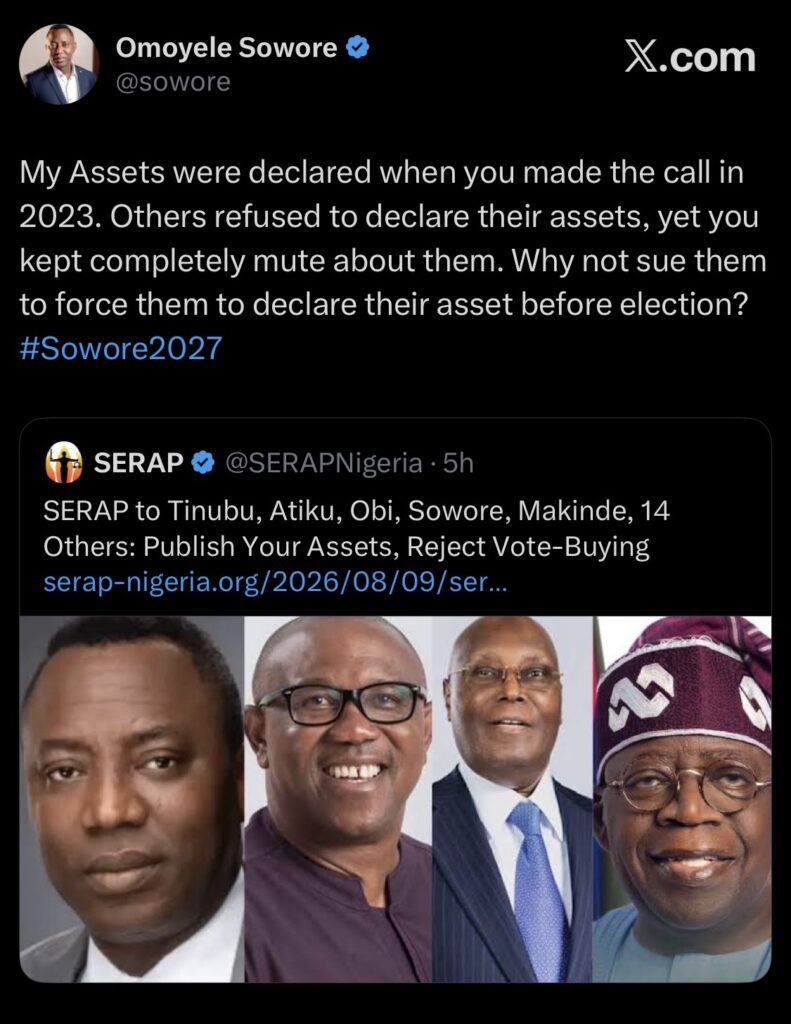
“My Assets were declared when you made the call in 2023. Others refused to declare their assets, yet you kept completely mute about them. Why not sue them to force them to declare their asset before election? #Sowore2027,” he wrote.
Sowore’s criticism places the spotlight on what he considers a troubling inconsistency in the campaign for political transparency: whether demands for accountability should apply equally to every presidential contender, regardless of political influence, popularity or electoral prospects.
SERAP, in its latest open letter dated August 8, 2026 and signed by its Deputy Director, Kolawole Oluwadare, urged all 19 presidential candidates to voluntarily publish comprehensive details of their assets and liabilities before seeking the votes of Nigerians.
The organisation specifically called on President Bola Ahmed Tinubu, former Vice President Atiku Abubakar, Labour Party presidential candidate Peter Obi, Sowore and 15 other presidential hopefuls to disclose their assets, those of their spouses and, where applicable, unmarried children below the age of 18.
SERAP also demanded that the candidates disclose the legitimate sources of their significant assets and publicly commit to rejecting vote-buying and electoral bribery throughout the 2027 electioneering process.
The organisation maintained that Nigerians have a right to know the financial standing of individuals seeking control of the nation’s vast public resources before handing them the enormous powers of the presidency.
But for Sowore, the renewed demand raises a more fundamental question: what happens when candidates refuse?
The AAC candidate pointed to his own disclosure ahead of the 2023 election as evidence that he had already subjected himself to the transparency standard SERAP is now seeking to impose on the entire field.
On July 23, 2022, Sowore publicly declared his assets following SERAP’s earlier appeal to presidential candidates.
His disclosure included two used vehicles — a Toyota Camry and a Lexus RX350 — as well as a house in his hometown in Ondo State, which he estimated at about N5 million.
He also listed a four-bedroom bungalow in New Jersey, several mobile phones and SaharaReporters Media Group among his assets.
Sowore went further by providing details of his bank accounts, claiming that the Nigerian government had frozen his accounts following his arrest over the #RevolutionNow protest in 2019.
He said his Guaranty Trust Bank account contained only N4,800 before it was frozen, while his Kuda Bank account had N463 at the time of his declaration.
He also disclosed having approximately $300 in a Capital One account in the United States and a Zenith Bank campaign account opened for his 2023 presidential bid.
At the time, Sowore said he had no other significant assets beyond occasional financial support from friends and family.
He also publicly declared that he had never operated offshore accounts or used tax havens to conceal his wealth.
Beyond the figures and properties, however, Sowore’s latest intervention has revived a larger political question that is likely to become increasingly contentious as the 2027 election approaches: should political transparency be voluntary, or should every presidential candidate be compelled to open their financial records to the public before asking Nigerians for their votes?
SERAP’s campaign suggests that voluntary disclosure would set a higher ethical standard for the 2027 contest. Sowore, however, wants the organisation to go a step further by confronting candidates who refuse to comply.
His challenge therefore puts SERAP under its own spotlight.
If asset declaration is essential to protecting Nigerians from leaders who may abuse public office for private enrichment, Sowore’s argument is straightforward: why merely appeal to candidates when the organisation can take legal action against those who refuse?
With the 2027 presidential race already taking shape, the dispute could become an early test of how seriously political actors, civil society organisations and the electorate are prepared to take the issue of transparency.
For Sowore, at least, the argument is settled: he says he has already put his assets on the table.
Now, he wants to know why everyone else has not been held to the same standard.