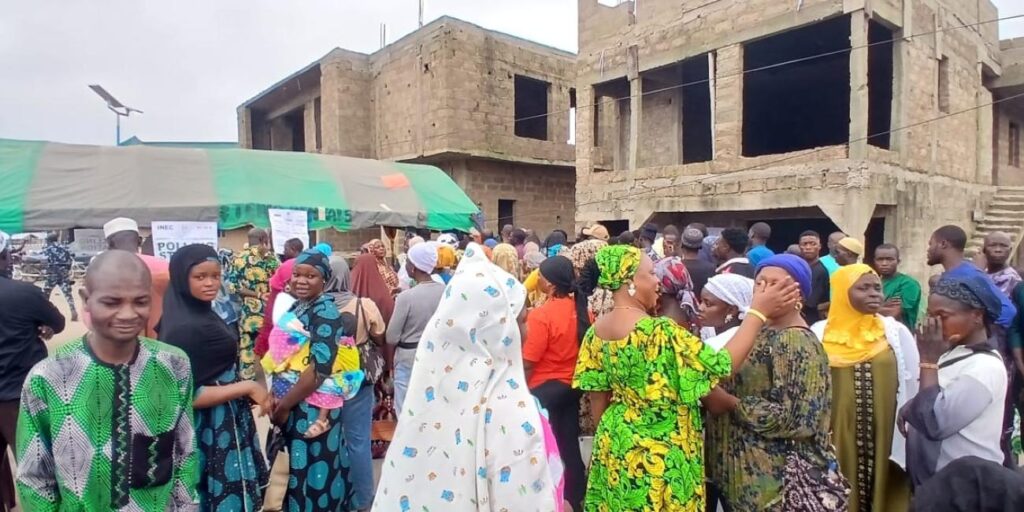
The ongoing Osun State governorship election has been hit by fresh allegations of vote-buying, intimidation and logistical challenges, with reports from several polling units raising concerns about the conduct and credibility of the exercise.
The Centre for Journalism Innovation and Development (CJID) reported that the All Progressives Congress (APC) and the Accord Party were allegedly offering cash to voters at some polling units, while suspected political thugs were also accused of intimidating journalists, polling agents and election observers monitoring the election.
In Iwo, a voter alleged that APC supporters were paying ₦20,000 to voters on the queue at Isale Oba 2 polling unit to vote for the party’s governorship candidate, Bola Oyebamiji.
The allegation had not been independently verified at the time of the report.
In Ilesa East, an unverified report also alleged that APC and Accord supporters were offering as much as ₦50,000 per voter at the Correspondence School polling unit.
Meanwhile, in Boluwaduro and Ola-Oluwa, voters were reportedly heard openly discussing alleged cash payments before casting their ballots.
The allegations have raised fresh questions about the credibility of the election, particularly the principle that voters should be allowed to freely choose their preferred candidates without financial inducement, pressure or coercion.
The reported incidents also extended to journalists, polling agents and observers attempting to document the election.
In Irewole, political thugs were allegedly involved in forcing a journalist to delete photographs taken during the voting process.
A polling agent was also reportedly assaulted, while his mobile phone was allegedly seized.
Observers attempting to take photographs at polling units in Ife Central and Ilesa East were similarly reported to have faced intimidation.
The incidents have heightened concerns over transparency and the ability of journalists and accredited observers to independently document events at polling units.
In its midday update at about 12pm, CJID said two developments had become increasingly prominent as voting progressed — stronger allegations of vote-buying and rising intimidation of reporters and polling agents.
Despite the allegations and reported incidents, voting remained largely peaceful in the areas monitored as of midday.
However, election stakeholders are closely watching the affected polling units amid calls for voters, journalists, observers and party agents to be allowed to perform their legitimate roles without intimidation or interference.
Meanwhile, a separate challenge emerged in Ilesa West Local Government Area, where a large number of voters were reportedly left stranded in a long queue at Ward 8, Polling Unit 5.
The delay was attributed to the slow operation of the Bimodal Voter Accreditation System (BVAS) machine deployed to the polling unit.
Voters reportedly struggled to remain on the queue for several hours while waiting to cast their ballots.
Some voters complained that the number of people at the polling unit was far greater than the capacity of the available personnel and equipment, with only one BVAS machine reportedly deployed to process voters.
Speaking about the situation, a voter, Agunbiade Tolulope, said the situation had subjected voters to prolonged waiting, stress and discomfort, particularly as the queue was barely moving.
According to Tolulope, the number of voters at the polling unit was too large compared with the available equipment and personnel.
“The election I have had over the time that I have been here is that the numbers of voters in this polling unit is too much compared to the gadgets and the resources that are available and the personnel,” he said.
Tolulope further said some voters had spent between six and seven hours waiting, with little or no movement on the queue.
The combination of alleged vote-buying, intimidation and technical or logistical difficulties has added to concerns surrounding the election as voters across Osun State continue to exercise their franchise.
While the allegations of vote-buying and intimidation remain claims requiring independent verification and investigation, they have already triggered questions among voters and election stakeholders about whether all participants are being allowed to take part in the process freely.
The credibility of the election will ultimately depend not only on the peaceful completion of voting but also on whether voters are able to cast their ballots without intimidation or financial influence, while journalists, observers and party agents are allowed to monitor and document the process without interference.
As voting continues, attention remains focused on polling units across the state, with stakeholders watching closely for further reports of vote-buying, violence, intimidation, BVAS failures and other developments that could affect the conduct of the election.