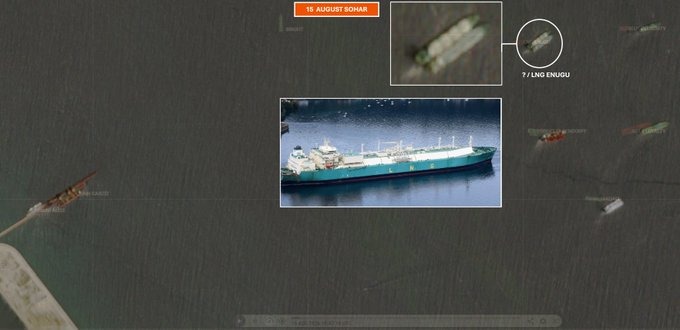
The crisis surrounding the Strait of Hormuz is taking a dramatic turn, with satellite imagery showing liquefied natural gas (LNG) tankers positioned for a possible ship-to-ship cargo transfer off Oman — a striking indication that energy operators are exploring alternative ways to keep Gulf gas moving while the strategic waterway remains fraught with danger.
The vessels were observed near Sohar, Oman, outside the immediate confines of the Strait of Hormuz, with LNG tanker Enugu positioned alongside another vessel in a configuration typically associated with ship-to-ship transfers.
The manoeuvre has raised fresh questions over how LNG exporters and shipping operators are attempting to navigate an increasingly dangerous maritime environment around the Persian Gulf.
The Strait of Hormuz is one of the world’s most important energy chokepoints, connecting the Persian Gulf with the Gulf of Oman and the wider Arabian Sea. Any prolonged disruption to the waterway threatens supplies from major Gulf energy producers and could send shockwaves through international gas markets.
The apparent transfer operation is particularly significant because it suggests that operators may be attempting to reduce the amount of time LNG carriers spend exposed to the most dangerous sections of the Gulf, potentially allowing cargoes to be moved between vessels outside the chokepoint.
However, satellite imagery showing vessels positioned alongside each other does not, by itself, conclusively prove that LNG cargo was transferred. The configuration is consistent with such an operation, but confirmation would require additional shipping or cargo data.
Still, the development underscores the extraordinary pressure facing the global LNG supply chain.
With maritime traffic through Hormuz heavily disrupted by escalating regional tensions, energy companies are confronting a dangerous combination of security risks, insurance concerns, disrupted schedules and uncertainty over future cargo deliveries.
The stakes are particularly high for countries heavily dependent on Gulf LNG.
Any sustained interruption to exports from major producers such as Qatar could tighten global supplies, increase prices and force importing countries to compete aggressively for alternative cargoes.
The apparent offshore manoeuvre near Oman therefore carries a significance far beyond the two vessels involved.
It represents a potentially new chapter in the struggle to keep Gulf energy flowing when the traditional route through Hormuz has become increasingly difficult to rely upon.
The message from the shipping lanes is stark: as the Strait of Hormuz becomes a greater security risk, the global energy industry is beginning to look for ways to move the cargo without depending entirely on the chokepoint.
And if such ship-to-ship transfers become more frequent, the world’s energy map could be quietly changing — not because Hormuz has ceased to matter, but because operators are becoming increasingly desperate to find a way around it.