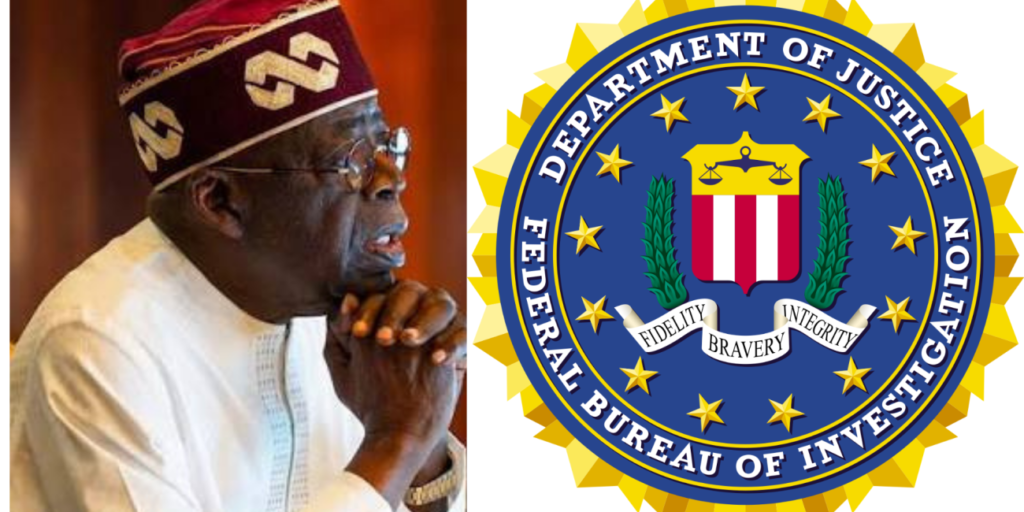
The United States Federal Bureau of Investigation (FBI) has asked a federal court in Washington, D.C., for permission to submit confidential declarations under seal and privately explain why it is withholding records relating to President Bola Ahmed Tinubu.
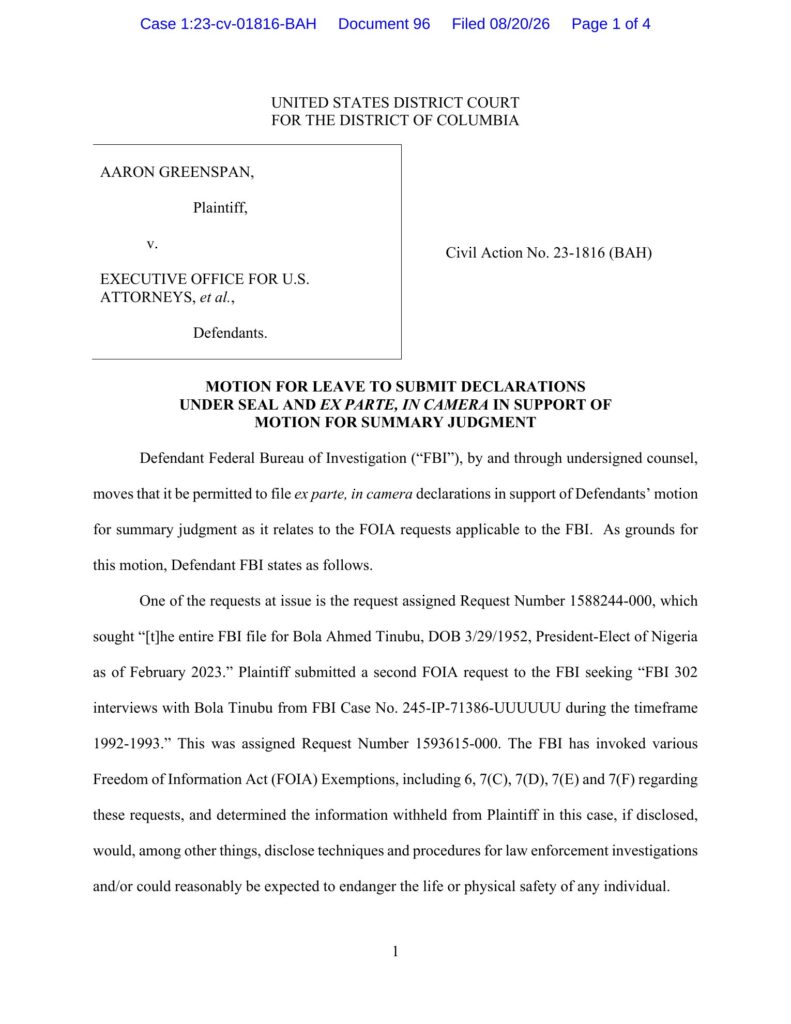
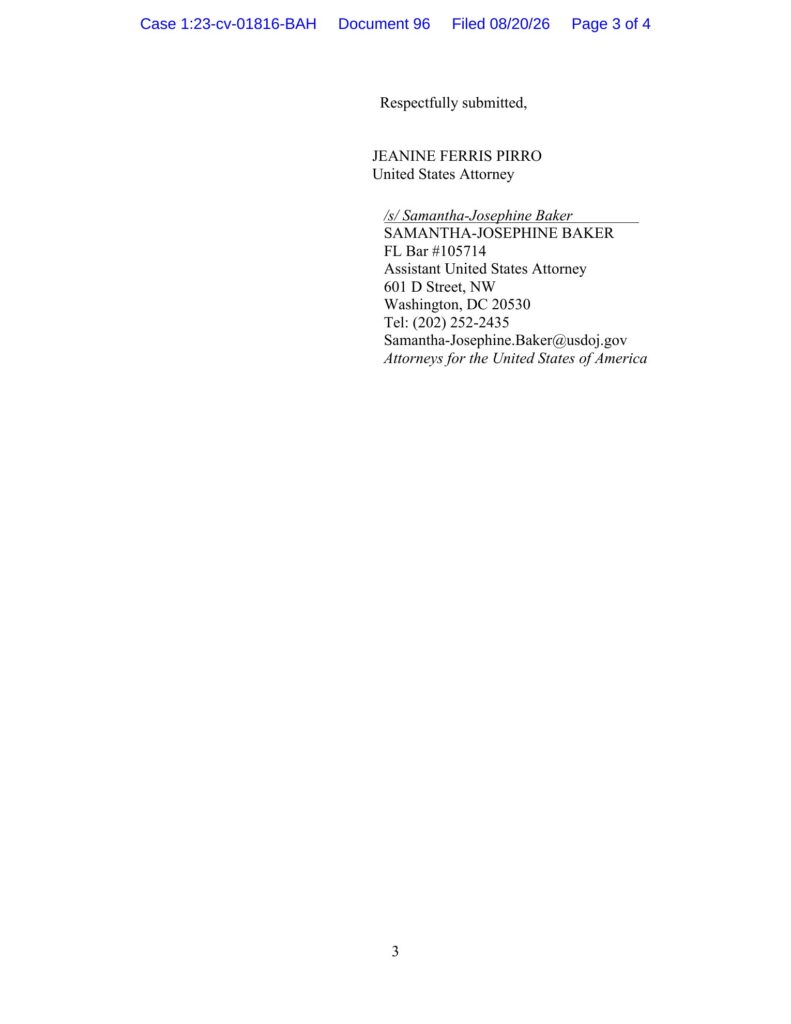
The request was contained in a four-page motion filed on August 20, 2026, in the long-running Freedom of Information Act (FOIA) case of Aaron Greenspan v. Executive Office for U.S. Attorneys, et al., Civil Action No. 23-1816 (BAH), before U.S. District Judge Beryl Howell.
The FBI is asking the court to allow it to submit the declarations “ex parte” and “in camera” in support of the U.S. government’s renewed motion for summary judgment.
In practical terms, the agency wants Judge Howell to privately examine information that neither the public nor the plaintiff would be allowed to see.
The records at the centre of the dispute include an FBI file concerning Tinubu and FBI interview records dating back to the 1990s.
One of the FOIA requests, identified as Request Number 1588244-000, sought “the entire FBI file for Bola Ahmed Tinubu, DOB 3/29/1952, President-Elect of Nigeria as of February 2023.”
A second request, numbered 1593615-000, sought “FBI 302 interviews with Bola Tinubu from FBI Case No. 245-IP-71386-UUUUUU during the timeframe 1992-1993.”
The FBI said it had relied on several exemptions under the U.S. Freedom of Information Act to withhold portions of the records, including Exemptions 6, 7(C), 7(D), 7(E) and 7(F).
According to the agency, some of the withheld information concerns law-enforcement matters and its disclosure could reveal investigative techniques and procedures.
The FBI also invoked an exemption relating to information that “could reasonably be expected to endanger the life or physical safety of any individual.”
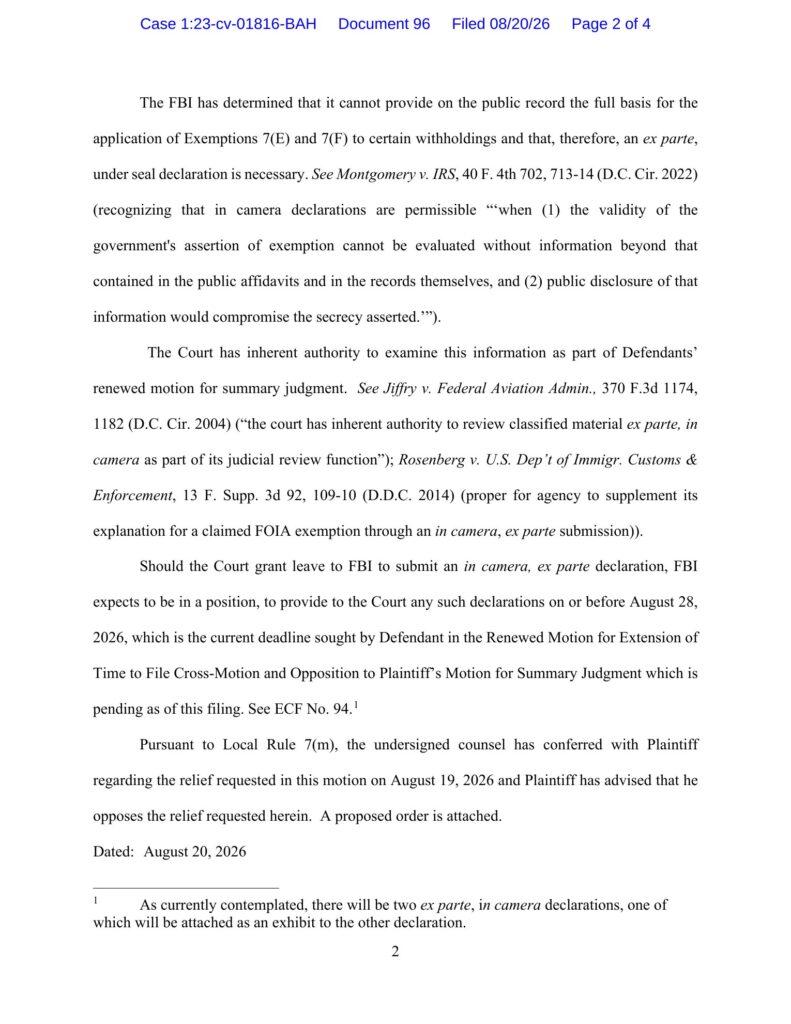
But the most striking aspect of the latest filing is the FBI’s position that it cannot publicly explain the full basis for relying on Exemptions 7(E) and 7(F).
“The FBI has determined that it cannot provide on the public record the full basis for the application of Exemptions 7(E) and 7(F) to certain withholdings and that, therefore, an ex parte, under seal declaration is necessary,” the agency stated in its motion.
The agency argued that Judge Howell has the authority to privately review the sensitive information when considering the government’s motion for summary judgment.
“The Court has inherent authority to examine this information as part of Defendants’ renewed motion for summary judgment,” the FBI argued, citing previous U.S. court decisions involving confidential government material.
The development means that, if the court grants the request, the FBI will be able to present part of its justification directly to the judge without placing the information on the public docket.
The agency said it expects to submit two confidential declarations to the court by August 28 if its request is approved.
“As currently contemplated, there will be two ex parte, in camera declarations, one of which will be attached as an exhibit to the other declaration,” the filing stated.
The FBI’s request is being opposed by the plaintiff, Aaron Greenspan.
According to the motion, government lawyers conferred with Greenspan on August 19, 2026, as required under the court’s Local Rule 7(m), and he informed them that he opposed the requested relief.
The motion was filed on behalf of the United States by government lawyers including U.S. Attorney Jeanine Ferris Pirro and Assistant U.S. Attorney Samantha-Josephine Baker.
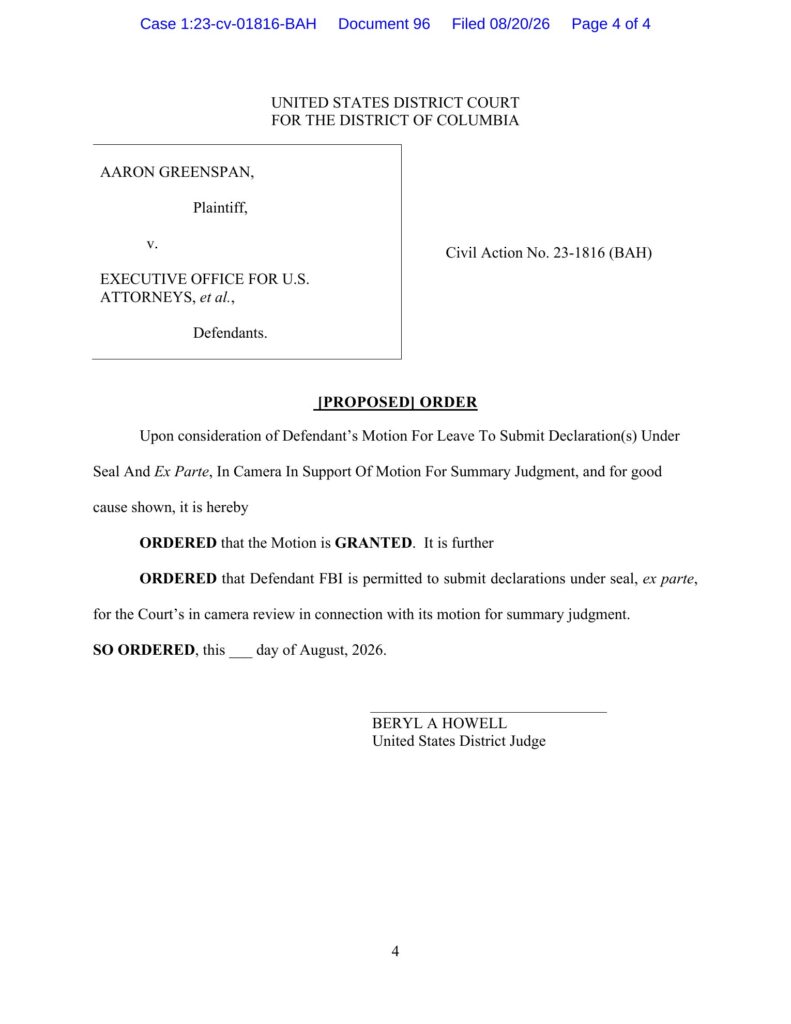
Attached to the filing is a proposed order for Judge Howell. The proposed order would authorize the FBI to submit the declarations under seal and allow the judge to examine them privately in connection with the government’s motion for summary judgment.
However, the document filed by the FBI does not establish that Judge Howell had signed the proposed order at the time of filing.
The FBI’s request therefore remains an application to the court rather than evidence that the judge has already approved the confidential review.
The records sought by Greenspan are part of a legal battle that has lasted for more than three years and has focused on U.S. government records concerning investigations involving Tinubu.
The controversy has attracted renewed attention because some of the records are connected to a U.S. investigation in the 1990s involving a Chicago-based heroin trafficking network and the forfeiture of $460,000 held in an account in Tinubu’s name.
According to U.S. court documents and affidavits previously reported in connection with the case, American authorities investigated a narcotics network operated by Chicago-based drug figures Adegboyega Mueez Akande and Abiodun Agbele, which was alleged to have trafficked heroin into Illinois between 1988 and 1991.
IRS Special Agent Kevin Moss reportedly determined during the investigation that funds generated by the drug operation were deposited into several U.S. bank accounts opened and controlled by Tinubu.
In January 1992, U.S. authorities obtained a court order freezing more than $1.4 million in accounts linked to Tinubu.
In October 1993, the U.S. District Court for the Northern District of Illinois ordered the forfeiture of $460,000 held in an account in Tinubu’s name.
The court order stated that the money represented proceeds of narcotics trafficking or was involved in financial transactions allegedly violating U.S. money-laundering laws.
Tinubu has consistently denied wrongdoing and rejected allegations linking him to drug trafficking.
His lawyers have maintained that the U.S. proceeding was an in rem civil forfeiture case, meaning the legal action was brought against the money or property rather than against Tinubu personally.
His legal team has also argued that Tinubu was never arrested, indicted, arraigned or criminally convicted of a drug offence in the United States.
The latest FBI filing, however, does not establish that Tinubu committed a drug-trafficking offence.
It concerns the agency’s request to privately provide Judge Howell with additional justification for withholding certain records under FOIA exemptions.
The distinction is significant because the FBI’s request does not amount to a new criminal allegation against Tinubu.
Nevertheless, the agency’s demand for confidential judicial review is likely to intensify political and public interest in the records, particularly because they concern a U.S. investigation dating back more than three decades and involve documents that remain inaccessible to the public.
The central unanswered question is what information the FBI believes is so sensitive that it cannot even disclose publicly the complete basis for withholding it.
The agency has not publicly stated that the confidential declarations contain new allegations against Tinubu.
Nor has the filing disclosed what specific information would allegedly compromise law-enforcement techniques, endanger individuals or otherwise justify continued secrecy.
Instead, the FBI is asking the judge to review the additional explanation privately and determine whether its position satisfies the requirements of the FOIA case.
The development comes as political scrutiny of Tinubu’s past intensifies ahead of Nigeria’s 2027 presidential election, in which the president is seeking another term.
The application was also brought into wider public view after being published on X by Von Batten-Montague-York, a Washington-based lobbying firm that has been hired by former Vice-President and African Democratic Congress (ADC) presidential candidate Atiku Abubakar ahead of the 2027 election.
The latest development follows a recent legal filing in which Tinubu formally joined the U.S. Department of Justice’s request for additional time to respond to the government’s motion for summary judgment.
In a notice filed before the U.S. District Court for the District of Columbia, Tinubu’s lawyers stated that the president, as an intervenor in the case, was joining the defendants’ request for a 10-day extension so that his response would remain on the same schedule.
Judge Howell subsequently denied the full extension request and granted a shorter extension.
The latest FBI motion therefore adds another layer to an already closely watched legal dispute: the plaintiff wants access to historical U.S. government records, while the FBI is now asking the court for permission to privately explain why some of those records cannot be fully disclosed.
If Judge Howell grants the request, the FBI’s two declarations could provide the court with information that will not initially be available to the public.
Whether any portion of that material eventually becomes public could depend on subsequent rulings in the FOIA litigation.
For now, the FBI’s filing leaves the most politically sensitive question unanswered.
What exactly does the agency believe must remain hidden from the public about the records concerning Tinubu?
The answer, if one emerges from the court’s eventual review, could further fuel scrutiny of the president’s long-contested history in the United States as Nigeria moves closer to another fiercely contested presidential election.