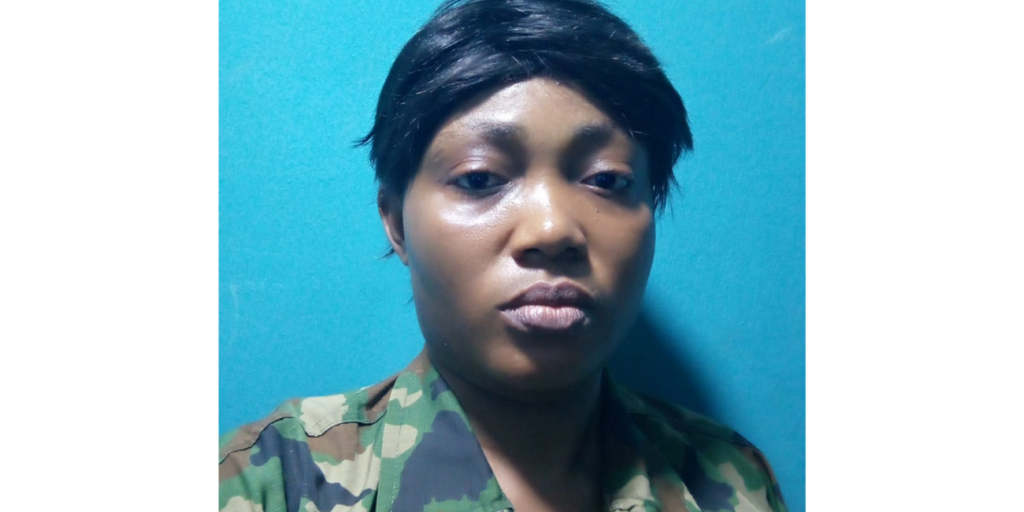
The National Human Rights Commission (NHRC) is facing renewed pressure to launch an independent investigation into the Nigerian Army over what has been described as glaring inconsistencies in its handling of the case involving former soldier, Corporal Matilda Anighoro, with fresh allegations that the military’s official position is contradicted by its own administrative records.
The development has intensified scrutiny of a dispute that has evolved from allegations of sexual harassment and victimisation into a broader controversy over military accountability, due process and the integrity of official records.
The latest petition, submitted in response to a letter from the Directorate of Legal Services, Army Headquarters (Ref: DLS/A/G/300/56 dated June 24, 2026), challenges the Army’s insistence that Anighoro was lawfully reduced in rank before her voluntary discharge from service.
Army Headquarters had maintained that the former soldier was subjected to disciplinary proceedings after being arraigned on a five-count charge bordering on disobedience to standing orders, offences relating to sentry duties, insubordinate conduct and behaviour prejudicial to service discipline under the Armed Forces Act.
According to the military, she was summarily tried and punished with successive reductions in rank—from Corporal to Lance Corporal and subsequently from Lance Corporal to Private—with effect from February 29, 2024. The Army further stated that her retirement benefits were processed based on her revised rank and dismissed allegations that it withheld her discharge certificate or service records.
However, the petitioner argues that the Army’s own records tell a fundamentally different story.
In a detailed submission titled “Re: Response to Army Headquarters Letter Ref: DLS/A/G/300/56 dated 24 June 2026,” the petitioner contends that official military documents consistently recognise Anighoro as a Corporal long after the date the Army claims she was demoted.
Among the documents cited is the approval of her Voluntary Discharge (Batch B, 2024), reportedly authorised by the Chief of Army Staff approximately seven months after the alleged demotion, in which she was still identified as a Corporal.
The petition further claims that Anighoro continued to receive the salary and allowances attached to the rank of Corporal until January 2025. Her Security Disbandment entitlement, it adds, was equally calculated and paid using the rank of Corporal, while her official military identity card also continued to bear the same rank.
Equally significant, according to the petitioner, is the alleged absence of any corresponding entry in the Army’s Part II Orders documenting the conviction, punishment or reduction in rank now being relied upon by Army Headquarters.
Describing these discrepancies as “fundamental inconsistencies,” the petitioner argues that such a significant disciplinary action should have been uniformly reflected across all official military records if it had genuinely occurred.
The petition invokes Section 36 of the 1999 Constitution (as amended), which guarantees the right to fair hearing, as well as provisions of the Armed Forces Act requiring disciplinary proceedings and punishments to be lawfully conducted, properly documented and verifiable.
Against this backdrop, the NHRC has been urged to compel the Nigerian Army to produce the complete documentary record relating to the alleged disciplinary proceedings.
The requested documents include the charge sheet, proceedings of the trial, findings, punishment awarded, approvals by the confirming or reviewing authority, relevant Part II Orders reflecting the reduction in rank, and every other official document supporting the Army’s position.
The petitioner argues that failure to produce such records should compel the Commission to draw the appropriate conclusions regarding the credibility of the Army’s claims.
Beyond the dispute over rank, the petition also urges the NHRC to investigate whether the disciplinary measures were influenced by Anighoro’s earlier allegations of sexual harassment involving a senior military officer.
The former soldier had previously alleged that she came under pressure after rejecting an alleged sexual advance by General Okoigi Solomon, claims that later formed the basis of wider allegations of intimidation, unlawful detention and victimisation.
The petitioner has therefore called on the Commission to determine whether any independent investigation has been conducted to establish if there was a connection between those allegations and the disciplinary action subsequently taken against her.
The controversy follows an earlier development reported on April 18, when Anighoro alleged that officials of the Army’s Special Investigation Bureau (SIB) contacted her and instructed her to report to Abuja for documentation relating to her case.
She said the call heightened fears for her safety, citing what she described as inconsistencies in the instructions she received regarding where she was expected to report.
Meanwhile, the Nigerian Army has firmly rejected allegations of wrongdoing.
In an earlier response signed by Lieutenant Colonel V.L. Williams on behalf of the Chief of Army Staff, the Army insisted that Anighoro’s discharge certificate had never been withheld, maintaining that the documents had been ready for collection since 2024.
It further accused the former soldier of refusing to collect the documents because they reflected her reduced rank, alleging instead that she chose to publicise the dispute on social media in an attempt to malign the institution.
The Army maintained that her substantive rank at retirement remained that of a Private Soldier and dismissed allegations of administrative impropriety as false, misleading and made in bad faith.
With sharply conflicting narratives now before the National Human Rights Commission, the case has assumed wider significance beyond an individual grievance. It raises fundamental questions about military transparency, the credibility of official records, observance of due process and the protection of personnel who raise allegations of misconduct.
As pressure mounts on the Commission to independently verify the competing claims, the outcome of its intervention is expected to shape public confidence in institutional accountability and the administration of justice within Nigeria’s armed forces.