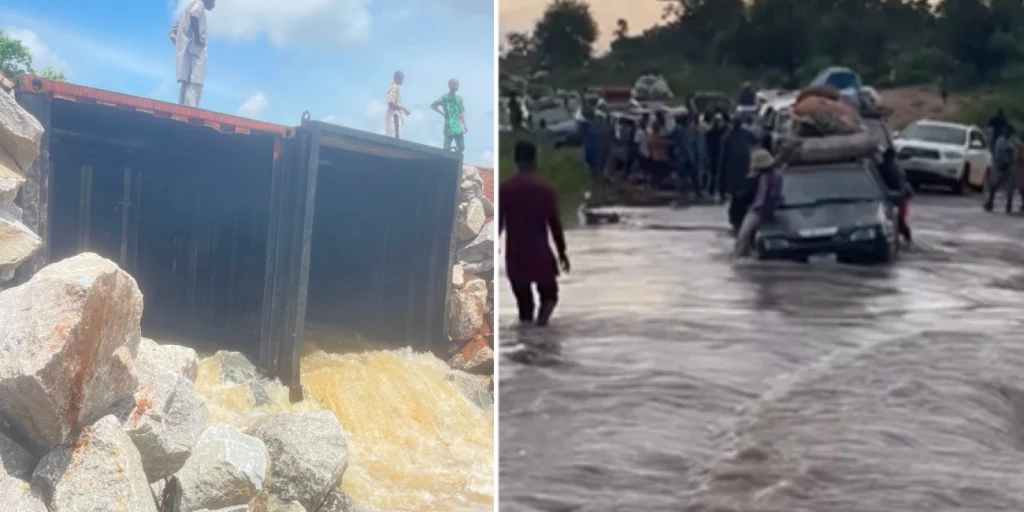
Floodwaters have overrun a major section of the Okolowo–Alapa Road linking Kwara and Oyo states, leaving vehicles stranded and residents struggling to cross the route just months after the Kwara State Government installed a makeshift “container bridge” as a temporary solution following the collapse of the Moro Bridge.
The development has renewed concerns over the adequacy and safety of the temporary intervention, particularly as heavy rainfall continues to affect the corridor and the route remains heavily used by commuters, traders, transporters and articulated vehicles.
ChroniclesReporters gathered that floodwaters spread across sections of the highway during rainfall, disrupting movement and leaving motorists and residents exposed to further danger.
Residents said the temporary structure had failed to address the longstanding flooding problem, adding that even relatively heavy rainfall was enough to render parts of the route difficult or impossible to navigate.
“This container bridge built by the government did not give us any solution to our problem here. Anytime little rain falls, all our community would be flooded. We are suffering too much in this community,” one resident said.
Another resident described the flooding as a recurring nightmare for communities along the route.
“We have been living with this problem for a long time. The government came and constructed this container bridge and we thought things would improve, but look at what is happening now,” the resident said.
“Once rain starts, the water rises quickly and covers the road. People who are going to work, traders and drivers are all affected. Sometimes you have to wait for hours before you can cross.”
A third resident said the situation had become particularly dangerous for motorists travelling with passengers and goods.
“This is the only road many of us depend on to move between these communities and other parts of Kwara and Oyo. When the flood takes over the road, everything stops,” the resident said.
“You cannot expect people to continue driving through water like this. If a vehicle gets stuck here, who will rescue the occupants?”
Another resident said the community had initially welcomed the government’s intervention after the collapse of the old Moro Bridge but argued that the temporary structure had not solved the underlying problem.
“We appreciate that the government tried to give us an alternative after the bridge collapsed, but what we have now is not solving the problem,” he said.
“We need a proper bridge and proper drainage. We don’t need something that will only work when there is no rain.”
Videos shared by residents on social media and reviewed by ChroniclesReporters showed floodwaters covering sections of the road around the Moro River, with motorists struggling to navigate the affected area.
In one of the videos, a resident could be heard drawing attention to the extent of the flooding and the difficulty motorists were experiencing.
“See Moro River now, vehicles can’t move because of the flood. The road is already split into two and the people are passing there with difficulty,” the resident said.
Another voice in the video warned that motorists were taking serious risks by attempting to cross the flooded section.
“Look at the level of this water. This is the road people use every day. If the water rises more, nobody will be able to pass here,” the person said.
A motorist who spoke on the situation said the flooding was also affecting commercial activities along the corridor.
“We are losing money whenever this road is blocked. Traders cannot move their goods, passengers cannot travel and drivers have to wait until the water goes down,” he said.
“This is supposed to be a major road connecting communities in Kwara and Oyo. Government should not allow it to remain like this.”
The latest flooding comes only months after the Kwara State Government constructed an alternative access road and makeshift bridge using shipping containers following the collapse of the old Moro Bridge.
The intervention, associated with the administration of Governor AbdulRahman AbdulRazaq, had generated concerns among residents and road users because of the volume of heavy-duty traffic using the route.
The Okolowo–Alapa corridor is an important transportation route connecting communities in Kwara with northern Oyo towns, including Igbeti and Kishi, while extending towards routes leading to the Nigeria–Benin Republic border.
Trailers, tankers, trucks transporting agricultural produce and other articulated vehicles regularly use the corridor.
During an earlier visit to the area, residents had warned that the container structure might not withstand the volume of heavy traffic and could become particularly vulnerable during the peak of the rainy season.
One resident had said that although the government had made an effort to restore movement after the collapse of the old bridge, the alternative structure was inadequate for the volume of traffic on the route.
“If you check the road from where the government started, you will see that they have tried, but the only problem is that the container bridge is not strong enough to withstand the weight of heavy-duty vehicles like trucks that always pass here,” the resident had said.
“But we can’t do anything about it. We are just praying to God against calamity.”
The resident had also warned about the potential effect of rising floodwaters on the structure.
“If water comes around September during the heavy rains, we are praying the bridge will not be washed away. But if you look beneath the bridge, you will see how the water flows. If the flood becomes heavy, there is a high chance it could wash away the bridge,” he said.
A civil engineer, Babatunde Abdulganiy, had also warned that although container bridges could be used as temporary crossings under properly engineered conditions, they were not suitable for sustained heavy-duty traffic without appropriate design and load restrictions.
Abdulganiy, a graduate of Ladoke Akintola University of Technology and resident of Ilorin, said the adequacy of the waterway beneath the structure was critical because of the area’s history of flooding.
“The success of such a structure depends largely on whether adequate hydraulic clearance and sufficient waterway have been provided to allow floodwaters to pass freely,” he said.
He warned that flooding could undermine the structure if the water passage was inadequate.
“We know that flood intensity in the area typically peaks between September and October. If the water passage is inadequate, there is a real possibility that rising floodwaters could overtop or undermine the bridge, creating a serious safety hazard,” he said.
He also cautioned against allowing articulated trucks and other heavy vehicles to use a structure that was not designed for sustained heavy axle loads.
“It is also important to emphasise that a container bridge is not designed to carry sustained heavy axle loads from articulated trucks, trailers and other heavy-duty lorries that regularly use that route,” he said.
“Such structures are generally intended as temporary installations with strict load limitations. Subjecting them to continuous heavy vehicular traffic would significantly increase the risk of structural failure.”
The latest flooding crisis follows the collapse of the old Moro Bridge, which caused a fatal accident and left several others injured.
The bridge collapsed on April 29, 2026, after a heavy-duty truck reportedly attempted to cross the ageing structure.
A subsequent visit to the scene showed the destroyed bridge, stranded vehicles and commuters struggling to find alternative routes.
Community members and vigilantes said the truck, reportedly carrying stones, triggered the collapse.
“The truck carrying stones stepped on the bridge and immediately the bridge gave way,” a vigilante had said.
The truck reportedly somersaulted into the collapsed section, with the driver rescued alive and taken to hospital.
Later, four young men from Mandala community riding on two motorcycles reportedly plunged into the collapsed section after apparently failing to notice adequate warning signs.
One of the riders died, while the others sustained serious injuries.
The incident renewed concerns about the condition of the bridge and the prolonged delay in completing a permanent replacement.
The history of the Moro Bridge reconstruction goes back several years.
An investigation by the International Centre for Investigative Reporting published in 2022 documented the prolonged abandonment of the reconstruction of the Moro and Ohan bridges along the Ilorin-Igbeti Road.
According to the investigation, the reconstruction contract was awarded to Bilijoe + Berger Construction Limited for N865,019,925.
The contract was subsequently augmented, with an additional N73.1 million approved in 2020 for extending the Moro Bridge, bringing the revised contract sum to N938,133,184.45.
The ICIR investigation later reported that a further augmentation in 2022 pushed the total amount allocated for the project to N1,214,822,585.65.
The contractor at the time attributed the delay to rising construction costs and said additional funds were required to complete the project.
The investigation also documented the importance of the corridor to communities and traders who depended on the road to transport agricultural produce and other goods between Kwara and Oyo states.
The Kwara State Government has previously said the Moro Bridge is federal infrastructure and that its intervention was intended only as a temporary measure pending construction of a permanent bridge by the Federal Government.
In September 2024, the state government announced that Governor AbdulRahman AbdulRazaq had approved immediate rehabilitation of the ageing Moro Steel Bridge after cracks developed on the structure.
The state described the intervention as a “stop-gap measure” intended to ease movement until the Federal Government completed a new concrete bridge.
Following the 2026 collapse and renewed controversy over the cost of interventions at the bridge, the Kwara State Ministry of Works said in May that the state had spent N27 million on the last palliative intervention on the federal bridge.
The ministry rejected claims that the AbdulRazaq administration spent N1.2 billion on the structure, saying the N1.2 billion figure associated with the project did not represent the amount spent by the state government on its intervention.
The ministry maintained that the state had only undertaken a modest temporary intervention while the Federal Government handled the permanent reconstruction.
The latest flooding has nevertheless revived questions about whether the temporary solution was adequate for a corridor historically affected by flooding and heavy traffic.
For residents, the immediate concern is no longer simply the condition of the collapsed bridge but whether the alternative route can safely withstand the rainy season.
“We don’t want another accident before government acts,” one resident said.
“We have already lost someone here. We don’t want to lose more people because of flooding or because this temporary bridge cannot cope with the situation.”
Another resident called on the government to urgently address the flooding before the situation becomes more dangerous.
“Government should come and see what is happening here by themselves. Let them come when the rain is falling and see what ordinary people are passing through,” he said.
“We have suffered enough. We need a permanent solution, not another temporary arrangement.”
ChroniclesReporters observed significant flooding along the route during its Tuesday visit and reviewed videos showing vehicles struggling to navigate the affected section.