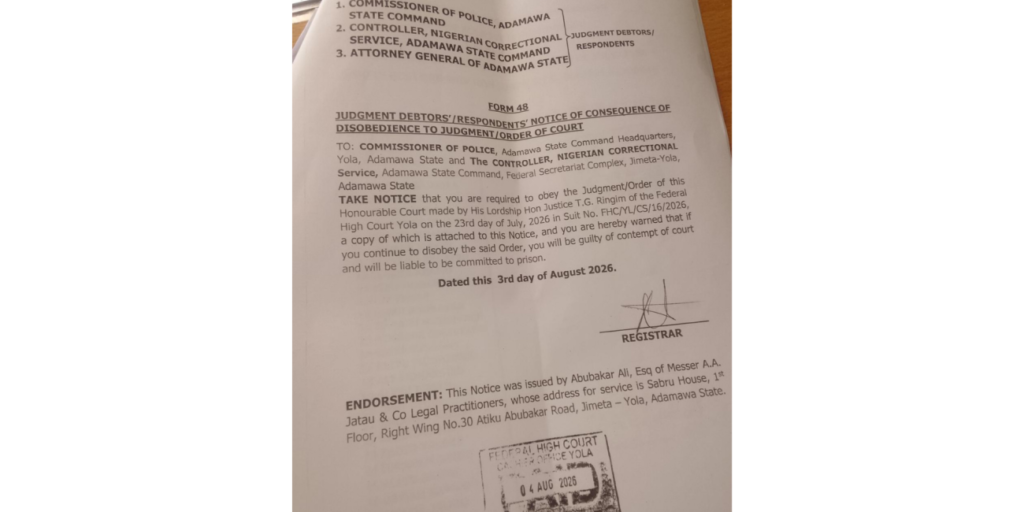
A fresh legal confrontation is brewing in Adamawa State as the Commissioner of Police and the Controller of the Nigerian Correctional Service (NCoS) in the state face contempt proceedings for allegedly refusing to obey a Federal High Court order directing the immediate release of 42 detainees arrested in Mubi.
The detainees, who have remained in custody for almost three months, were ordered to be released by the Federal High Court, Yola Division, after the court declared their arrest and continued detention illegal, unconstitutional, null and void.
Rather than release the detainees in accordance with the judgment, the two authorities allegedly transferred them from the correctional facility in Yola to Numan Prison, an action that has now escalated the dispute from a fundamental-rights case into an alleged disobedience-of-court-order proceeding.
The 42 men were arrested on May 6, 2026, when officers of the Adamawa State Police Command reportedly stormed Mubi Town and took them into custody.
Court documents indicated that the detainees were handcuffed, bundled into police vehicles and transported for more than 200 kilometres from Mubi to Yola without being told the reasons for their arrest or the offences they were alleged to have committed.
Upon arrival in Yola, they were detained at the State Criminal Investigation Department, Jimeta, before some of them were subsequently transferred to the correctional centre.
The detainees later challenged the legality of their continued detention, arguing that the police had failed to investigate or charge them despite holding them for several weeks.
According to their court filings, the police obtained a remand warrant from Chief Magistrate Court 2, Yola, on May 8, 2026, which was subsequently relied upon to keep them in custody.
But the applicants challenged the jurisdiction of the magistrate court to issue the remand order, arguing that they were arrested in Mubi, which falls within the Mubi Magisterial District and is more than 200 kilometres away from Yola.
They contended that Chief Magistrate Court 2, Yola, therefore lacked the requisite territorial jurisdiction to issue a remand order concerning their arrest and detention.
The detainees further alleged that neither the police nor any other authority had informed them of the specific offences they were accused of committing.
They also alleged that no meaningful investigation had been conducted and that they had neither been charged nor arraigned before a competent court despite spending almost three months in detention.
Repeated requests for their release on bail, made personally and through their relatives, were allegedly rejected by the police.
The applicants claimed they were told that their arrest and detention were connected to an executive order allegedly issued by the Adamawa State Governor, Ahmadu Umaru Fintiri.
With their continued detention unresolved, the detainees, through their lawyer, Abubakar Ali, Esq., approached the Federal High Court in Suit No. FHC/YL/CS/16/2026, seeking the enforcement of their fundamental rights.
The defendants in the suit were the Commissioner of Police, Adamawa State Command; the Controller of the Nigerian Correctional Service, Adamawa State Command; and the Attorney General of Adamawa State.
In a landmark judgment delivered on July 23, 2026, the Federal High Court found in favour of the applicants and condemned their arrest and continued detention.
The court held that keeping the applicants in custody without confronting them with the facts and reasons for their arrest, without charging them and without arraigning them before a competent court violated their constitutionally guaranteed rights to personal liberty and fair hearing.
The court specifically relied on Sections 35 and 36 of the 1999 Constitution, as well as Articles 4, 5, 6 and 12(2) of the African Charter on Human and Peoples’ Rights.
The court also declared the remand warrant obtained from Chief Magistrate Court 2, Yola, in respect of the Mubi detainees illegal, null and void.
It consequently ordered the police and correctional authorities to immediately release each of the 42 applicants after they had entered into a two-year bond before the court to be of good behaviour.
The court further restrained the respondents, their agents, privies and assigns from arresting or detaining the applicants again on the same facts without following due process of law.
However, rather than bringing the prolonged detention to an end, the applicants allege that the police and correctional authorities chose to move them from Yola to Numan Prison.
The alleged transfer, coming after the Federal High Court had expressly ordered their immediate release, has now raised a more serious question: whether the authorities are deliberately refusing to obey a binding judicial order.
The applicants have consequently commenced contempt proceedings against the Commissioner of Police and the NCoS Controller.
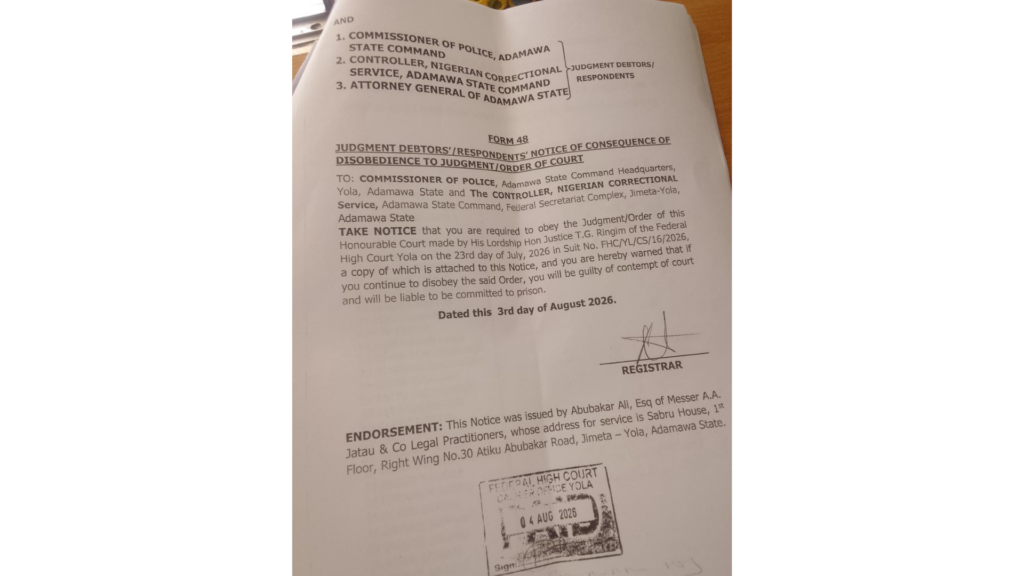
A committal summons in Form 48 was reportedly issued and served on the two officials, warning them of the consequences of continued disobedience of the court’s order.
The development has effectively transformed the case into a direct test of the authority of the judiciary and the obligation of government agencies to obey court orders.
When contacted over the alleged refusal to comply with the judgment and the reported service of the Form 48, the spokesperson for the Adamawa State Police Command, SP Suleiman Yahaya Nguroje, said he had not been briefed about the development.
Nguroje said he would contact the command’s legal department and provide clarification.
However, he had not responded as promised as of the time of filing this report.
Repeated attempts to obtain the position of the Nigerian Correctional Service in Adamawa State were also unsuccessful.
The command’s spokesperson reportedly failed to answer repeated telephone calls and did not respond to a text message seeking confirmation of the alleged transfer of the detainees to Numan Prison and the reported service of the Form 48 on the Controller.
The 42 applicants are Salim Isah, Abubakar Ahmadu, Ahmadu Samaila, Bashir Musa, Moses Ayuba, Abubakar Ibrahim, Ijasini Ahmadu, Lukman Jibrin, Zayyanu Shuaibu, Ishaka Adamu, Isah Mohammed, Eze Ebube, Umar Abubakar, Iliyasu Mohammed, Aimadgi Chiebelum, Liazarus Isah, Aliyu Mohammed, Ali Mohammed, Aliyu Ismail, Isah Umar, Ibrahim Kabiru and Kamaladdeen Umar.
Others are Sadiq Talake, Ibrahim Saidu, Aliyu Saidu, Usman Ahmadu, Ismail Jauro, Abdu Ismail, Bello Adamu, Ahmed Abdullahi, Jabir Bala, Usman Mohammed, Yusuf Pius, Sale Abubakar, Umar Isiaka Abdullahi, Mujahid Yerima Yakubu, Tasiu Musa, Nuhu Musa, Saad Abubakar, Ibrahim Yusuf, Hassan Abubakar and Husseini Ahmed.
The unfolding legal battle has placed the conduct of the Adamawa police and correctional authorities under intense judicial scrutiny, with the central issue now extending beyond the liberty of the 42 detainees to the fundamental constitutional question of whether executive authorities can disregard a subsisting order of a competent court.