Human rights activist and African Action Congress (AAC) presidential candidate, Omoyele Sowore, on Wednesday appeared before the Federal High Court in Abuja as his trial over an alleged cybercrime offence linked to comments about President Bola Ahmed Tinubu resumed.
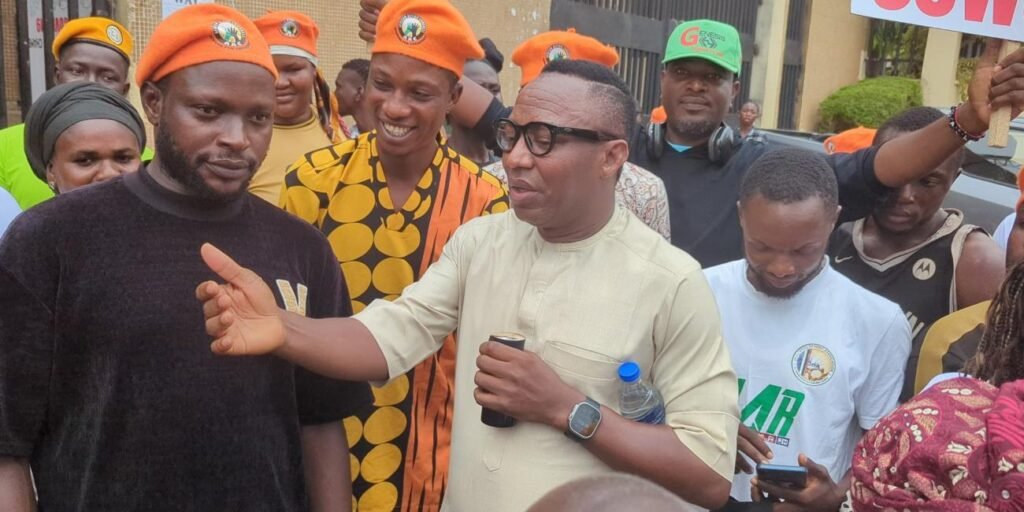
Sowore arrived at the court alongside scores of supporters and activists who gathered in solidarity ahead of proceedings before Justice Mohammed Umar.
The Department of State Services (DSS) is prosecuting the activist over a social media post in which he allegedly described President Tinubu as “a criminal,” an allegation the security agency says amounts to an offence under Nigeria’s cybercrime laws.
The courtroom witnessed a heavy presence of supporters as the case resumed, with both the prosecution and defence preparing to continue legal arguments in the high-profile trial.
Sowore, who is also the publisher of SaharaReporters, has consistently dismissed the charges as politically motivated, insisting they are part of efforts to silence critics and suppress freedom of expression in Nigeria.
The latest hearing follows an earlier ruling by the Federal High Court, where Justice Umar rejected an application by the DSS seeking to shut out Sowore’s defence after his legal team failed to appear in court.
At the previous sitting, the prosecution, led by Kehinde Akinlolu, urged the court to foreclose the defence and proceed to convict the activist, arguing that repeated delays showed he was unwilling to defend himself.
Addressing the court from the dock, Sowore explained that his lead counsel, Adeyinka Olumide-Fusika (SAN), had informed the court in advance of an official trip to the United Kingdom, while another lawyer handling the matter was engaged in proceedings outside the Federal Capital Territory.
When Justice Umar asked whether he was prepared to continue without legal representation, Sowore declined, insisting that the gravity of the case required the presence of his lawyers. He consequently sought an adjournment to enable his lead counsel personally handle the defence.
Sowore also attempted to seek the court’s permission to temporarily retrieve his passport to attend to what he described as urgent family matters requiring his appearance at the United States Embassy in Lagos.
However, Justice Umar ruled that such an application could only be entertained if Sowore intended to represent himself in court. The activist clarified that he was not conducting his own defence but appealed to the court to consider the urgency of the request.
The prosecution opposed the application for adjournment, urging the court to enforce its earlier directive that the matter should proceed on a day-to-day basis. Akinlolu argued that the defence had repeatedly relied on the absence of its lead counsel to delay proceedings, despite previous assurances that a key witness would testify.
The prosecution maintained that the absence of Sowore’s senior lawyer should not frustrate the trial and renewed its request for the court to close the defence’s case.
In his ruling, Justice Umar acknowledged the defence’s request for more time, noting that the allegations against the activist were serious and required adequate legal representation before the trial proceeds.
The case has continued to draw widespread public attention, with supporters of the activist describing the prosecution as a test of free speech and democratic rights, while the DSS insists it is enforcing the law.