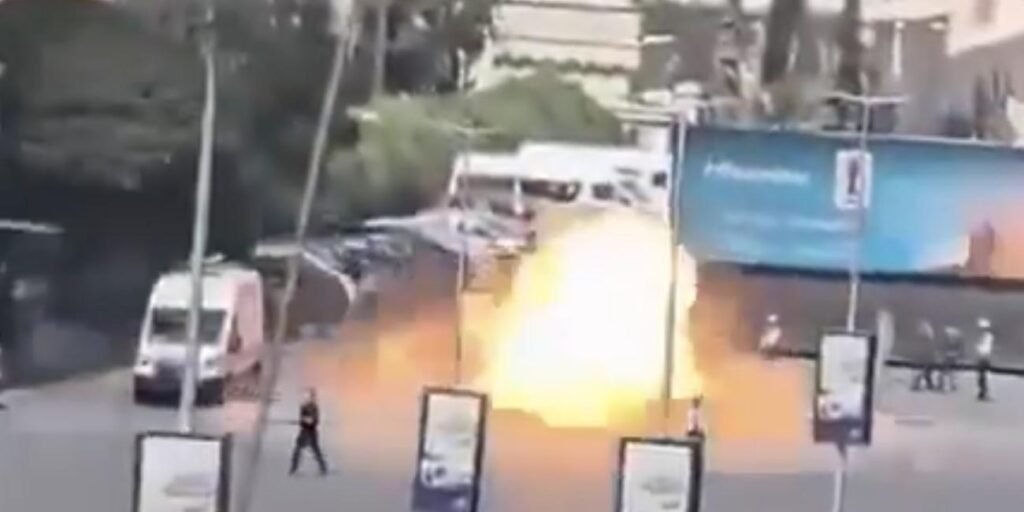
French President Emmanuel Macron’s landmark visit to Syria was dramatically overshadowed on Tuesday after multiple bomb explosions erupted near the hotel accommodating his delegation in Damascus, underscoring the country’s precarious security landscape despite ongoing efforts to rebuild international confidence.
The explosions, which occurred in the Syrian capital, prompted security agencies to immediately cordon off the surrounding area, shut down nearby roads and reinforce protective measures around key government facilities and foreign delegations.
Despite the security scare, the French Presidency insisted that Macron’s itinerary remained unaffected. The Élysée Palace said the French leader neither heard nor was aware of the explosions, noting that they were inaudible from the presidential convoy.
“The explosions were not audible from the presidential motorcade,” the French Presidency said, adding that Macron proceeded with his official engagements as scheduled.
A Reuters journalist embedded with the French delegation also reported that there were no signs of panic during the President’s movements and that his programme continued uninterrupted.
Soon after the incident, Macron held talks with Syria’s interim President, Ahmed al-Sharaa, at the Presidential Palace, according to Syrian state television.
The visit is widely regarded as historic, marking the first official trip to Syria by a serving European Union head of state since the dramatic 2024 ouster of former President Bashar al-Assad by rebel forces led by al-Sharaa.
Eyewitnesses reported hearing powerful explosions that sent plumes of smoke into the sky as security personnel rushed to secure the affected area. Authorities had yet to disclose the cause of the blasts or whether they were linked to a targeted attack.
Macron’s visit comes at a crucial moment as Syria seeks to restore diplomatic ties with Western nations following years of international isolation. Since assuming power, al-Sharaa—once associated with al-Qaeda before distancing himself from the group—has sought to reposition Syria on the global stage by pursuing engagement with European and Middle Eastern governments.
However, Tuesday’s explosions served as a stark reminder that the country remains vulnerable to violence after more than a decade of devastating civil war that enabled extremist organisations, including the Islamic State, to establish strongholds across vast territories.
Although al-Sharaa has repeatedly pledged to build an inclusive political order following the collapse of the Assad family’s more than five-decade rule, his administration has struggled to contain recurring outbreaks of sectarian and ethnic violence.
Over the past year, clashes involving pro-government forces and minority communities have claimed hundreds of lives, raising fresh concerns over the country’s ability to achieve lasting peace even as it pursues diplomatic rehabilitation.