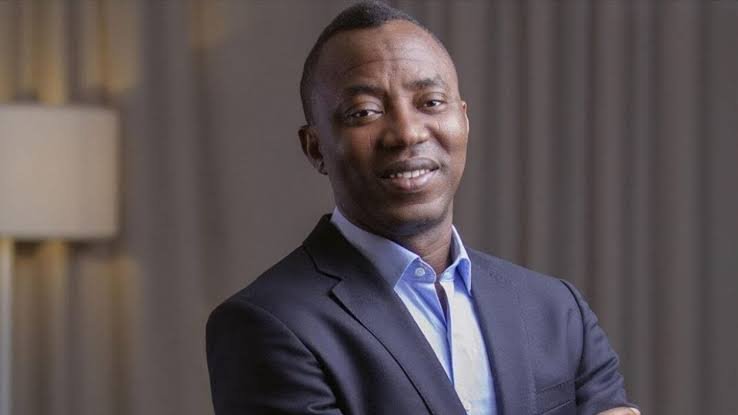
African Action Congress (AAC) presidential candidate, Omoyele Sowore, has launched a blistering attack on the Nigerian Union of Journalists (NUJ), describing the organisation as “dead” following its decision to honour the Director-General of the Department of State Services (DSS), Oluwatosin Adeola Ajayi, with a Man of the Year Award amid ongoing allegations of human rights abuses against the agency.
Sowore, reacting to the award, accused the NUJ of abandoning its core responsibility of defending press freedom and protecting victims of state repression, insisting that the union had instead chosen to celebrate individuals allegedly linked to violations of fundamental rights.
“The Nigerian Union of Journalists in Nigeria is dead if it now celebrates those presiding over some of Nigeria’s most egregious human rights violations,” Sowore declared.
He described the honour conferred on the DSS boss as a “stain on the conscience of the journalism profession,” questioning the rationale behind recognising a security chief whose agency has repeatedly faced allegations of arbitrary arrests, prolonged detentions, intimidation of journalists and suppression of dissent.
“A journalists’ union should stand with victims of repression, not oppressors!” he added.
The NUJ had announced the award during its National Security Summit held in Abuja between June 18 and 19, 2026, organised in collaboration with the DSS under the theme “Media and Security Agencies as Partners in Nation Building.”
According to the union, the recognition was in acknowledgement of Ajayi’s efforts in promoting openness, dialogue and improved relations between security agencies and the media. The announcement was contained in a statement issued by NUJ National President, Alhassan Abdullahi, at the end of the summit.
However, the decision has triggered fresh controversy, particularly from critics who argue that the NUJ has compromised its independence by partnering with a security agency widely accused by rights groups and activists of rights violations.
Sowore’s reaction is the latest in his long-standing confrontation with the DSS, an agency he has repeatedly accused of political persecution and abuse of power.
The DSS had previously instituted legal action against Sowore over a social media post in which he described President Bola Ahmed Tinubu as a “criminal,” a statement that sparked legal and public backlash and drew condemnation from international rights organisations.
Amnesty International Nigeria had also criticised the DSS over attempts to compel social media platform X to remove Sowore’s post, describing the move as an attempt to silence dissent and shrink civic space.
Beyond Sowore’s case, the DSS has continued to face accusations from civil society organisations and legal practitioners over alleged arbitrary arrests and disregard for court orders, allegations the agency has consistently denied.
Fresh concerns were also raised in recent weeks following reports that a detainee, Ntari Danladi, was allegedly denied access to legal representation after being arraigned in court following years in detention without trial—claims that further fuelled scrutiny of the agency’s operations.
Against this backdrop, the NUJ award to the DSS chief has intensified debate over the role of professional journalism bodies in holding power to account versus collaborating with state security institutions.
As reactions continue to trail the development, critics insist the honour undermines the credibility of the union, while supporters of the award maintain it reflects efforts to strengthen cooperation between the media and security agencies.