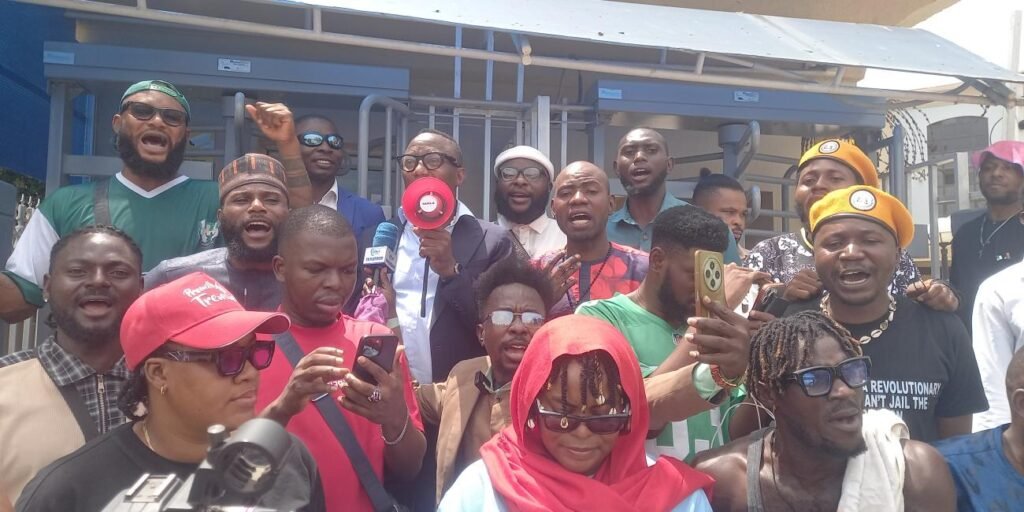
Human rights activist and President candidate Omoyele Sowore, on Wednesday led a crowd of aggrieved Nigerians to the headquarters of MTN Nigeria in Maitama, Abuja, igniting a charged protest over what demonstrators described as systemic exploitation, poor service delivery, and unjustified data depletion by telecom providers.
The protest, branded “Occupy MTN,” drew attention to growing public frustration over the rising cost of internet access in Nigeria, as well as persistent complaints about network instability and disappearing data bundles. Protesters declared the action the first phase of what could evolve into a nationwide resistance campaign demanding affordable, reliable, and unlimited internet access.
Addressing the crowd, Sowore accused major telecom operators of profiting off Nigerians without delivering commensurate value, insisting that subscribers were being shortchanged daily. He argued that data plans marketed as lasting for specific durations often failed to meet expectations, with users reporting unusually rapid depletion rates.
“This is just the beginning of the struggle,” Sowore declared. “If a Nigerian pays for a one-day plan, it must last a full day. If it’s a monthly plan, it should serve the subscriber for the entire month. Anything short of that is exploitation.”
The activist extended his criticism beyond MTN, naming other major operators including Globacom, Airtel Nigeria, and 9mobile, accusing them of engaging in similar practices. He also took aim at the Nigerian Communications Commission (NCC), alleging regulatory failure and complicity in allowing telecom companies to operate without sufficient accountability.
According to Sowore, Nigeria’s internet services rank among the most expensive globally when weighed against service quality, a situation he said has inflicted financial losses on individuals and businesses alike. He noted that entrepreneurs, freelancers, and digital workers who rely heavily on stable connectivity are among the worst hit.
Protesters at the scene echoed similar frustrations, vowing to sustain pressure until telecom operators reduce costs, improve service quality, and introduce consumer-friendly data plans that reflect the realities of a digital economy.
Also speaking during the protest, Rex Elanu, National Publicity Secretary of the African Action Congress (AAC), accused telecom companies of exploiting Nigerians through excessive charges and poor network performance. He alleged that the government had failed to protect citizens despite the increasing dependence on internet services for education, business, and communication.
“Data is no longer a luxury—it is a necessity,” Elanu said. “Yet Nigerians are paying heavily for services that do not meet basic expectations. This must change.”
A social media critic known as Mama Pee added her voice to the growing outrage, warning that continued silence would only deepen the hardship faced by citizens. She highlighted the real-life consequences of unreliable internet, citing cases of lost job opportunities and disrupted online businesses due to unstable connections.
“In today’s economy, many Nigerians survive through digital platforms,” she said. “People run businesses on Instagram and other online spaces because they cannot afford physical shops. Yet before they even finish uploading content, their data is gone.”
She described the protest as a “clarion call” for collective action, urging Nigerians to demand accountability from both telecom operators and government regulators. She warned that failure to address the issues could trigger a more disruptive nationwide shutdown protest in the near future.
Security operatives, including armed police officers from the Maitama Division, were deployed to the scene to maintain order as tensions simmered.
As dissatisfaction with telecom services continues to mount, the “Occupy MTN” protest signals a potential escalation in civic resistance against corporate practices in Nigeria’s telecommunications sector, raising broader questions about regulation, consumer protection, and the true cost of connectivity in Africa’s largest economy.