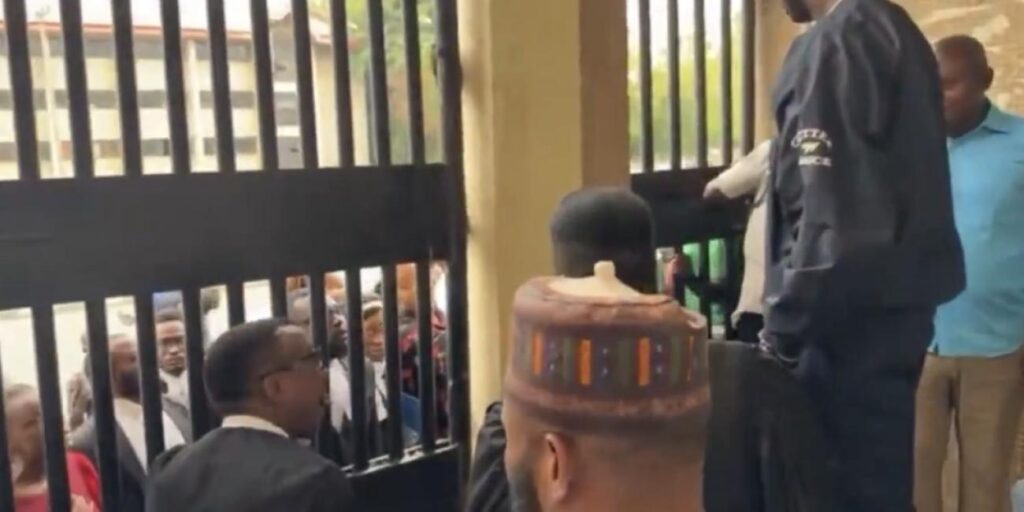
Human rights activist Omoyele Sowore on Friday confronted security operatives at the premises of the Federal High Court Abuja after lawyers, journalists, activists, and other Nigerians with legitimate court business were reportedly denied access to the court.
Eyewitnesses said confusion broke out early in the day when security personnel stationed at the main gate of the court allegedly locked the entrance and began enforcing what they described as a sudden restriction limiting entry to only five persons at a time. The directive immediately sparked tension, as several individuals already scheduled for court proceedings were left stranded outside the premises.
According to accounts from the scene, Sowore arrived at the court alongside supporters and was met with the restriction. He was seen calmly engaging the security operatives, questioning the legality and justification for shutting out members of the public from a court that is constitutionally expected to be open for judicial proceedings.
Witnesses said the exchange drew the attention of lawyers, court users, and journalists who also challenged the restriction, insisting that the court is a public institution and cannot be arbitrarily sealed off without lawful justification. The situation reportedly led to moments of argument between security personnel and affected court users at the gate.
Sowore, in the encounter, maintained that if he was not directly involved in any matter before the court, he would ordinarily have no reason to insist on entry, stressing that those present had legitimate cases and constitutional rights to access judicial proceedings.
The restriction, according to him, was not only disruptive but also an infringement on fundamental rights, including access to justice and fair hearing, adding that public trials cannot be subjected to arbitrary limitations by security agencies.
The situation was further intensified by claims from security operatives that the restriction was linked to Monday’s protest at the Federal Ministry of Justice over the continued remand of social media influencer and activist Justice Chidiebere, popularly known as “Justice Crack.” The officers were said to have cited security concerns arising from that protest as justification for limiting access.
However, Sowore rejected the explanation, describing it as unlawful and unconstitutional, insisting that no security directive can override citizens’ rights to attend open court proceedings.
He later took to social media to condemn the development, accusing authorities of attempting to use security concerns as a cover to restrict civic space and judicial transparency.
“At the Federal High Court today, security personnel attempted to restrict access to the court premises, claiming that only five people would be allowed entry,” he was quoted as saying.
“They cited Monday’s protest action at the Ministry of Justice over the unjust remand of Justice Chidiebere, also known as Justice Crack, as the reason for the limitation. We rejected these unlawful restrictions outright. No authority has the right to arbitrarily deny citizens access to open court proceedings, especially in matters directly concerning them.”
He further argued that such restrictions violate fundamental freedoms, including the right to fair hearing, public trial, and peaceful civic participation.
As of the time of filing this report, normalcy had reportedly begun to return around the court premises, although several affected court users had already expressed frustration over delays and missed proceedings caused by the temporary lockout.