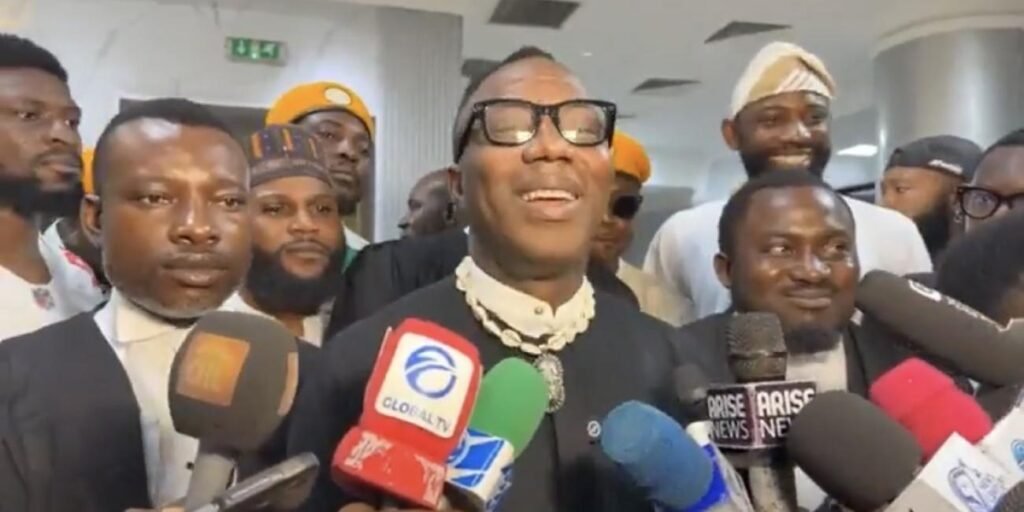
Human rights activist and presidential aspirant of the African Action Congress (AAC), Omoyele Sowore, on Friday openly challenged the integrity of the Federal High Court handling his alleged defamation and cyberbullying trial linked to President Bola Ahmed Tinubu, demanding that the presiding judge, Justice Umar Mohammad, immediately recuse himself from the matter over alleged bias and unfair treatment.
The dramatic courtroom confrontation followed the court’s dismissal of Sowore’s no-case submission in the charge instituted against him by the Department of State Services (DSS), which accused the activist of cyberbullying and insulting the President.
Justice Umar Mohammad ruled that the prosecution had established a prima facie case against Sowore and consequently ordered him to open his defence.
However, the ruling triggered tension inside the courtroom as Sowore insisted that the court had already taken sides with the prosecution and could no longer guarantee him justice or fair hearing.
In a heated exchange before the court, Sowore sought permission to personally address the judge after the ruling, but the request was initially resisted by both the prosecution counsel, Akinlolu Kehinde, and the presiding judge himself.
Kehinde argued that the defendant had no right to directly address the court and insisted that only his legal counsel could speak on his behalf.
The court also reportedly demanded legal authorities before allowing Sowore to speak, prompting his lawyer, Abubakar Marshal, to cite Section 36 of the 1999 Constitution alongside other judicial authorities guaranteeing fair hearing and freedom of expression.
After prolonged arguments, the court eventually permitted Sowore to speak.
Addressing the court directly, the activist accused the Federal Government and the court of creating an atmosphere of intimidation against his legal team while alleging that the proceedings had become politically motivated.
“My Lord, I do not believe that I can get justice in this court based on the conduct of the Federal Government’s counsel and the way my lawyers have been treated,” Sowore declared before the court.
He further argued that the manner in which the case had been handled suggested an orchestrated attempt to secure his conviction ahead of future political activities and elections.
“The conduct of this court has shown that I cannot get justice here. I am only asking that this matter be reassigned so that I can have a fair hearing,” he added.
Sowore also accused the court of humiliating his legal representatives during proceedings, insisting that the alleged treatment had already weakened confidence in the neutrality of the judiciary.
Following his remarks, lead defence counsel, Abubakar Marshal, formally aligned himself with the request for Justice Umar Mohammad to withdraw from the matter.
Marshal argued that the court’s dismissal of the no-case submission suggested that findings had already been made on critical ingredients of the offence before the defence was called upon to present its case.
“With due respect, my Lord, we believe the court has already made findings on essential ingredients of the offence at the no-case stage,” Marshal submitted.
The defence lawyer further referenced previous rulings in related civil proceedings, which he said deepened concerns that Sowore would not receive impartial justice before the same court.
“We respectfully urge Your Lordship to recuse yourself from this matter and return the case file to the Chief Judge for reassignment to another court,” he stated.
Courtroom tension reportedly escalated after the request, with the judge visibly angered by the application seeking his withdrawal from the case.
Justice Umar Mohammad subsequently directed the defence team to file a formal application on the request before abruptly adjourning the matter till May 19, 2026, despite objections from the defence that the date was inconvenient due to prior legal engagements.
Speaking with journalists shortly after the proceedings, Marshal criticised the court’s ruling, arguing that the prosecution failed to establish sufficient legal grounds to warrant the dismissal of the no-case submission.
According to him, the ruling failed to satisfy the legal standards required for determining whether a defendant should be compelled to enter a defence.
“Upon reviewing the applicable law, the circumstances surrounding the prosecution, and the antecedents of the matter, we considered it imperative to consult with the defendant on the next line of action,” he explained.
Marshal maintained that both the defence team and Sowore now firmly believe that another judge should preside over the matter in the interest of justice and fairness.
“It is our honest belief that another judge ought to determine this matter. The defendant believes that this court has treated him unfairly, and we agree with him,” he said.
The lawyer further disclosed plans to formally apply for the case to be transferred back to the Chief Judge for reassignment.
“At this stage, the matter ought to be transferred back to the Chief Judge for reassignment in the interest of justice,” he added.
Marshal also accused the court of fixing hearing dates despite being informed that members of the defence team were already occupied with other legal matters on those dates.
He went further to condemn what he described as the growing use of the Cybercrime Act by authorities to silence critics, activists, whistleblowers, and dissenting voices in Nigeria.
Referencing Section 24 of the Cybercrime Act, Marshal warned that prosecutions under the law now pose serious threats to constitutional freedoms and democratic expression.
“We are now at a crossroads where the government appears more interested in suppressing dissent than addressing governance challenges,” he stated.
“In a country where citizens face insecurity, poor infrastructure, and economic hardship, Nigerians have the right to demand accountability from public officials.”
The defence counsel further lamented what he described as increasing hostility toward whistleblowers and anti-corruption advocates in the country.
He cited instances where individuals who exposed alleged corruption involving funds meant for soldiers’ welfare were allegedly targeted instead of protected by state institutions.
According to him, Sowore’s prosecution is directly linked to his continued criticism of government institutions and public officials.
“They are uncomfortable with the fact that Sowore speaks truth to power and demands accountability from state institutions,” Marshal alleged.
He warned against actions capable of eroding democratic freedoms and constitutional liberties in Nigeria.
“Nigeria is not a police state. We must never surrender the liberties our forefathers fought hard to attain,” he said.
The case continues to generate nationwide debate over freedom of expression, judicial independence, political intolerance, and the increasing use of cybercrime-related charges against government critics and activists under the current administration.