In the unforgiving silence of darkness that has swallowed entire communities in Abaji Area Council, a fresh political storm is brewing—one that exposes not just a failure of infrastructure, but a deeper crisis of leadership, ego, and calculated sabotage.
What began as a simple civic call-out has now evolved into a full-blown confrontation of narratives.
A concerned voice had publicly challenged the incumbent Chairman, Abubakar Umar Abdullahi, urging him to prioritize two fundamental responsibilities before nursing higher political ambitions: attract a commercial bank to Abaji and resolve the long-standing electricity crisis that has crippled economic and social life in the area for years.
But in a twist that reflects the often chaotic logic of grassroots politics, critics aligned with the Turaki camp quickly deflected responsibility, redirecting the spotlight to Ajiya Abdulrahman, popularly known as Turaki, insisting that as a federal lawmaker, he too bears responsibility for fixing Abaji’s electricity.
That argument, however, may not be as straightforward as it appears.
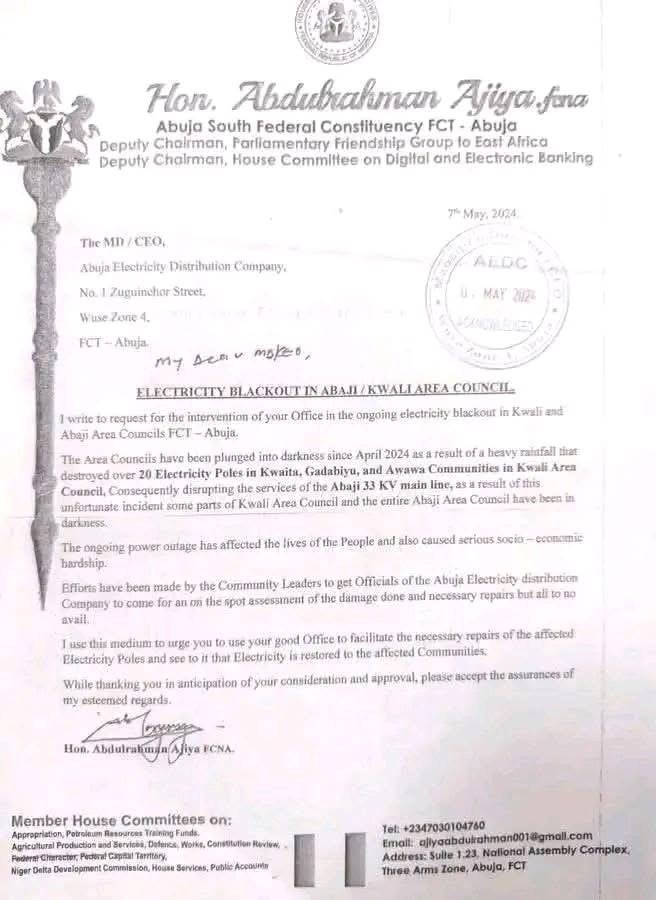
According to insights circulating on the Facebook page of Kwali Politics, the narrative being pushed by Turaki’s critics ignores a crucial layer of the story. Far from being absent, Turaki has reportedly made multiple attempts—documented and undocumented—to intervene in the electricity crisis plaguing Abaji. The referenced letter currently in circulation is said to be just one piece of a broader effort, not the beginning of it.
Yet, these interventions, sources allege, have consistently hit a brick wall—not due to federal negligence, but because of internal political interference at the local level.
The allegation is heavy: that efforts initiated by Ajiya Abdulrahman to restore power in Abaji have been deliberately stalled or hijacked by the leadership of the Area Council under Abubakar Umar Abdullahi.
The motive? Political survival.
In a terrain where visibility equals viability, allowing a rival political figure to solve a long-standing crisis could shift public loyalty. And in a system where electoral fortunes are often built on perception rather than performance, such a shift could be fatal.
If these claims hold any truth, then what Abaji faces is not just an electricity problem—but a governance tragedy where public suffering is weaponized for political advantage.
Meanwhile, the people remain trapped in darkness—literally and metaphorically.
Small businesses continue to collapse under the weight of generator costs. Students struggle to study at night. Health centers operate below standard. Economic activities shrink, and hope fades slowly.
The bigger question, however, is not who should fix Abaji’s electricity.
The real question is: why hasn’t it been fixed despite multiple hands claiming to have tried?
Governance is not a battlefield for ego. It is a responsibility to the people. Whether at the federal or local level, leadership must rise above rivalry when the survival and dignity of citizens are at stake.
Because in the end, the people of Abaji do not vote for excuses.
They vote for light.